


























Views
Downloads
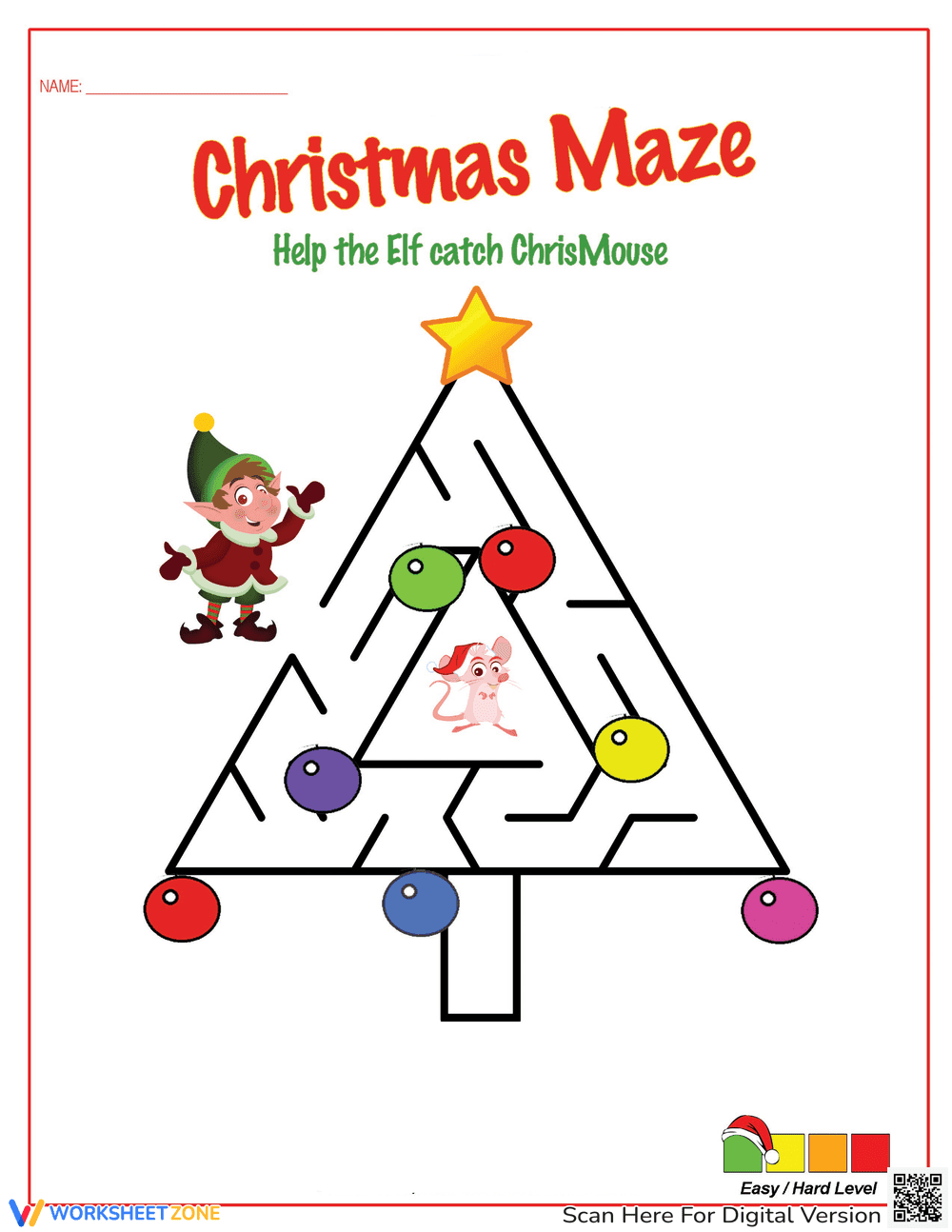

Easy Christmas Tree Maze | Printable K-2 Holiday Puzzle
Paste this activity's link or code into your existing LMS (Google Classroom, Canvas, Teams, Schoology, Moodle, etc.).
Students can open and work on the activity right away, with no student login required.
You'll still be able to track student progress and results from your teacher account.
This printable Christmas Tree Maze worksheet provides early learners with a festive way to develop essential fine motor control and spatial reasoning skills. Students help the holiday elf find the path to "ChrisMouse" through a structured geometric maze. It serves as an engaging holiday activity that reinforces pencil grip and path-finding logic.
At a Glance
- Grade: K-2 · Subject: Holidays
- Standard:
K.G.A.1— Describe objects in the environment and their relative positions- Skill Focus: Fine motor control
- Format: 1 page · 1 task · Answer key included · PDF
- Best For: Morning work or holiday stations
- Time: 5–10 minutes
The worksheet features a high-contrast Christmas tree graphic containing a medium-complexity maze. It includes clear start and end points marked by character illustrations. The layout is designed for standard letter-sized paper, ensuring that the paths are wide enough for young children to navigate without frustration. A digital version is also accessible via the included QR code for flexible classroom use.
This resource is designed for immediate classroom implementation with a total teacher prep time of under 2 minutes. First, print the single-page PDF for your entire class or small group. Second, distribute the sheets during a transition period or as a festive fast-finisher task. Third, review the completed paths visually to check for accuracy and pencil control. It is an ideal emergency sub plan component during the busy winter season.
This activity aligns with `CCSS.MATH.CONTENT.K.G.A.1`, which requires students to describe the relative positions of objects. By navigating the maze, students must mentally process up, down, left, and right movements within a bounded space. This standard code can be copied directly into lesson plans, IEP goals, or district curriculum mapping tools to ensure all holiday activities remain academically grounded.
Use this worksheet as a calming morning work activity during the final week before winter break to keep students focused. Alternatively, place it in a holiday-themed learning center alongside other puzzles. Teachers can observe formative progress by noting which students struggle with boundary awareness or those who plan their route before drawing. Expected completion time for most students is 7 minutes.
This puzzle is perfect for Kindergarten through 2nd-grade students, including those receiving occupational therapy for fine motor delays. It pairs naturally with a holiday read-aloud or a geometry lesson on triangles. The visual nature of the task makes it accessible for English Language Learners who are practicing directional vocabulary and basic problem-solving strategies in a low-stress format.
Research by Fisher & Frey (2014) emphasizes the importance of scaffolded independence in early childhood education, where simple tasks like mazes bridge the gap between guided instruction and independent problem-solving. This Christmas Tree Maze utilizes spatial reasoning to engage the brain's executive functions, specifically planning and motor inhibition. According to the NAEP, early exposure to spatial tasks is a strong predictor of later success in STEM subjects. By integrating these skills into a holiday-themed activity, educators can maintain high engagement while reinforcing the K.G.A.1 standard. This worksheet provides a low-stakes environment for students to practice the precision required for letter formation and geometric identification. It is a practical tool for any early elementary classroom looking to combine seasonal fun with measurable developmental milestones in fine motor coordination and spatial awareness. The inclusion of a digital version further supports diverse learning environments and modern classroom needs.


