


























Views
Downloads

Easter Egg Patterns Coloring Page | Essential Grade K-2
Paste this activity's link or code into your existing LMS (Google Classroom, Canvas, Teams, Schoology, Moodle, etc.).
Students can open and work on the activity right away, with no student login required.
You'll still be able to track student progress and results from your teacher account.
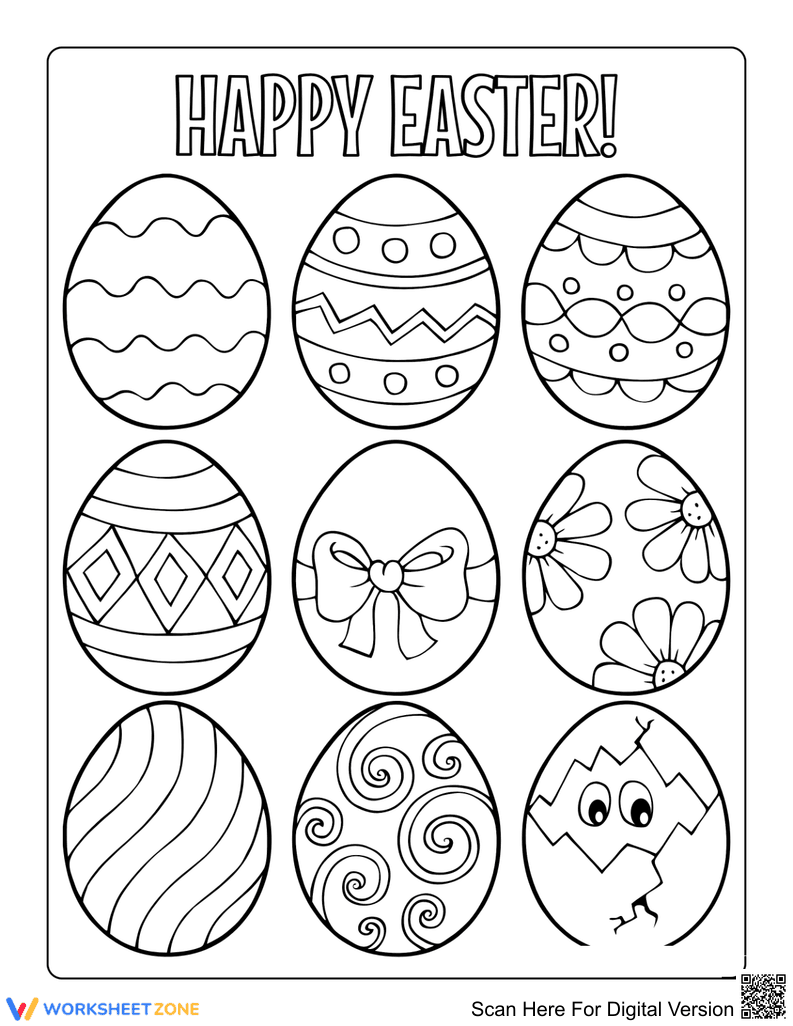
This printable Easter egg coloring worksheet provides young learners with a creative way to develop fine motor control and pattern recognition. By engaging with 9 distinct egg designs, students practice hand-eye coordination while celebrating the holiday season. It serves as a perfect bridge between artistic expression and the physical stamina required for early writing tasks.
At a Glance
- Grade: Kindergarten · Subject: Arts & English
- Standard:
CCSS.ELA-LITERACY.L.K.1.A— Demonstrate command of the conventions of standard English grammar and usage when writing.- Skill Focus: Fine motor control and pattern identification
- Format: 1 page · 9 problems · No answer key · PDF
- Best For: Morning work or holiday centers
- Time: 15–20 minutes
What's Inside: This single-page PDF features 9 high-quality line-art illustrations of Easter eggs. Each egg contains a unique geometric or organic pattern, including waves, chevrons, and floral motifs. The variety ensures students are challenged to stay within different boundaries. No teacher setup is required beyond basic coloring supplies like crayons or markers.
Zero-Prep Workflow
- Print: Generate the single-page PDF for your entire class in under 30 seconds.
- Distribute: Hand out the sheets with coloring tools to provide an immediate, quiet transition activity.
- Review: Observe student grip and control during the process to identify those needing additional support.
Total teacher preparation time is under 3 minutes, making it an ideal choice for emergency sub plans or transition periods during the busy holiday week.
Standards Alignment: The primary alignment is CCSS.ELA-LITERACY.L.K.1.A, which focuses on the physical act of writing and print concepts. While this is a coloring activity, the precision required to navigate the patterns directly supports the muscular development needed for letter formation. Additionally, it supports visual-spatial awareness. Both standard codes can be copied directly into lesson plans, IEP goals, or district curriculum mapping tools.
How to Use It: Use this worksheet as a warm-up activity to settle students into a focused mindset. Alternatively, assign it as a choice-time activity. Teachers should observe pencil grip and pressure, providing formative feedback on hand positioning to prevent fatigue during writing blocks. Expected completion time is 15 to 20 minutes.
Who It's For: This resource is designed for Kindergarten and First Grade students refining fine motor skills. It is also effective for occupational therapy or English Language Learners learning descriptive vocabulary like "zigzag" or "swirl." Pair this with a read-aloud about Easter traditions or a lesson on symmetry in art.
Research from Fisher & Frey (2014) emphasizes the importance of scaffolded tasks that build the foundational physical skills necessary for academic success. This Easter egg patterns worksheet utilizes the principle of purposeful play to engage students in high-repetition fine motor practice. By focusing on 9 distinct patterns, the activity encourages students to adapt their hand movements to varying shapes, which is a precursor to complex letter and number formation. According to the RAND AIRS 2024 report on early childhood education, integrating seasonal themes into skill-based practice increases student engagement and retention of spatial concepts. This worksheet provides a structured yet creative environment for students to demonstrate CCSS.ELA-LITERACY.L.K.1.A competencies through non-textual media. It serves as a reliable tool for educators seeking to balance holiday celebrations with meaningful developmental milestones in a classroom setting.


