


























Views
Downloads
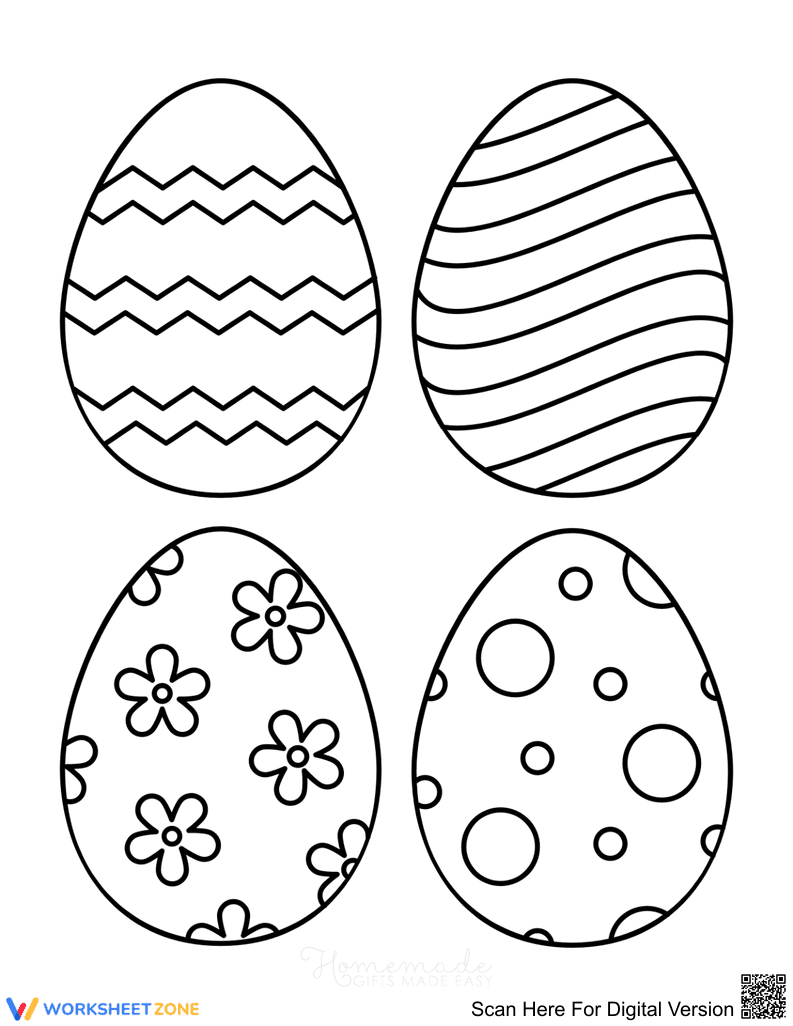

Grade K Printable Easter Eggs Coloring Page
Paste this activity's link or code into your existing LMS (Google Classroom, Canvas, Teams, Schoology, Moodle, etc.).
Students can open and work on the activity right away, with no student login required.
You'll still be able to track student progress and results from your teacher account.
This printable Easter eggs coloring page provides young students with an engaging holiday activity that builds fine motor control and pattern recognition. Featuring four distinct egg designs, this resource allows learners to practice focus and creativity while celebrating the spring season in the classroom.
At a Glance
- Grade: K · Subject: Art
- Standard:
CCSS.ELA-LITERACY.SL.K.5— Add drawings or visual displays to provide detail- Skill Focus: Fine motor control
- Format: 1 page · 4 problems · No answer key · PDF
- Best For: Morning work or holiday centers
- Time: 15–20 minutes
Inside this single-page PDF, educators will find four large Easter eggs featuring unique patterns: zig-zags, wavy lines, simple flowers, and polka dots. The bold outlines help early learners stay within the lines. Because this is an open-ended creative task, no answer key is required, making it a straightforward addition to spring lesson plans.
This resource offers a streamlined zero-prep workflow:
- Print (1 minute): Simply download the PDF and print a class set. The black-and-white design is highly ink-efficient.
- Distribute (1 minute): Hand out the pages along with crayons, markers, or colored pencils.
- Review (0 minutes): No formal grading is needed, allowing teachers to focus on observing fine motor skills.
With a total teacher prep time of under two minutes, this worksheet is an excellent option for emergency sub plans or spontaneous holiday activities.
This activity aligns with CCSS.ELA-LITERACY.SL.K.5, which encourages students to "add drawings or other visual displays to descriptions as desired to provide additional detail." While primarily a fine motor and creative exercise, coloring patterned eggs supports foundational visual communication skills. Both standard codes can be copied directly into lesson plans, IEP goals, or district curriculum mapping tools.
Teachers can utilize this coloring page as morning work during the weeks leading up to Easter, giving students a quiet task as they settle in. It also works perfectly in a holiday-themed center rotation. While students color, teachers can conduct formative assessments by observing pencil grip and color selection. Expected completion time ranges from 15 to 20 minutes.
This worksheet is primarily designed for Kindergarten and early elementary students developing their fine motor capabilities. It naturally accommodates differentiation; students needing extra support can use thicker markers or crayons, while advanced learners can be challenged to create complex color patterns within the existing designs. This resource pairs wonderfully with a read-aloud of a spring-themed picture book or a direct instruction lesson on seasonal traditions.
Integrating creative tasks like this Easter egg coloring page into the daily curriculum supports essential developmental milestones for early learners. According to a 2024 report by EdReports, incorporating structured visual arts activities significantly enhances fine motor development, hand-eye coordination, and spatial awareness in early childhood education. When students engage with materials aligned to CCSS.ELA-LITERACY.SL.K.5, they practice adding drawings or visual displays to provide detail, which builds the foundational physical skills necessary for later handwriting and visual communication. Activities that require sustained attention to patterns and boundaries also foster cognitive regulation, patience, and focus. By providing targeted, low-stress creative outlets, educators can support holistic student development while celebrating seasonal events in the classroom. This simple yet highly effective tool ensures that holiday activities remain both engaging and developmentally appropriate for young learners across diverse educational settings.


