


























Views
Downloads
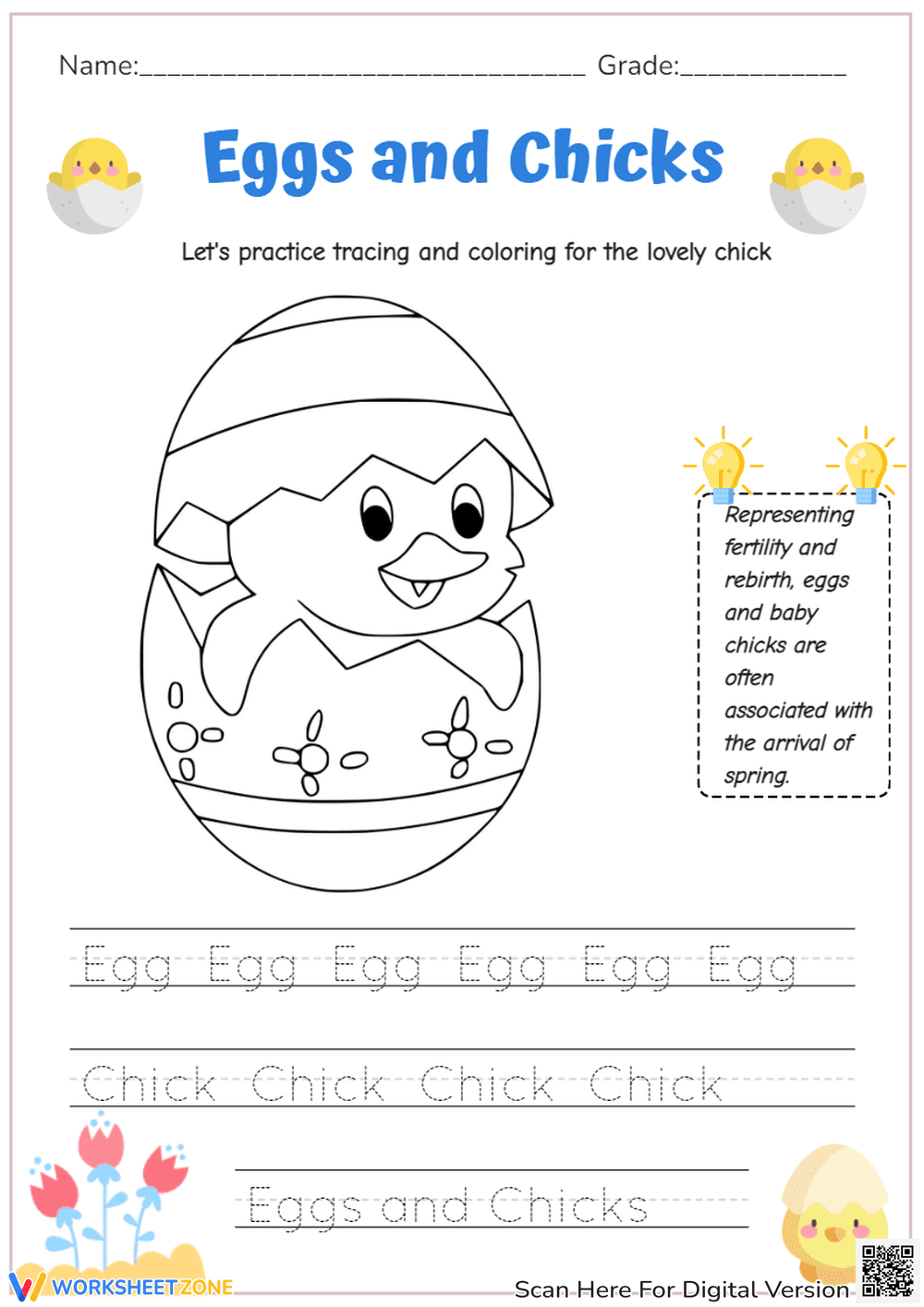

Easter Chick Tracing Worksheet | Grade K-1 Printable
Paste this activity's link or code into your existing LMS (Google Classroom, Canvas, Teams, Schoology, Moodle, etc.).
Students can open and work on the activity right away, with no student login required.
You'll still be able to track student progress and results from your teacher account.
This Grade K-1 Easter handwriting worksheet helps students master letter formation through engaging seasonal themes. By combining coloring with word tracing, learners develop the fine motor control necessary for legible writing while connecting vocabulary to holiday concepts. It provides a structured environment for early writers to practice high-frequency spring words with confidence and precision.
At a Glance
- Grade: K-1 · Subject: Handwriting
- Standard:
CCSS.ELA-LITERACY.L.K.1.A— Print many upper- and lowercase letters correctly during writing tasks- Skill Focus: Letter formation and fine motor control
- Format: 1 page · 12 tasks · No answer key needed · PDF
- Best For: Morning work or holiday centers
- Time: 15–20 minutes
What's Inside
Inside this resource, you will find a single-page activity designed for immediate use. It features a large, clear illustration of a chick hatching from an egg for coloring, alongside three distinct tracing lines. The tracing portion includes six repetitions of the word "Egg," four repetitions of "Chick," and a final full-phrase trace of "Eggs and Chicks" to build stamina.
Zero-Prep Workflow
The zero-prep workflow is designed for busy educators. First, print the single-page PDF (30 seconds). Second, distribute the sheets along with crayons and pencils to your students (1 minute). Third, review the completed tracing for proper letter height and line alignment as students finish their coloring (under 1 minute). Total teacher preparation time is less than two minutes, making it an ideal sub plan addition.
Standards Alignment
This worksheet aligns with `CCSS.ELA-LITERACY.L.K.1.A`, which requires students to print many upper- and lowercase letters. It also supports `CCSS.ELA-LITERACY.RF.K.1.B` by reinforcing the relationship between spoken words and their written representations. Both standard codes can be copied directly into lesson plans, IEP goals, or district curriculum mapping tools.
How to Use It
Use this worksheet as a calming morning work activity during the week leading up to Easter or spring break. It also serves as an excellent formative assessment tool; observe students as they trace to identify those struggling with pencil grip or letter directionality. Expect students to spend approximately 15 to 20 minutes completing both the tracing and coloring components.
Who It's For
This resource is ideal for Kindergarten and first-grade students who are refining their handwriting skills. It is particularly helpful for English Language Learners (ELLs) who benefit from the visual-to-word association. Pair this worksheet with a read-aloud about spring life cycles or a simple anchor chart showing proper pencil grip for a complete instructional block.
According to Fisher & Frey (2014), the gradual release of responsibility begins with clear modeling and supported practice, which this tracing format provides for emerging writers. By integrating fine motor tasks like coloring with academic tasks like letter formation, the worksheet reduces cognitive load for Grade K-1 learners. Research indicates that multisensory approaches to handwriting—combining visual, motor, and linguistic cues—significantly improve letter recognition and retention. This specific resource utilizes 12 distinct tracing opportunities to build muscle memory, ensuring that students move toward independent writing proficiency. The inclusion of a thematic "fun fact" also encourages early literacy engagement by providing context for the vocabulary being practiced. Educators can rely on this structured approach to meet foundational ELA standards while maintaining high student interest through seasonal themes. This evidence-based design ensures that handwriting practice is both effective and developmentally appropriate for early childhood classrooms.


