




























Views
Downloads

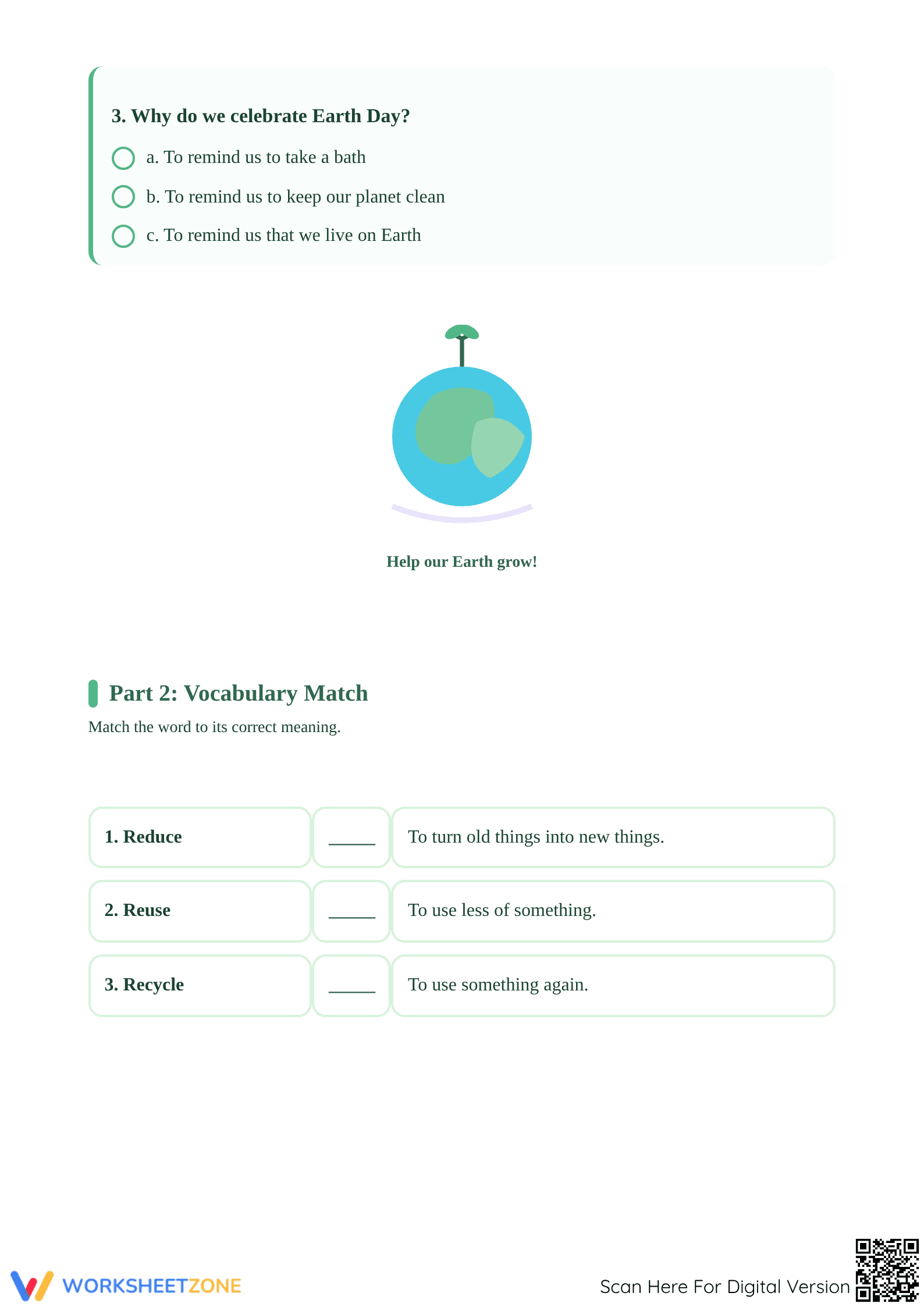


Grade 2 Earth Day Reading — Printable No-Prep Worksheet

Paste this activity's link or code into your existing LMS (Google Classroom, Canvas, Teams, Schoology, Moodle, etc.).
Students can open and work on the activity right away, with no student login required.
You'll still be able to track student progress and results from your teacher account.
This Earth Day reading comprehension worksheet helps early elementary students build foundational literacy skills while learning about environmental awareness. Students read a short informational passage and answer targeted questions to demonstrate their understanding of key details, ensuring meaningful practice with informational text.
At a Glance
- Grade: 2 · Subject: ELA
- Standard:
CCSS.ELA-LITERACY.RI.2.1— Answer questions to demonstrate understanding of key details.- Skill Focus: Reading Comprehension
- Format: 3 pages · 9 problems · Answer key included · PDF
- Best For: Independent practice or morning work
- Time: 15–20 minutes
This three-page packet includes a brief reading passage about Earth Day. Following the text, students tackle nine tasks: three multiple-choice questions, a three-part vocabulary matching section on reduce, reuse, and recycle, a creative drawing prompt, and two true-or-false statements. A complete answer key makes grading quick.
Designed for immediate classroom implementation, this resource requires virtually no teacher setup. Follow this simple workflow:
- Print (1 minute): Generate copies of the three-page PDF for your entire class.
- Distribute (1 minute): Hand out the packets during morning work, literacy centers, or as a timely holiday activity.
- Review (3 minutes): Use the included answer key to quickly check student responses or guide a whole-class discussion.
With a total teacher prep time of under two minutes, this packet is highly suitable for emergency sub plans or busy holiday weeks.
This resource is strictly aligned to CCSS.ELA-LITERACY.RI.2.1, requiring students to ask and answer such questions as who, what, where, when, why, and how to demonstrate understanding of key details in a text. It also supports vocabulary acquisition by contextualizing environmental terms. Both standard codes can be copied directly into lesson plans, IEP goals, or district curriculum mapping tools.
Teachers can deploy this worksheet during independent literacy centers or as a whole-group reading activity on April 22nd. Before direct instruction, use the passage to introduce the concept of conservation and activate prior knowledge. As a formative assessment observation tip, monitor how students locate evidence in the text to answer the multiple-choice questions. The entire activity has an expected completion time range of 15 to 20 minutes.
This material is primarily designed for first through third-grade students developing their informational reading skills. For differentiation, teachers can read the passage aloud to below-level readers while allowing on-level students to complete the packet independently. It serves as an excellent natural pairing resource alongside a read-aloud of a picture book about recycling or a direct instruction lesson on community helpers and environmental stewardship.
Integrating thematic informational texts into early elementary literacy instruction significantly boosts reading comprehension and content knowledge. According to a RAND AIRS 2024 study, providing students with structured opportunities to interact with cross-curricular topics enhances their ability to extract key details from non-fiction sources. This worksheet directly targets CCSS.ELA-LITERACY.RI.2.1, challenging students to answer questions to demonstrate understanding of key details within an Earth Day context. By combining multiple-choice questions, vocabulary matching, and a creative writing prompt, the resource offers a multifaceted approach to assessing comprehension. Regular practice with these text-dependent tasks ensures young readers build the analytical skills necessary for complex informational texts. The zero-prep format allows educators to implement these evidence-based reading strategies efficiently, maximizing instructional time while celebrating environmental awareness.


