


























Views
Downloads

Letter E Tracing Worksheet | Essential Grade K-1 Phonics
Paste this activity's link or code into your existing LMS (Google Classroom, Canvas, Teams, Schoology, Moodle, etc.).
Students can open and work on the activity right away, with no student login required.
You'll still be able to track student progress and results from your teacher account.
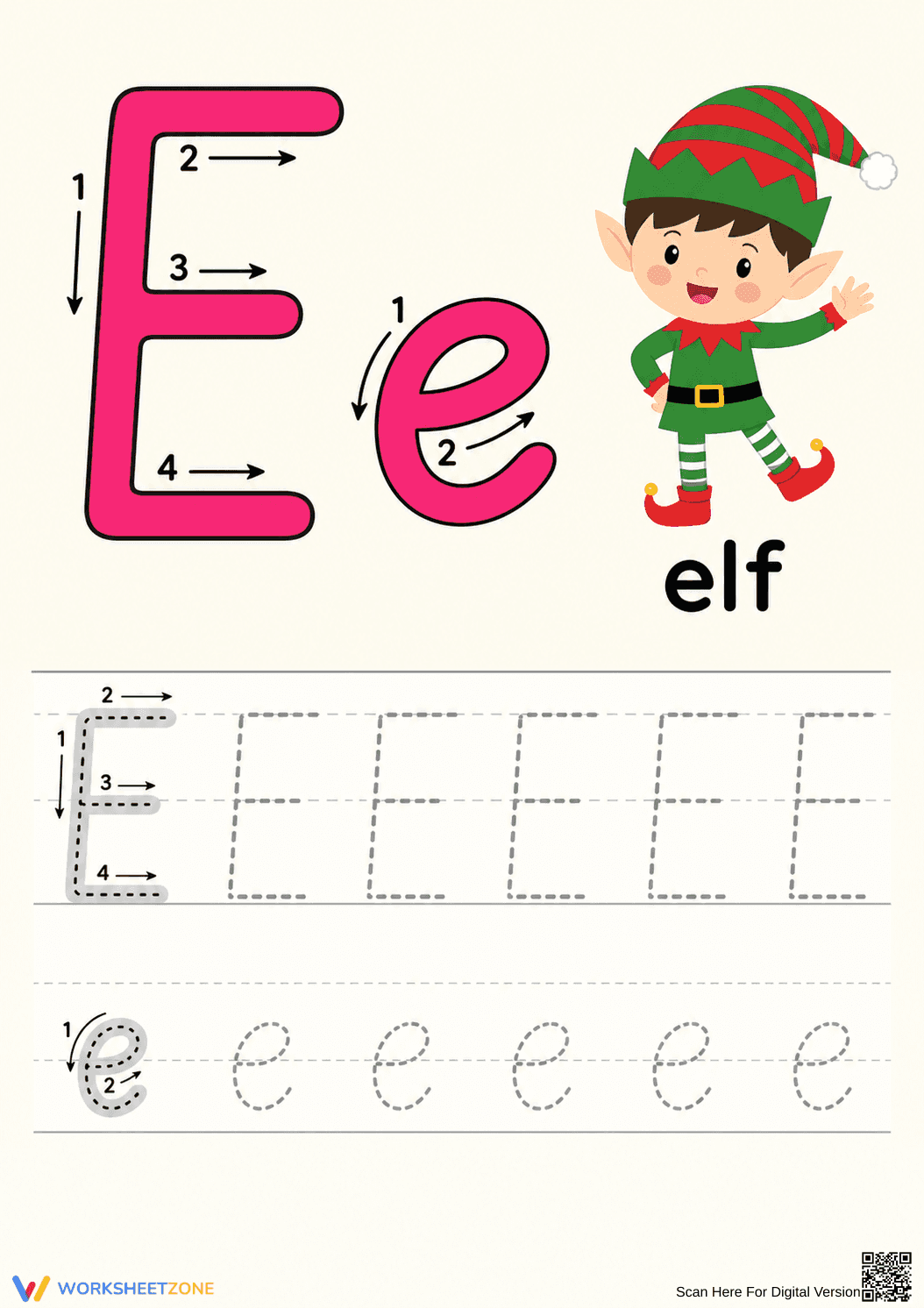
This Grade K-1 phonics worksheet provides immediate practice for students learning to identify and write the letter E. By combining visual cues with guided tracing, learners develop the fine motor control necessary for legible handwriting while reinforcing the short /e/ sound through the "elf" keyword. It is a foundational tool for early literacy.
At a Glance
- Grade: K-1 · Subject: ELA Phonics
- Standard:
CCSS.ELA-LITERACY.L.K.1.A— Print many upper- and lowercase letters of the alphabet- Skill Focus: Letter E formation and beginning sounds
- Format: 1 page · 12 tracing tasks · No key needed · PDF
- Best For: Morning work or literacy centers
- Time: 5–10 minutes
The worksheet features a large, colorful header showing the proper stroke order for both uppercase 'E' and lowercase 'e'. Below the instructional graphic, students find two dedicated rows of dashed-line letters. There are 6 uppercase and 6 lowercase letters to trace, ensuring repetitive practice that builds muscle memory. The inclusion of the "elf" illustration provides a concrete phonemic anchor for the beginning sound.
This resource is designed for a zero-prep classroom environment. Teachers can print the single-page PDF in seconds. Distribution takes less than a minute during transition periods. Reviewing student work is instantaneous, as the tracing lines provide immediate visual feedback on penmanship and letter orientation. It is an ideal "grab-and-go" activity for substitute folders or supplemental homework.
This activity aligns with `CCSS.ELA-LITERACY.L.K.1.A`, which requires students to print many upper- and lowercase letters. It also supports `CCSS.ELA-LITERACY.RF.K.1.D` by helping students recognize and name specific alphabet characters. Both standard codes can be copied directly into lesson plans, IEP goals, or district curriculum mapping tools.
Use this worksheet during the "You Do" phase of a gradual release lesson on the letter E. It works well as a quiet morning work activity to settle students as they arrive. For formative assessment, observe the directionality of the student's pencil strokes to ensure they follow the numbered arrows. Completion typically takes 5 to 10 minutes depending on the student's fine motor development.
This resource is for Kindergarten and first-grade students who are beginning their handwriting journey. It is particularly helpful for English Language Learners (ELLs) who need visual anchors for vocabulary. Pair this with a short vowel anchor chart or a read-aloud book featuring characters whose names start with the letter E to reinforce the phonics connection.
According to Fisher & Frey (2014), the gradual release of responsibility is most effective when students are provided with clear, scaffolded models before moving to independent practice. This worksheet utilizes that principle by providing numbered stroke guides followed by dashed-line tracing. Research indicates that tactile engagement with letter forms significantly improves letter recognition speed in early childhood. By focusing on the specific standard CCSS.ELA-LITERACY.L.K.1.A, this resource ensures that students are meeting high-frequency literacy benchmarks. The integration of the "elf" keyword further supports phonemic awareness, a critical precursor to decoding. This structured approach to handwriting and phonics provides the necessary repetition for long-term retention of alphabet knowledge. Educators can rely on this evidence-based design to support foundational writing skills in diverse classroom settings.


