


























Views
Downloads


Dolch Sight Word Mastery Worksheet | Grade 3 Essential
Paste this activity's link or code into your existing LMS (Google Classroom, Canvas, Teams, Schoology, Moodle, etc.).
Students can open and work on the activity right away, with no student login required.
You'll still be able to track student progress and results from your teacher account.
This comprehensive Dolch Sight Word Mastery worksheet provides a structured approach to high-frequency word recognition and application. By bridging the gap between isolated word recognition and contextual usage, students develop the automaticity required for fluent reading. This resource ensures learners can identify and deploy essential vocabulary across multiple grade-level expectations.
At a Glance
- Grade: Grade 3 · Subject: English Language Arts
- Standard:
RF.3.3.D— Read grade-appropriate irregularly spelled words with accuracy and automaticity- Skill Focus: High-frequency word mastery
- Format: 2 pages · 11 problems · Answer key included · PDF
- Best For: Literacy centers and fluency intervention
- Time: 15–20 minutes
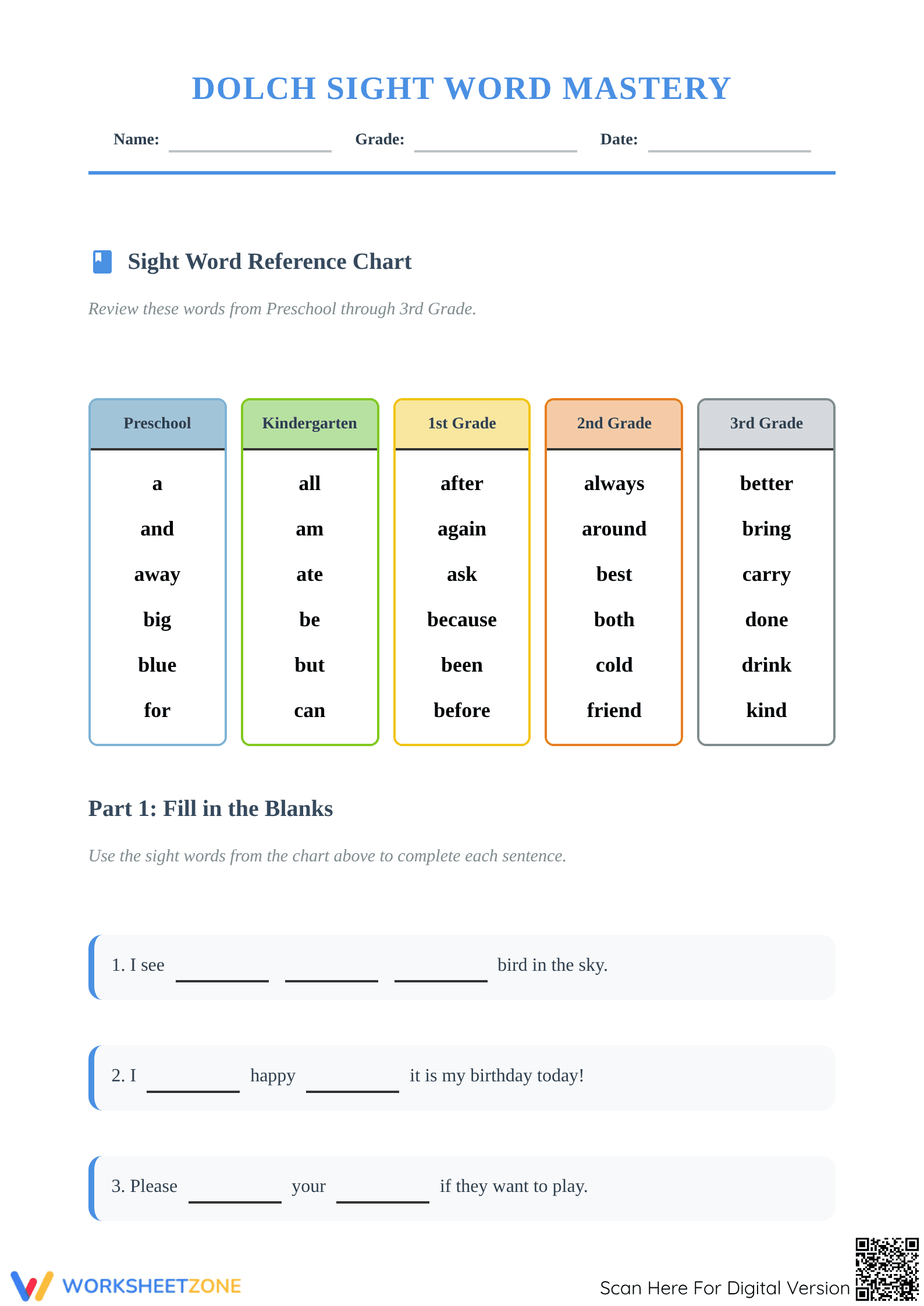
What's Inside: This two-page PDF includes a multi-level reference chart spanning Preschool through 3rd Grade, providing a visual anchor for 30 targeted sight words. The first page features 6 contextual fill-in-the-blank sentences that require students to select the correct word based on syntax. The second page transitions to 5 sentence-building prompts, encouraging original composition and proper grammar application. A full answer key is provided for rapid grading.
Skill Progression
- Guided Practice: Students begin by reviewing the organized reference chart, which categorizes words by difficulty to provide a clear visual map of their learning trajectory.
- Supported Practice: The 6 cloze-style sentences offer semantic clues, allowing students to practice word selection within a controlled linguistic environment.
- Independent Practice: The final 5 tasks require students to generate original sentences, moving from passive recognition to active production of high-frequency vocabulary.
This sequence follows the research-backed gradual release of responsibility model, ensuring students are never asked to produce work without sufficient scaffolding.
Standards Alignment
The primary focus of this resource is `CCSS.ELA-LITERACY.RF.3.3.D`, which mandates that students read grade-appropriate irregularly spelled words. By requiring students to both read and write these words in context, the worksheet also supports `CCSS.ELA-LITERACY.L.3.2.F`, focusing on spelling high-frequency words correctly. Both standard codes can be copied directly into lesson plans, IEP goals, or district curriculum mapping tools.
How to Use It
This worksheet is ideal for use during the "independent practice" portion of a literacy block. Teachers can assign the first page as a formative assessment to check for word recognition accuracy. The second page serves as an excellent extension for students who demonstrate early mastery. Expected completion time ranges from 15 to 20 minutes depending on the student's typing or writing speed. Use the sentence-building section to observe if students are applying correct capitalization and punctuation alongside their sight word usage.
Who It's For
This resource is designed for Grade 3 students but is highly effective for Grade 2 students ready for a challenge or older students requiring Tier 2 intervention. It pairs naturally with a weekly spelling list or a shared reading passage. The inclusion of lower-grade words in the reference chart makes it a supportive tool for English Language Learners (ELLs) who need to build a foundational vocabulary base quickly.
According to Fisher & Frey (2014), the acquisition of high-frequency words is a foundational component of reading stamina and comprehension. This worksheet aligns with those findings by providing repetitive, meaningful exposure to the Dolch list. By utilizing a multi-grade reference chart, the resource addresses the 11 tasks through a lens of cumulative review, ensuring that gaps in earlier word lists are closed before moving to complex 3rd-grade vocabulary. Research from the NAEP suggests that students who master these irregularly spelled words by the end of the third grade are significantly more likely to meet proficiency benchmarks in later years. This tool provides the necessary drill-and-practice framework to achieve that mastery through both recognition and active sentence construction, making it a vital component of any evidence-based literacy program.


