


























Views
Plays




Division Practice Without Remainders | Essential Grade 3
Paste this activity's link or code into your existing LMS (Google Classroom, Canvas, Teams, Schoology, Moodle, etc.).
Students can open and work on the activity right away, with no student login required.
You'll still be able to track student progress and results from your teacher account.
This Grade 3 division worksheet provides comprehensive practice for students mastering basic division without remainders. By solving 17 diverse problems, learners develop a deep understanding of partitioning totals into equal groups. Activities transition from simple equations to word problems, ensuring students apply division skills in real-world contexts.
At a Glance
- Grade: 3 · Subject: Math
- Standard:
CCSS.MATH.CONTENT.3.OA.A.2— Interpret whole-number quotients of whole numbers as the number of objects in each share- Skill Focus: Division facts and inverse operations
- Format: 4 pages · 17 problems · Answer key included · PDF
- Best For: Formative assessment or independent math centers
- Time: 20–30 minutes
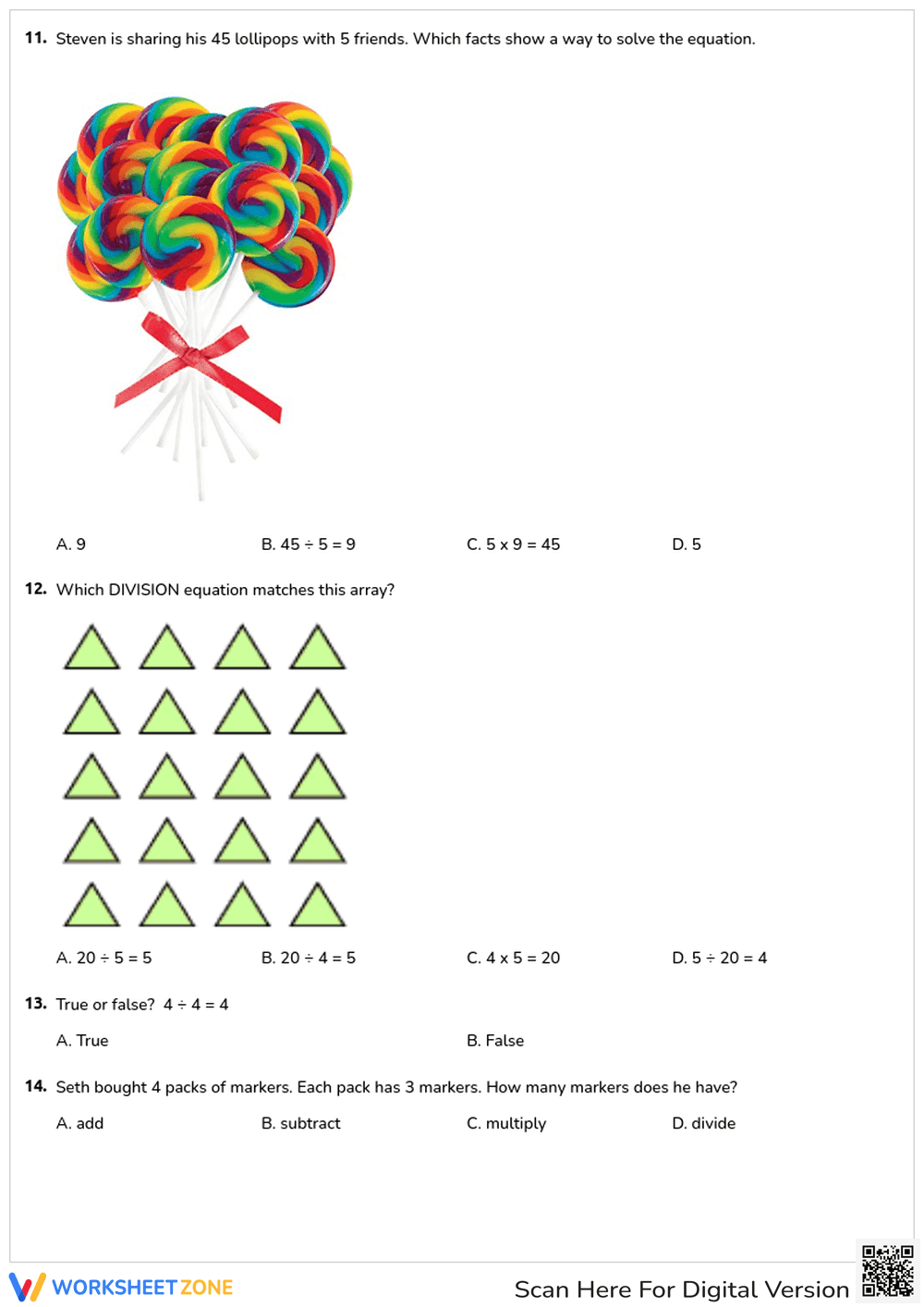
This 4-page PDF contains 17 multiple-choice questions to evaluate student proficiency. It features visual aids, including arrays and number bonds, to support conceptual understanding. The layout includes word problems, comparison tasks, and exercises highlighting the relationship between multiplication and division. A full answer key is provided for quick grading.
- Guided practice: The first 5 questions focus on direct computation and simple grouping visuals to build initial confidence.
- Supported practice: Questions 6-12 introduce word problems and arrays, requiring students to translate scenarios into expressions.
- Independent practice: The final problems challenge students with inverse operations and comparisons without visual scaffolding.
This sequence follows a gradual-release model, moving from concrete models to abstract reasoning.
This resource is primarily aligned with `CCSS.MATH.CONTENT.3.OA.A.2`, which requires students to interpret whole-number quotients as the number of objects in each share when objects are partitioned equally. Additionally, it supports 3.OA.B.6 by emphasizing the relationship between multiplication and division. Both standard codes can be copied directly into lesson plans, IEP goals, or district curriculum mapping tools.
Use this worksheet as a formative assessment to identify students struggling with the transition from multiplication to division. Observe how students interact with array-based questions to gauge spatial reasoning. The worksheet takes 20 to 30 minutes, making it ideal for independent work or a graded quiz.
This material is tailored for Grade 3 but serves as a challenge for advanced Grade 2 learners or review for Grade 4. It is effective for visual learners who benefit from diagrams. Pair this resource with a division anchor chart or physical manipulatives for students requiring Tier 2 support.
According to the RAND AIRS 2024 report on elementary mathematics, the use of multiple representations—such as the arrays and number bonds found in this worksheet—is critical for developing fluency in early algebraic thinking. This resource targets CCSS.MATH.CONTENT.3.OA.A.2 by requiring students to interpret quotients within the context of equal sharing and grouping. Research from Fisher & Frey (2014) suggests that scaffolding from visual models to abstract equations, as seen in these 17 tasks, significantly improves long-term retention of division facts. By integrating word problems with direct computation, the worksheet ensures that students do not just memorize procedures but understand the underlying logic of partitioning. This balanced approach is a hallmark of high-quality instructional materials that bridge the gap between conceptual understanding and procedural fluency in the third-grade classroom.


