































Divide Using Equal Groups: Essential Real-World Modeling

Paste this activity's link or code into your existing LMS (Google Classroom, Canvas, Teams, Schoology, Moodle, etc.).
Students can open and work on the activity right away, with no student login required.
You'll still be able to track student progress and results from your teacher account.
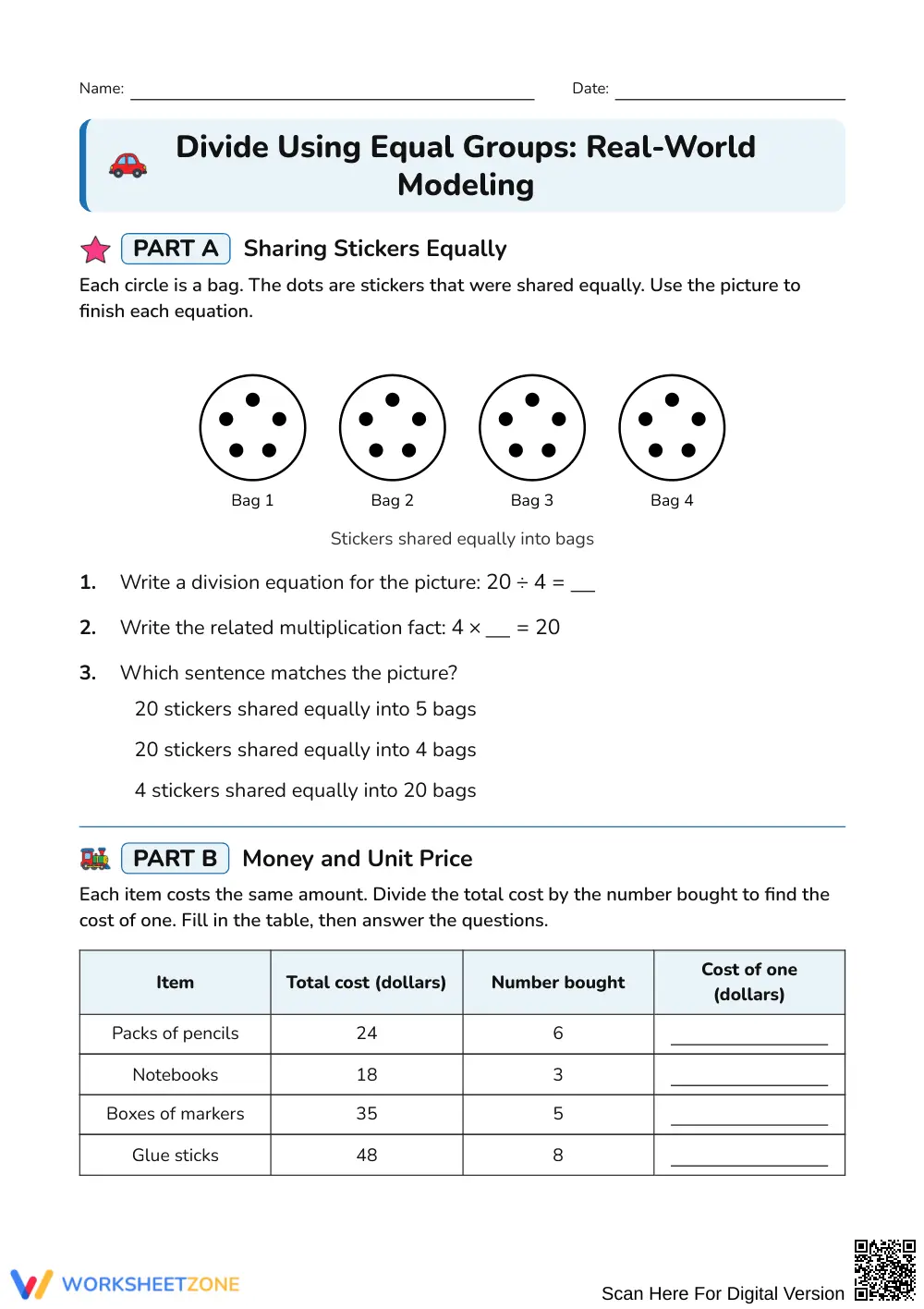
This Grade 3 math worksheet strengthens division fluency by connecting equations directly to concrete everyday scenarios. Students solve 20 structured modeling problems spanning equal sharing, unit cost, linear measurement, and remainders. By interpreting remainders and calculating single-item rates, learners develop critical problem-solving skills and operational mastery.
At a Glance
- Grade: 3 · Subject: Math
- Standard:
3.OA.A.3— Solve real-world division problems using equal groups, arrays, and measurement models- Skill Focus: Real-World Division Modeling
- Format: 3 pages · 20 problems · Answer key included · PDF
- Best For: Guided practice, small groups, or independent problem-solving
- Time: 35–45 minutes
What's Inside
Across 3 printable student pages, learners encounter visual models, structured data tables, and contextual applications. Part A links visual equal groupings to division and multiplication equations. Part B uses a price chart to calculate unit rates and verify costs. Part C applies division to garden dimensions and ribbon measurements. Part D challenges students to interpret quotients with remainders in real-life settings. A complete 3-page answer key provides solutions and explanatory checks.
Skill Progression
- Guided practice (Part A, 5 tasks): High scaffolding with visual circle-and-dot grouping models to connect multiplication and division equations.
- Supported practice (Parts B and C, 9 tasks): Moderate scaffolding using unit-price tables, inverse multiplication checks, and measurement ribbon lines.
- Independent practice (Part D, 6 tasks): Low scaffolding requiring independent problem solving and realistic remainder interpretation.
This sequence follows the gradual-release model, transitioning students from visual representations to independent reasoning.
Standards Alignment
This resource aligns directly with 3.OA.A.3: Use multiplication and division within 100 to solve word problems in situations involving equal groups, arrays, and measurement quantities. It also supports 3.OA.B.6 by treating division as an unknown-factor problem. Both standard codes can be copied directly into lesson plans, IEP goals, or district curriculum mapping tools.
How to Use It
Deploy this worksheet after initial division instruction during guided practice or small-group intervention. Have students complete Parts A and B together before attempting Parts C and D independently. During work time, observe whether students identify what leftover quantities represent, such as rounding up vans to transport all students. Expected completion time is 35 to 45 minutes.
Who It's For
This resource supports Grade 3 general education classes and Grade 4 remediation groups. Embedded pictorial supports assist English learners and students with math accommodations. Pair this activity with an equal-groups anchor chart or manipulative counters for concrete reinforcement.
According to research highlighted by Fisher & Frey (2014) on effective gradual-release frameworks, student mathematical achievement accelerates when instructional tasks transition systematically from teacher-scaffolded visual representations to independent application. This 3-page Grade 3 mathematics resource embeds those exact instructional design principles to address standard 3.OA.A.3, which targets solving real-world multiplication and division word problems within 100 using equal groups, arrays, and measurement models. By moving through 20 structured problems—spanning visual sticker groupings, unit-price data tables, measurement ribbon cuts, and real-life remainder interpretations—students construct enduring mental representations of division operations. Empirical findings demonstrate that coupling visual grouping models with inverse multiplication verification solidifies mathematical discourse and conceptual retention for diverse elementary learners. Consequently, educators can reliably deploy this classroom-tested resource during targeted interventions or core practice to establish rigorous, standards-aligned mastery in elementary mathematical modeling and everyday contextual problem-solving.


