































Divide Using Equal Groups: Essential Prerequisite Check

Paste this activity's link or code into your existing LMS (Google Classroom, Canvas, Teams, Schoology, Moodle, etc.).
Students can open and work on the activity right away, with no student login required.
You'll still be able to track student progress and results from your teacher account.
This Grade 3 math worksheet builds division readiness through equal-group models, number lines, and related fact families. As a targeted diagnostic check, the two-page activity ensures students understand division notation, equal shares, and simple remainders before tackling complex multi-step problems.
At a Glance
- Grade: 3 · Subject: Math
- Standard:
3.OA.A.2— Interpret whole-number quotients of whole numbers by partitioning sets into equal shares or groups- Skill Focus: Prerequisite equal groups concepts, number line representations, and division notation
- Format: 2 printable pages · 21 structured problems · Full answer key included · PDF
- Best For: Diagnostic prerequisite assessment and targeted small-group intervention
- Time: 20–30 minutes
What's Inside
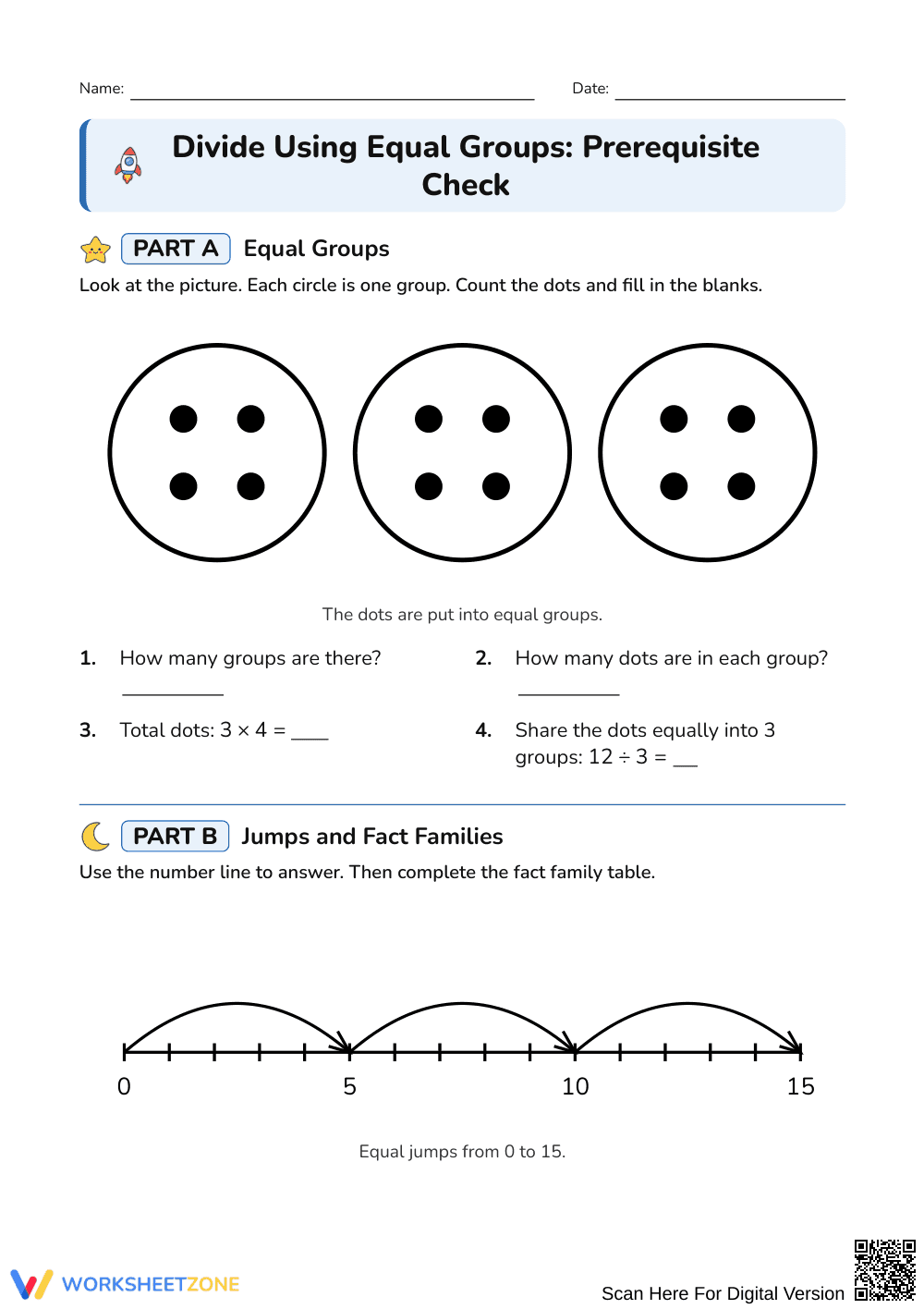
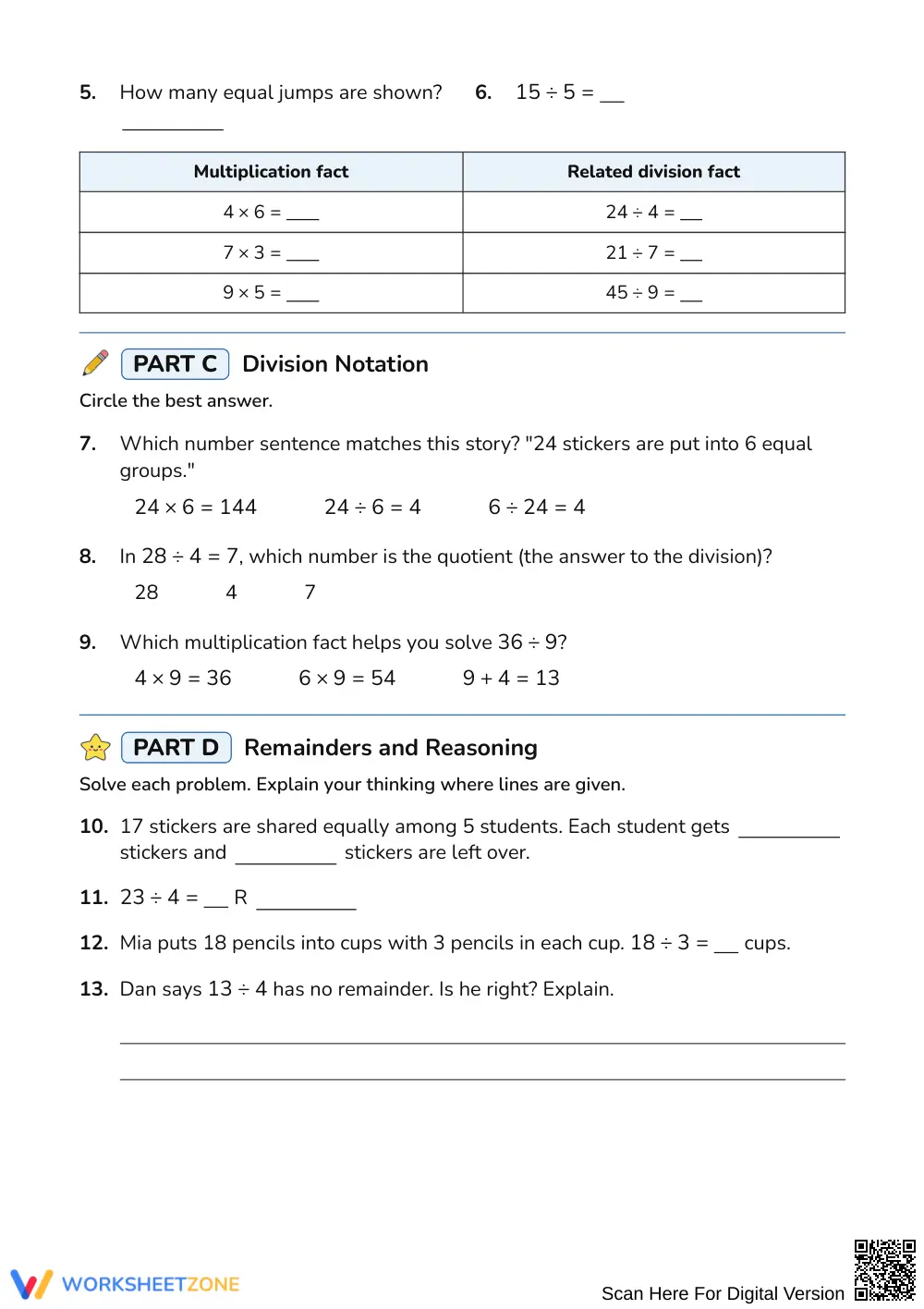
The two-page worksheet provides 21 diagnostic tasks organized into four sequential sections. Part A uses dot-array models for equal sharing. Part B features number line jumps and fact family tables. Part C tests division notation through multiple-choice questions. Part D includes word problems with remainders requiring written reasoning. A complete two-page answer key provides quick verification.
Skill Progression
- Guided practice (Tasks 1–4): Visual dot models guide students to identify group quantities and division equations.
- Supported practice (Tasks 5–13): Number lines and fact family tables connect multiplication to division notation.
- Independent practice (Tasks 14–21): Multiple-choice problems and remainder reasoning prompts assess independent mastery.
This sequence follows a gradual-release framework, transitioning students from concrete visual models to abstract division equations.
Standards Alignment
This resource aligns to Common Core standard `3.OA.A.2`: Interpret whole-number quotients of whole numbers as equal shares or equal groups. It also reinforces supporting standard `3.OA.B.6` by connecting division to unknown-factor multiplication. Both standard codes can be copied directly into lesson plans, IEP goals, or district curriculum mapping tools.
How to Use It
Administer this worksheet as a diagnostic check before starting your division unit to identify misconceptions with equal shares. During completion, observe whether students connect repeated jumps on number lines to division notation. Alternatively, use it during small-group intervention to reteach quotient concepts. Most students complete the 21 problems in 20 to 30 minutes.
Who It's For
This worksheet serves Grade 3 students preparing for division units, as well as Grade 4 learners needing Tier 2 intervention on foundational grouping concepts. Visual models support English language learners, while remainder prompts challenge advanced thinkers. Pair this printable with a direct instruction lesson on equal sharing and arrays.
According to Fisher & Frey (2014), effective formative assessment and prerequisite diagnostic reviews establish the baseline understanding necessary for complex mathematical reasoning. When third-grade students transition from additive thinking to multiplicative structures, recognizing equal groups forms the cognitive bridge to division fluency under standard 3.OA.A.2. This resource directly assesses that critical developmental milestone by evaluating whether learners can interpret whole-number quotients through concrete arrays, number line intervals, and inverse multiplication relationships. Rather than overwhelming students with lengthy algorithmic drills, targeted diagnostic tasks reveal specific procedural gaps in division notation and equal sharing concepts. Classroom data show that addressing these fundamental prerequisite skills early prevents persistent misconceptions when solving multi-step word problems involving remainders. Educational researchers emphasize that structured scaffolding and explicit vocabulary instruction accelerate student mastery, ensuring all learners develop conceptual competence before advancing to complex multi-digit division.


