































Divide Using Equal Groups: Complete Worked Examples

Paste this activity's link or code into your existing LMS (Google Classroom, Canvas, Teams, Schoology, Moodle, etc.).
Students can open and work on the activity right away, with no student login required.
You'll still be able to track student progress and results from your teacher account.
Mastering division begins with concrete conceptual models. This Grade 3 math worksheet helps students understand division as sharing into equal groups through step-by-step worked examples. Learners analyze visual models, complete missing reasoning steps, and connect division equations to multiplication facts to build lasting conceptual understanding and operational fluency.
At a Glance
- Grade: 3 · Subject: Math
- Standard:
3.OA.A.2— Partition collections into equal shares and find unknown quotient values- Skill Focus: Dividing using equal groups and worked examples
- Format: 3 pages · 14 problems · Answer key included · PDF
- Best For: Guided instruction and conceptual math intervention
- Time: 30–45 minutes
What's Inside
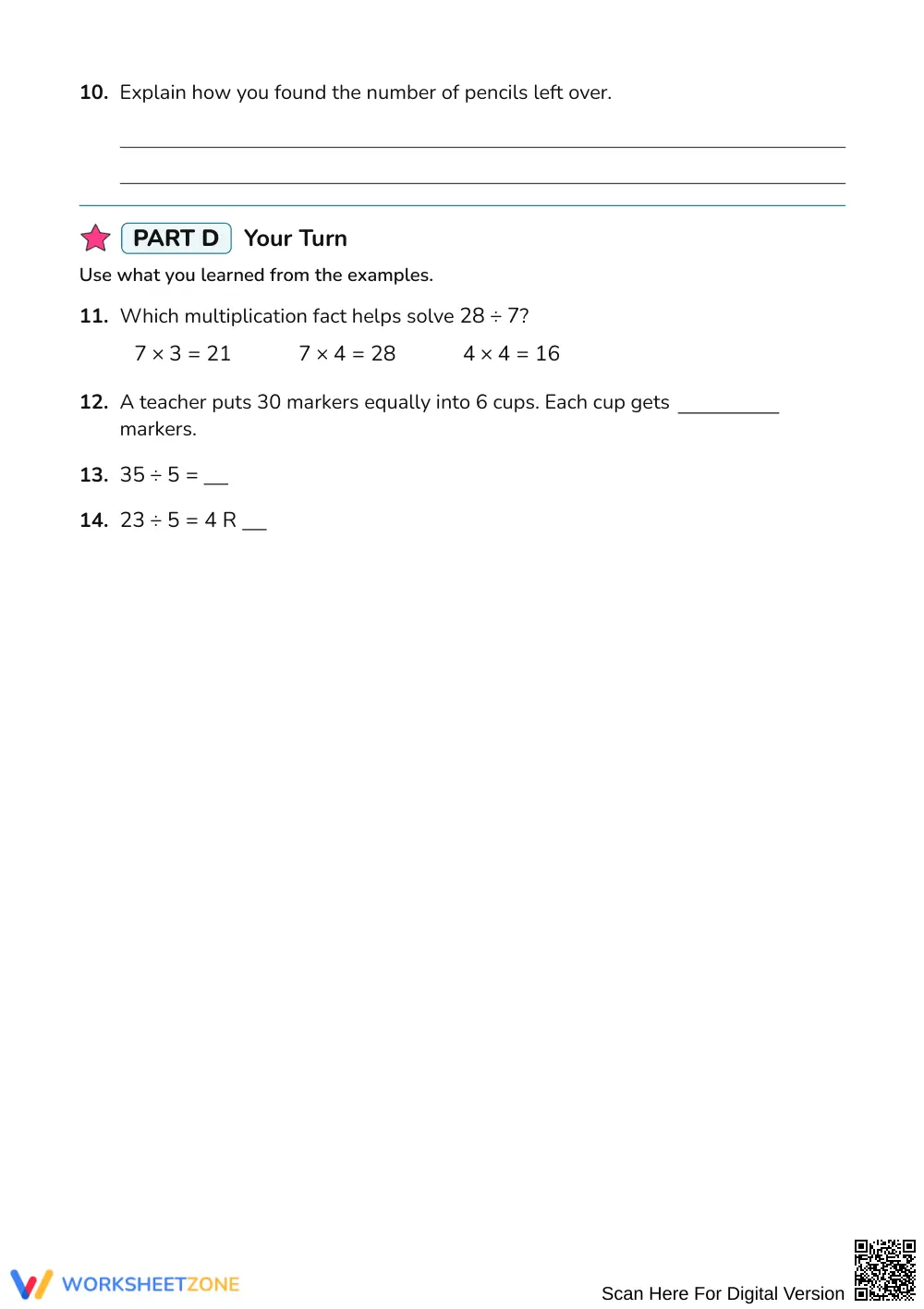
This 3-page printable resource contains 14 structured tasks organized across four progressive parts. Students examine visual plate groupings, jump sequences along number lines, and skip-counting sequences with remainders. Each section provides a worked example with missing explanatory steps, requiring students to articulate mathematical connections, calculate remainders, and complete related multiplication sentences. A complete 3-page answer key provides full model responses for quick review.
Skill Progression
- Guided Practice (Part A): Students examine equal group visual models (4 tasks) with heavy scaffolding, identifying group sizes and explaining multiplication-division relationships.
- Supported Practice (Parts B & C): Students analyze number line intervals and skip-counting patterns (6 tasks) with moderate scaffolding, solving quotients and explaining leftover remainder values.
- Independent Practice (Part D): Students independently evaluate multi-representation division problems and inverse operations (4 tasks) without visual support.
This structured sequence follows the gradual-release framework, moving learners smoothly from teacher-guided modeling to independent mathematical problem solving.
Standards Alignment
This worksheet directly aligns to 3.OA.A.2, requiring students to calculate whole-number quotients of whole numbers when objects are partitioned into equal shares. It also supports 3.OA.B.6 by reinforcing division as an unknown-factor multiplication problem. Both standard codes can be copied directly into lesson plans, IEP goals, or district curriculum mapping tools.
How to Use It
Administer this worksheet during guided math rotations or immediately after initial direct instruction on division concepts. As students complete the written reasoning prompts, observe whether they count individual items or recognize equal group units to formatively assess multiplicative thinking. Students typically complete the 14 problems within 30 to 45 minutes of instructional time.
Who It's For
This activity is designed for third-grade students developing initial division concepts, as well as fourth-grade math intervention groups requiring conceptual reinforcement. The written prompts support multilingual learners through structured sentence models. Pair this practice with an equal-groups anchor chart or hands-on counter manipulatives.
Grounding division instruction in concrete equal-sharing representations aligns with findings from Fisher & Frey (2014) on the gradual-release model, which demonstrates that pairing worked examples with student-generated explanations significantly reduces cognitive load during multi-step procedural tasks. Standard 3.OA.A.2 requires Grade 3 learners to interpret whole-number quotients by partitioning collections into equal shares, transitioning from physical groupings to symbolic mathematical expressions. By providing explicit worked examples alongside partially completed reasoning steps, this resource guides students to articulate the inverse relationship between multiplication and division while constructing conceptual knowledge of quotients and remainders. Incorporating structured number lines, equal grouping diagrams, and written justification tasks ensures that students move beyond rote computation toward durable relational understanding. Educational practitioners can directly integrate this targeted 14-task worksheet into standards-aligned elementary mathematics curricula to measure student progress, diagnose emerging misconceptions, and reinforce foundational algebraic thinking.


