



























Divide Using Equal Groups: Complete Visual Models
Paste this activity's link or code into your existing LMS (Google Classroom, Canvas, Teams, Schoology, Moodle, etc.).
Students can open and work on the activity right away, with no student login required.
You'll still be able to track student progress and results from your teacher account.
Mastering multi-digit division requires moving from rote memorization to visual mathematical models. This 3-page Grade 4 worksheet provides 21 scaffolded tasks to divide whole numbers using equal groups, arrays, and area models. Students connect division equations to multiplication facts and interpret remainders with confidence.
At a Glance
- Grade: 4 · Subject: Math
- Standard:
4.NBT.B.6— Divide whole numbers and find remainders using visual models and place-value strategies- Skill Focus: Concrete and visual division models
- Format: 3 pages · 21 problems · Answer key included · PDF
- Best For: Guided math practice, intervention, and reteaching
- Time: 30–45 minutes of instructional time
What's Inside
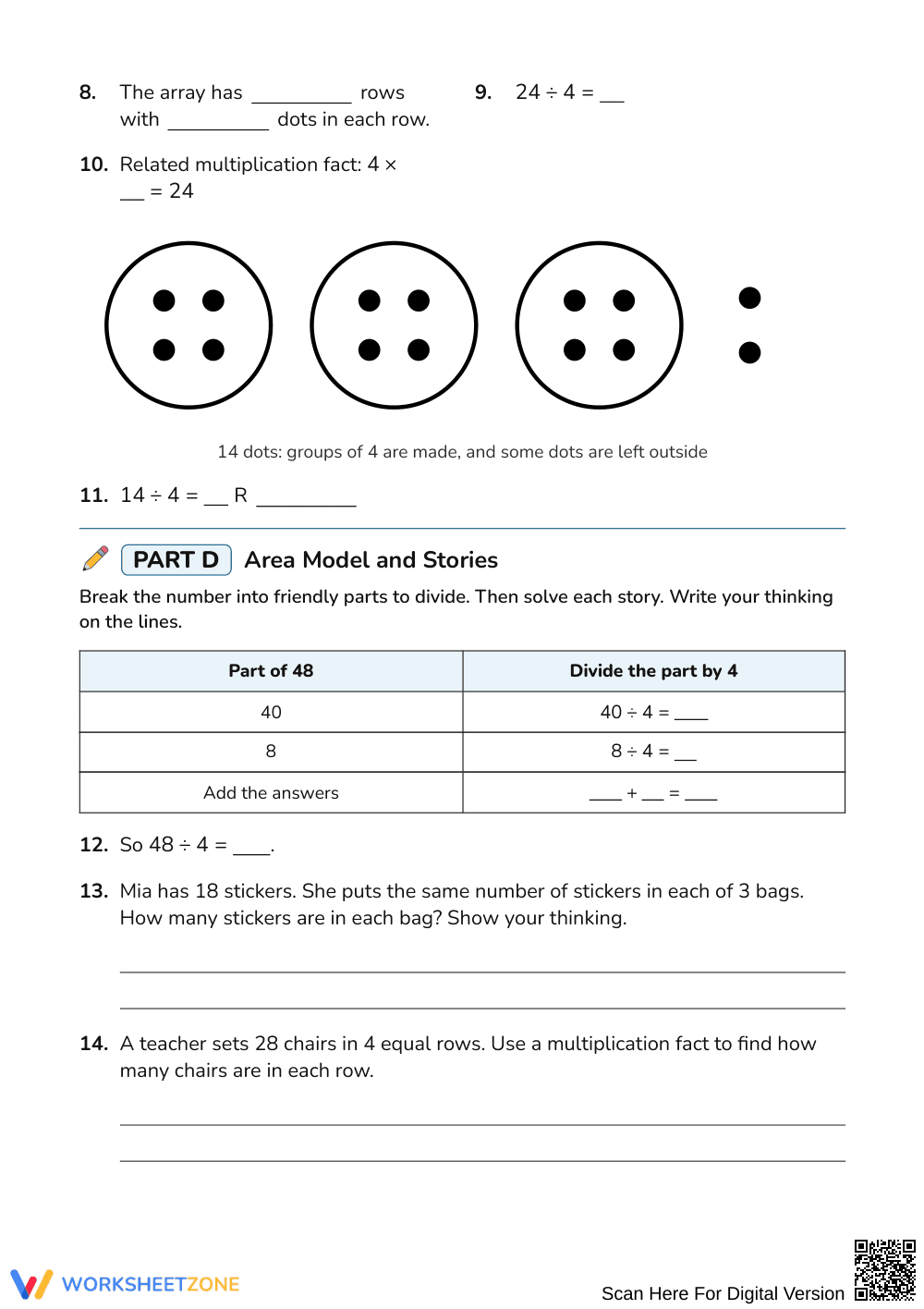
This 3-page worksheet contains 21 tasks across four progressive sections, accompanied by a complete 3-page answer key with worked solutions. Part A uses dot groups to represent equal sharing. Part B features number lines with equal jumps. Part C utilizes rectangular arrays and introduces remainders alongside related multiplication facts. Part D concludes with area model decomposition and word problems.
Skill Progression
- Guided Practice (Part A, 5 problems): Students analyze visual dot groupings and identify matching division equations with direct pictorial scaffolds.
- Supported Practice (Parts B & C, 8 problems): Learners divide along number lines and arrays, determining quotients and remainders using linked multiplication facts.
- Independent Practice (Part D, 8 problems): Students decompose numbers into area models and solve word problems independently with written explanations.
This sequence follows the gradual release of responsibility model (I Do, We Do, You Do) to build mastery step by step.
Standards Alignment
This worksheet aligns to primary standard `4.NBT.B.6`: Find whole-number quotients and remainders with up to four-digit dividends and one-digit divisors, using strategies based on place value, the properties of operations, and the relationship between multiplication and division. It also supports `4.OA.A.3` through multi-step word problems involving remainders. Both standard codes can be copied directly into lesson plans, IEP goals, or district curriculum mapping tools.
How to Use It
Use this worksheet during core instruction right after introducing visual division models, completing Parts A and B collaboratively. Assign Parts C and D during small-group intervention to evaluate understanding. As students work, check whether they use multiplication arrays or count individual dots to spot developing multiplicative reasoning. Expect completion within 30 to 45 minutes.
Who It's For
This resource supports fourth-grade students building initial division fluency, as well as intervention groups needing visual scaffolding. Pair this worksheet directly with counters, base-ten blocks, or a classroom division anchor chart.
According to Fisher & Frey (2014), structured scaffolds within gradual release instruction accelerate mathematical reasoning by bridging visual representations and abstract symbolic computation. This Grade 4 instructional resource addresses standard 4.NBT.B.6 by guiding students through 21 targeted exercises that build mastery of whole-number division using concrete and visual models. By progressing systematically through equal dot groups, linear number lines, rectangular arrays, and area model partitioning, students internalize how multiplication and division operate as inverse operations while learning to interpret remainders meaningfully. The integration of visual models ensures that students do not rely solely on procedural memorization, but instead develop robust mental schemas for equal sharing and partitioning. Educators can utilize the included worked solutions and structured problem sets to conduct targeted formative assessments, verify student comprehension during small-group intervention, and monitor individual growth toward foundational arithmetic standards across elementary mathematics curricula.


