
































Divide Using Equal Groups: Complete Error Analysis

Paste this activity's link or code into your existing LMS (Google Classroom, Canvas, Teams, Schoology, Moodle, etc.).
Students can open and work on the activity right away, with no student login required.
You'll still be able to track student progress and results from your teacher account.
This Grade 4 division worksheet helps students master equal groups division through targeted error analysis. Across 22 problems, learners inspect visual models, verify answers with multiplication, interpret remainders, and correct break-apart division. By evaluating common mistakes, students build deeper conceptual understanding and self-checking routines.
At a Glance
- Grade: 4 · Subject: Math
- Standard:
4.NBT.B.6— Divide whole numbers and explain remainders using equal groups- Skill Focus: Division error analysis and equal groups reasoning
- Format: 3 pages · 22 problems · Answer key included · PDF
- Best For: Formative assessment and targeted error review
- Time: 35–45 minutes
What's Inside
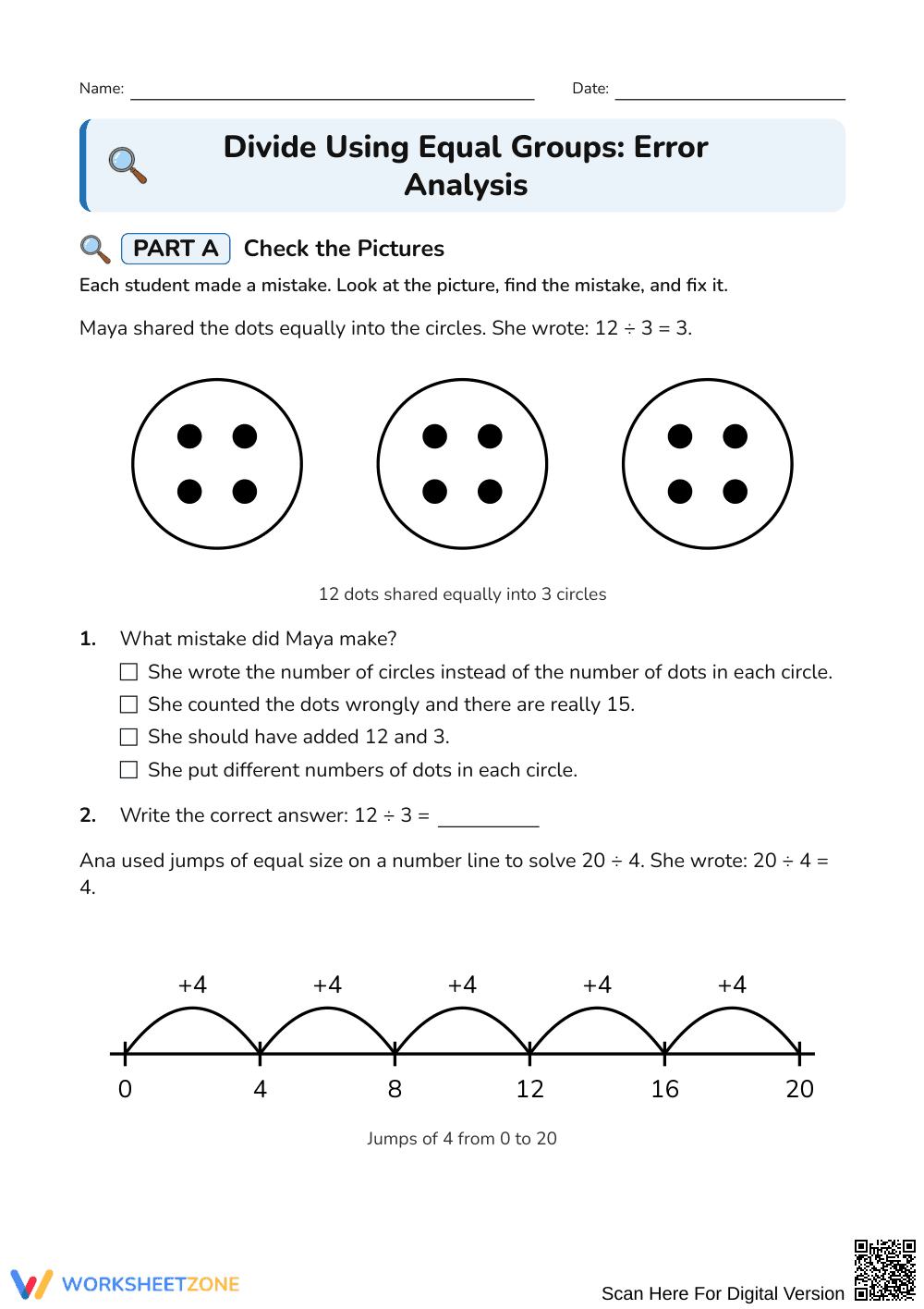
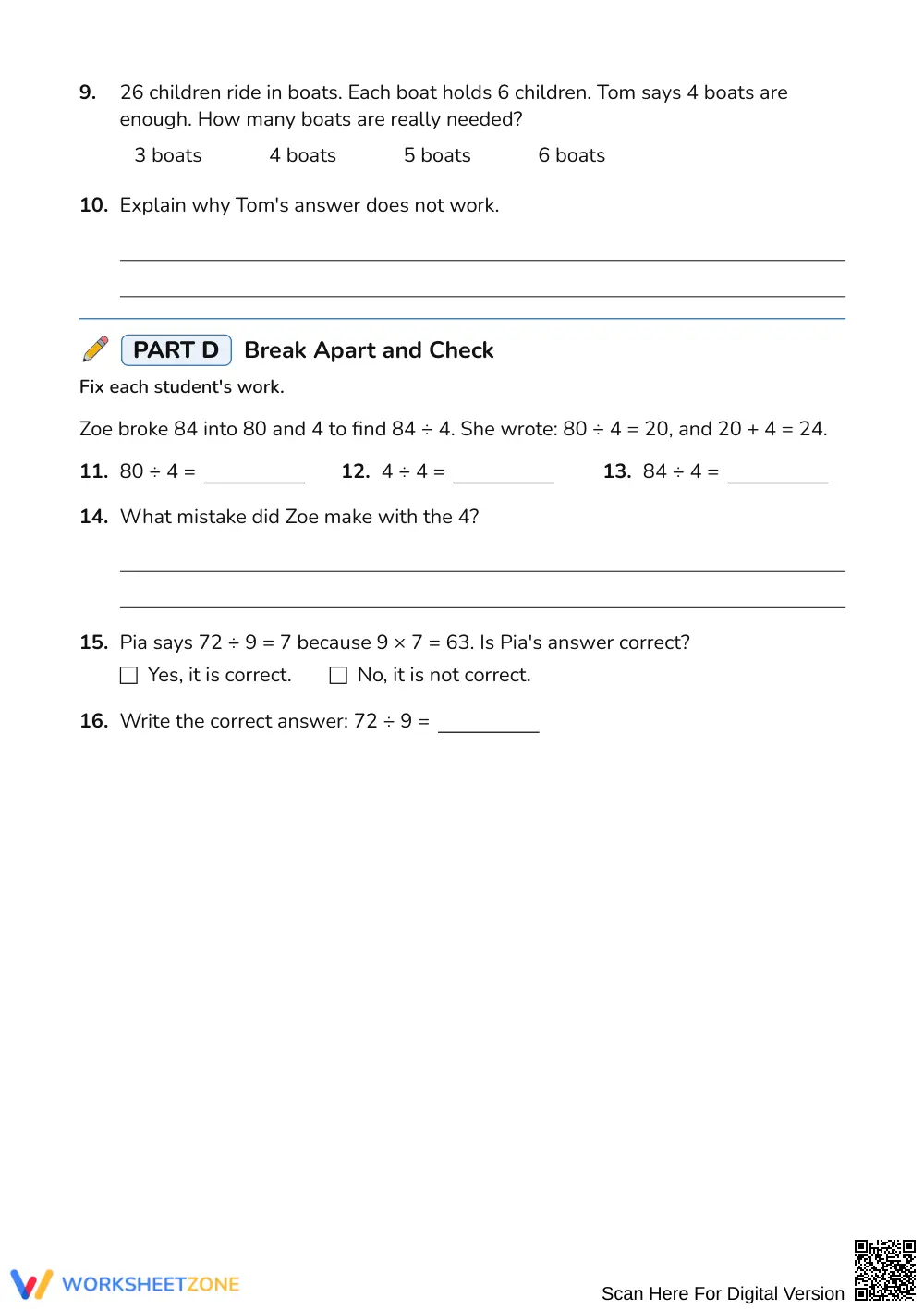
The 3-page student worksheet includes four focused sections. Part A challenges visual errors using dot models and number lines. Part B uses multiplication check tables to verify single-digit division facts. Part C requires students to identify remainder misconceptions in contextual word problems. Part D addresses errors in multi-digit decomposition. A complete 3-page answer key provides worked corrections and written rationales.
Skill Progression
- Guided practice (Part A & Part B, 8 problems): Visual models and structured verification tables scaffold students to detect and fix basic equal group errors.
- Supported practice (Part C, 8 problems): Word problem prompts guide learners to analyze remainders, compare remainders against divisors, and justify boat capacities.
- Independent practice (Part D, 6 problems): Unscaffolded partitioning tasks challenge students to repair multi-digit break-apart division equations independently.
This sequence follows an I Do, We Do, You Do gradual-release model.
Standards Alignment
This worksheet aligns directly with `4.NBT.B.6`: Find whole-number quotients and remainders with up to four-digit dividends and one-digit divisors, using strategies based on place value, operations, and the relationship between multiplication and division. The tasks also support `4.OA.A.3` by requiring students to solve multistep word problems and interpret remainders in context. Both standard codes can be copied directly into lesson plans, IEP goals, or district curriculum mapping tools.
How to Use It
Use this resource after introducing equal groups division. During small-group instruction, assign Parts A and B to observe whether students check inverse relationships or merely guess. Next, assign Parts C and D as an independent exit ticket to assess conceptual mastery. Students typically complete the 22 items in 35 to 45 minutes.
Who It's For
This worksheet serves Grade 4 students solidifying division concepts and Grade 5 students needing targeted remediation. Scaffolds like multiple-choice stems support striving learners. Pair this printable with counter manipulatives or an anchor chart during small-group review.
According to research highlighted in Fisher & Frey (2014), engaging elementary students in targeted error analysis significantly improves mathematical reasoning compared to repetitive calculation drills alone. This three-page Grade 4 resource operationalizes standard 4.NBT.B.6 by asking students to identify calculation mistakes, correct faulty division equations, and explain the underlying logic of equal sharing. By analyzing misconceptions in visual arrays, multiplication checks, remainders, and place-value decomposition, learners move beyond rote algorithmic execution into genuine conceptual comprehension. The systematic progression from supported image critique to independent distributive property analysis ensures that students develop metacognitive verification habits. Teachers can deploy these twenty-two scaffolded tasks during guided practice or intervention blocks to diagnose precise arithmetic misconceptions before high-stakes assessments. Consequently, students construct a durable understanding of whole-number quotients, remainder constraints, and inverse relationships that prepares them for long division algorithms.


