































Divide Using Equal Groups: Complete Accuracy Practice

Paste this activity's link or code into your existing LMS (Google Classroom, Canvas, Teams, Schoology, Moodle, etc.).
Students can open and work on the activity right away, with no student login required.
You'll still be able to track student progress and results from your teacher account.
This Grade 4 division worksheet builds accuracy in dividing with equal groups and models. Students calculate quotients and remainders across 23 problems, connecting dot arrays, number lines, and inverse multiplication facts. The clear sequence moves learners from visual grouping models to abstract arithmetic precision.
At a Glance
- Grade: 4 · Subject: Math
- Standard:
4.NBT.B.6— Find whole-number quotients and remainders using equal groups- Skill Focus: Dividing using equal groups and remainders
- Format: 2 pages · 23 problems · Answer key included · PDF
- Best For: Independent practice and skill verification
- Time: 25–35 minutes
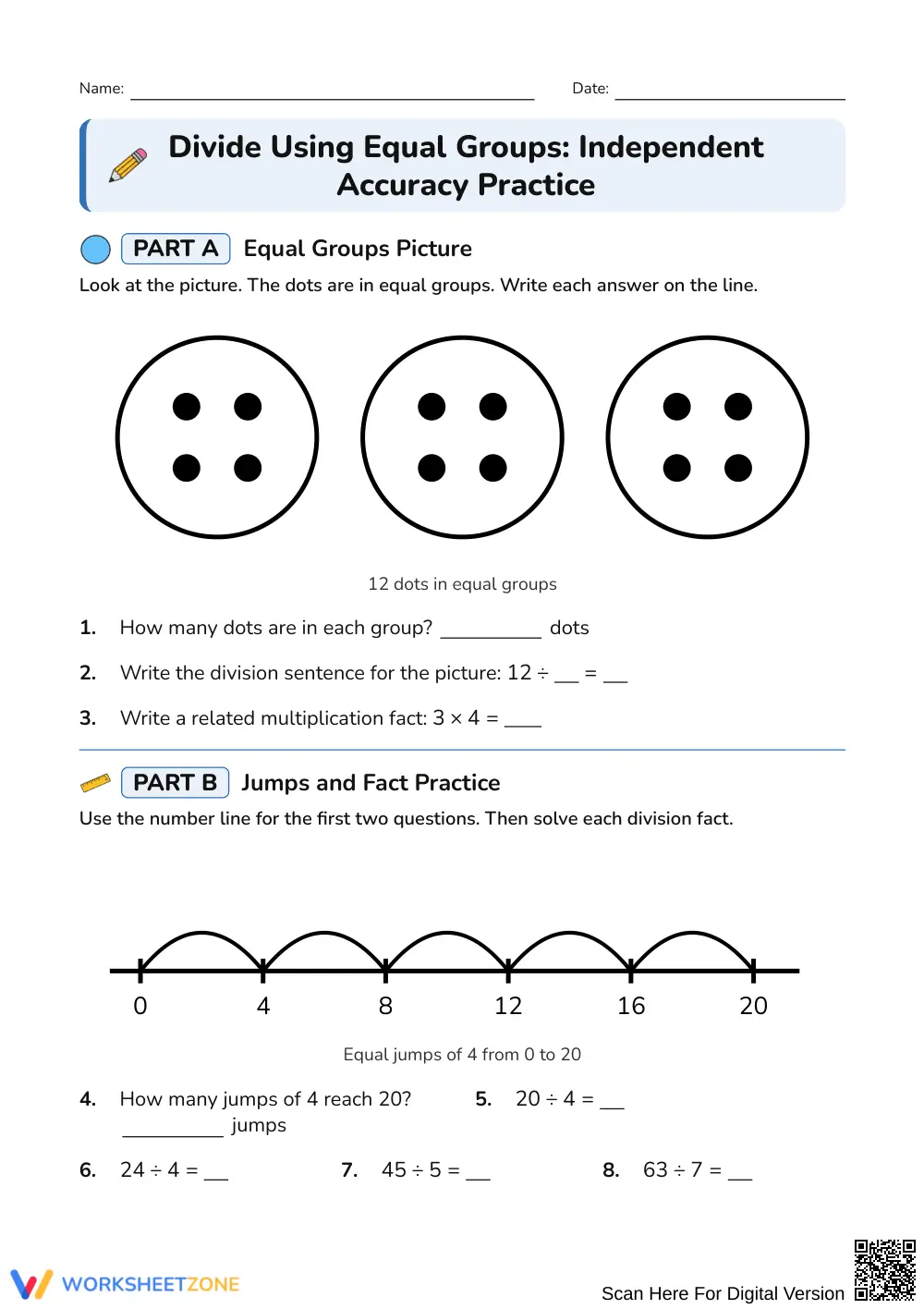
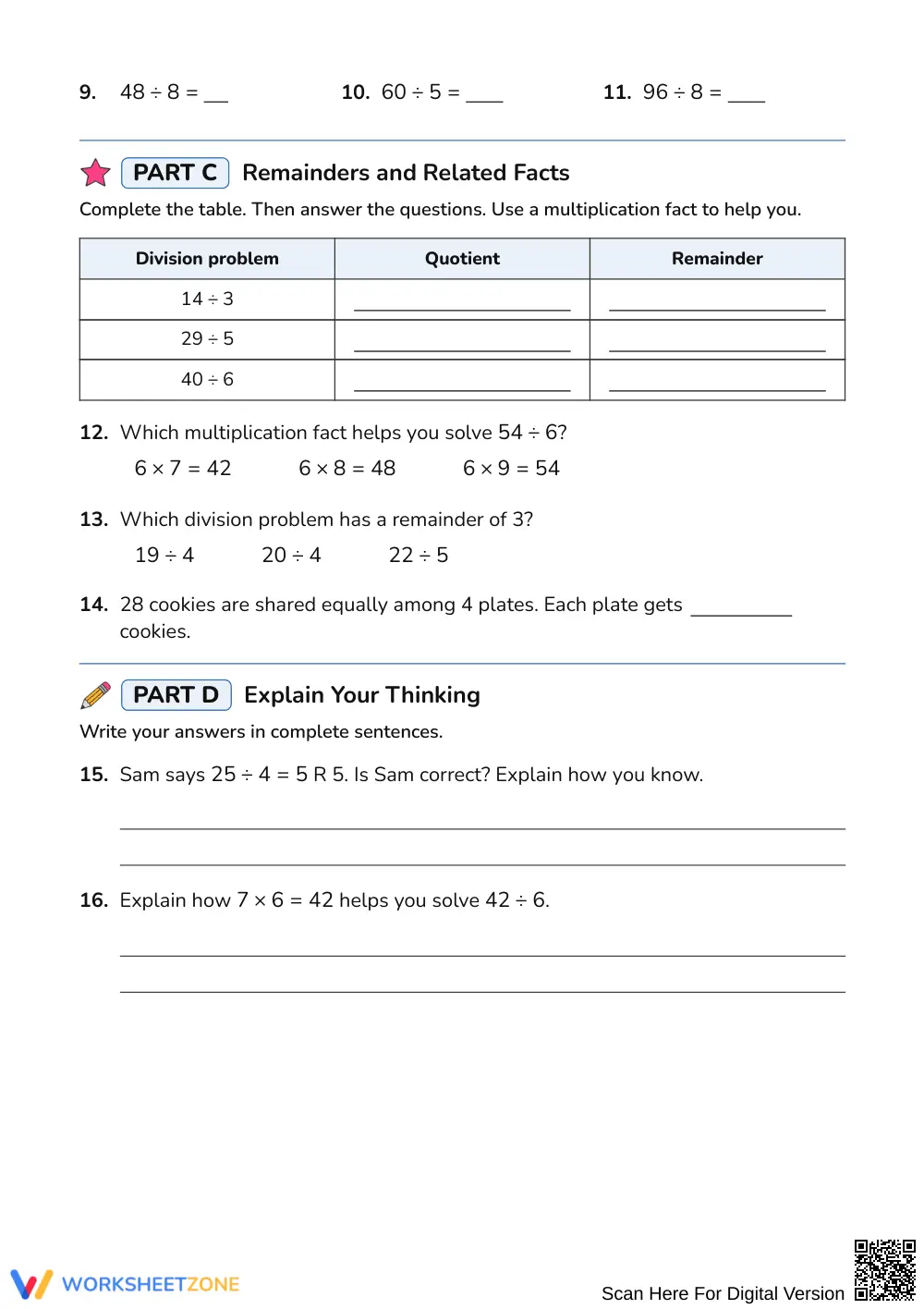
The 2-page worksheet presents 23 problems across four parts, accompanied by a 2-page answer key. Part A uses dot pictures to link equal groups to division and multiplication. Part B introduces number line jumps before single-step fact practice. Part C provides a quotient and remainder table with related facts, and Part D prompts students to explain their mathematical reasoning.
Skill Progression
- Guided Practice (Part A, 3 problems): Heavy visual support with dot arrays to record division sentences and inverse multiplication facts.
- Supported Practice (Part B, 9 problems): Moderate support utilizing number line jumps before solving division facts independently.
- Independent Practice (Parts C & D, 11 problems): Unscaffolded remainder tables, multiple-choice items, word problems, and written error analysis.
This sequence mirrors the gradual release of responsibility model, transitioning fourth graders from visual grouping to independent accuracy.
Standards Alignment
This worksheet aligns to primary standard `4.NBT.B.6`: Find whole-number quotients and remainders with up to four-digit dividends and one-digit divisors, using strategies based on place value, the properties of operations, and the relationship between multiplication and division. It also supports `4.OA.A.3` through multi-step remainder problem solving. Both standard codes can be copied directly into lesson plans, IEP goals, or district curriculum mapping tools.
How to Use It
Use this resource for independent practice after direct instruction on equal groups division, or assign it during math rotations. Formatively observe whether students verify that remainders are smaller than divisors when analyzing Sam's work in Part D. Expected completion time is 25 to 35 minutes.
Who It's For
This activity suits Grade 4 students building division accuracy and Grade 5 learners needing remainder intervention. Provide counters for students needing tactile support on Part C. Pair this sheet with an equal groups anchor chart linking factors and dividends.
According to the Fisher & Frey (2014) framework on instructional scaffolding, students achieve durable mathematical competence when visual representations systematically bridge concrete grouping models and abstract division algorithms. This Grade 4 instructional resource directly targets standard 4.NBT.B.6 by guiding learners to calculate whole-number quotients and decompose remainders using equal groups and inverse multiplication relationships. The 2-page curriculum tool structures 23 analytical tasks across progressive tiers of cognitive demand, moving intentionally from pictorial dot arrays and linear jumps to symbolic arithmetic and written error explanation. By explicitly demanding that students articulate why remainders cannot exceed divisors, the task sequence prevents common procedural misconceptions while establishing deep conceptual flexibility. Educational practitioners can deploy these 23 problems to gather reliable diagnostic evidence of student division readiness, ensuring that foundational operations translate successfully into advanced multi-digit quotient calculation across upper elementary mathematics.


