





























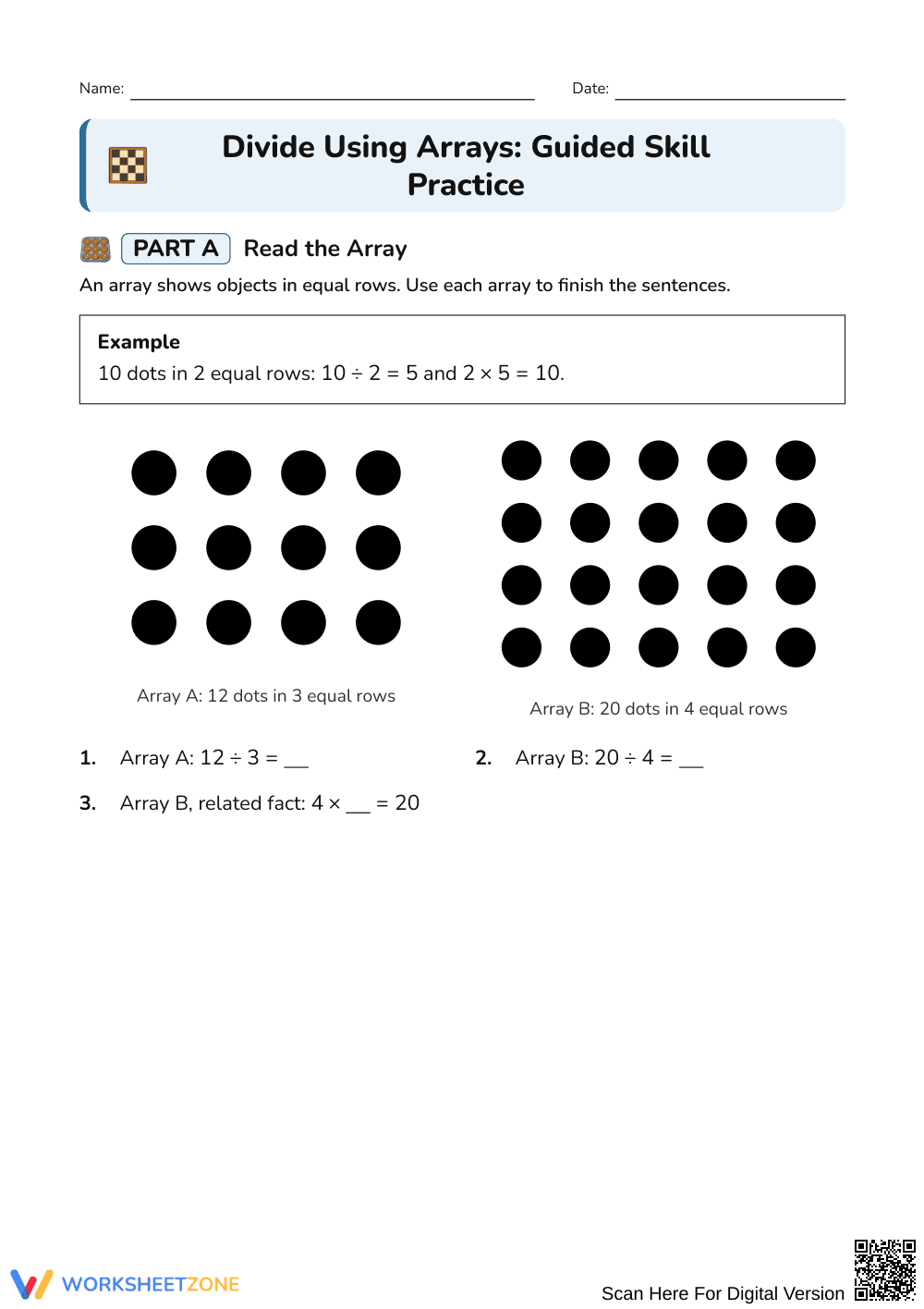


Divide Using Arrays: Guided Skill Practice

Paste this activity's link or code into your existing LMS (Google Classroom, Canvas, Teams, Schoology, Moodle, etc.).
Students can open and work on the activity right away, with no student login required.
You'll still be able to track student progress and results from your teacher account.
This Grade 3 math worksheet strengthens early division competence by teaching students to connect visual arrays with division and multiplication equations. Across 11 targeted problems, learners build conceptual understanding of equal sharing and grouping, moving from visual models to abstract calculation and written mathematical reasoning.
At a Glance
- Grade: 3 · Subject: Math
- Standard:
3.OA.A.3— Use multiplication and division within 100 to solve word problems in equal groups- Skill Focus: Dividing using visual arrays and related multiplication facts
- Format: 2 pages · 11 problems · Answer key included · PDF
- Best For: Guided practice and independent skill review
- Time: 20–30 minutes
What's Inside
The 2-page student worksheet provides 11 structured exercises divided into three intentional instructional sections. Students interact with visual dot arrays, complete fill-in-the-blank equations, connect row and column dimensions, and solve contextual word problems. The resource features clear worked examples and includes a complete 2-page answer key showing step-by-step solutions for immediate verification.
Skill Progression
- Guided practice (Part A): Four problems use a worked example and pre-labeled arrays of 12 and 20 dots to connect equal rows with quotient values.
- Supported practice (Part B): Four problems prompt students to analyze arrays of 15 and 18 dots using both rows and columns, building conceptual flexibility.
- Independent practice (Part C): Three problems remove visual models, requiring students to use related multiplication facts, interpret remainders, and write mathematical explanations.
This sequence follows a gradual-release framework, guiding students from teacher-supported modeling to independent fluency.
Standards Alignment
This worksheet aligns directly with `3.OA.A.3` by having students use multiplication and division within 100 to solve array-based word problems. It also reinforces `3.OA.B.5` through inverse operations. Both standard codes can be copied directly into lesson plans, IEP goals, or district curriculum mapping tools.
How to Use It
Assign this worksheet immediately after direct instruction on arrays during a 20 to 30-minute math block. Alternatively, use Parts A and B in guided small groups and Part C as an independent exit ticket. When observing students, check whether they identify related multiplication facts to quickly assess mastery.
Who It's For
This resource supports Grade 3 learners mastering division concepts and Grade 4 students needing remedial review. English learners and students with learning accommodations benefit from the structured visual supports. Pair this worksheet with an anchor chart showing equal groups or hands-on counter manipulatives for best results.
Grade 3 division using array representations targets standard 3.OA.A.3 by teaching learners to interpret whole-number quotients through concrete visual models and inverse multiplication relationships. Grounded in research on structured instructional design by Fisher & Frey (2014), this worksheet implements an intentional gradual-release architecture that systematically shifts cognitive responsibility from teacher modeling to independent student execution. Students begin by examining pre-structured dot arrays, advance to flexible row-and-column decomposition, and culminate in abstract word problem analysis requiring clear written mathematical justifications. This explicit multi-step progression ensures that conceptual understanding consistently precedes procedural computation, helping elementary students internalize the core mathematical relationship between equal grouping structures and arithmetic operations. By combining visual representations with structured algebraic thinking across 11 targeted tasks, the 2-page resource equips classroom educators with a highly reliable instructional tool for standards mastery and ongoing formative assessment.


