































Divide Using Arrays: Complete Worked Examples

Paste this activity's link or code into your existing LMS (Google Classroom, Canvas, Teams, Schoology, Moodle, etc.).
Students can open and work on the activity right away, with no student login required.
You'll still be able to track student progress and results from your teacher account.
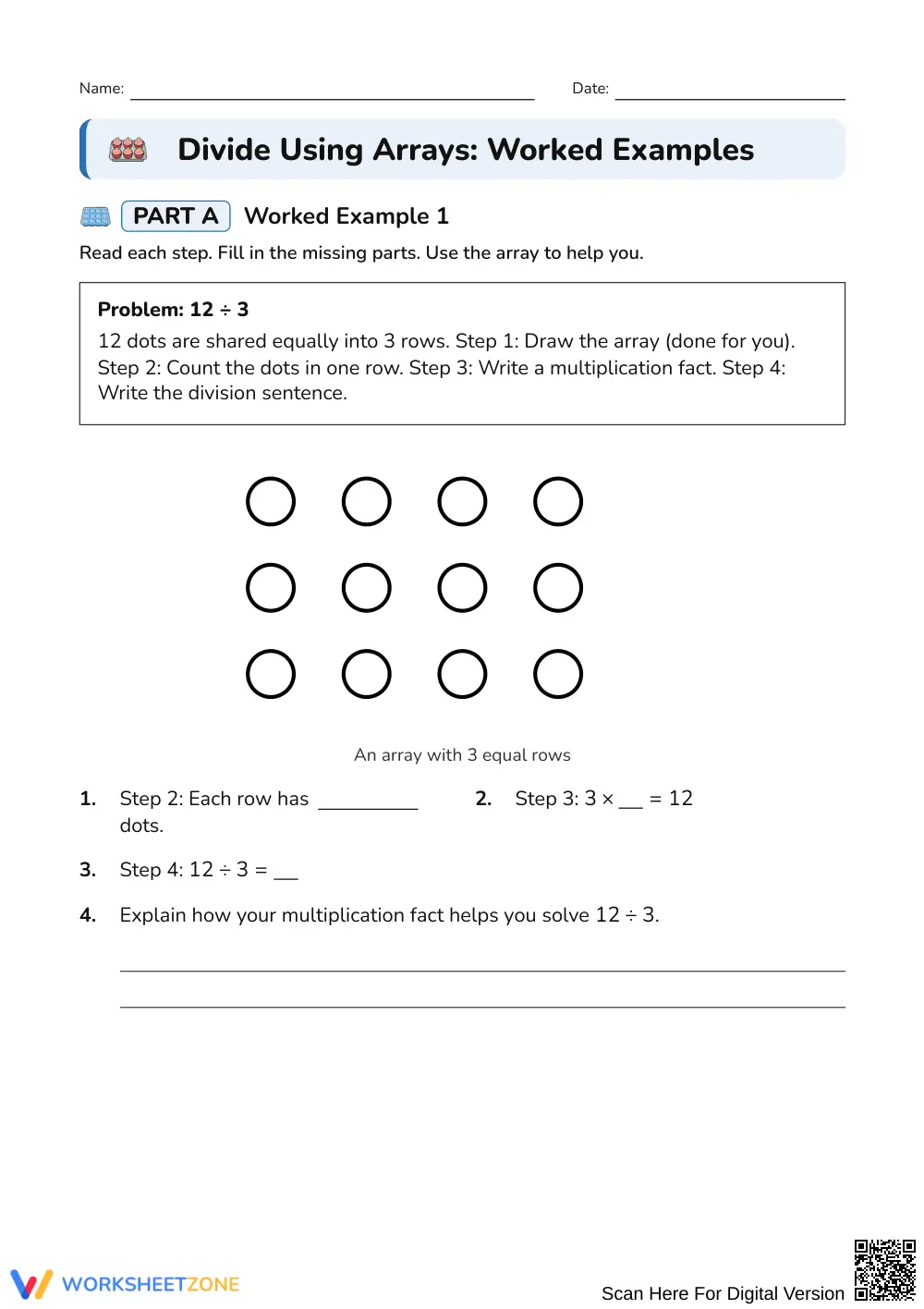
This Grade 3 math worksheet develops conceptual understanding of division by connecting equal rows in arrays to multiplication facts and division equations. Students examine worked examples with missing reasoning steps, explain inverse operations, and calculate whole-number quotients and remainders across structured tasks.
At a Glance
- Grade: 3 · Subject: Math
- Standard:
3.OA.A.2— Interpret whole-number quotients by partitioning objects into equal shares or equal rows- Skill Focus: Array division with worked examples and missing reasoning steps
- Format: 3 pages · 19 problems · Answer key included · PDF
- Best For: Small group intervention and guided instruction
- Time: 25–35 minutes
What's Inside
The 3-page printable resource includes 19 structured tasks across four progressive parts. Students work through visual array models, step-by-step reasoning prompts, fact-family identification, and tabular calculation tasks. Scaffolding elements include annotated arrays, explicit four-step solution pathways, and a complete 3-page answer key.
Skill Progression
- Guided Practice (Part A): Students examine an initial worked example for 12 ÷ 3, filling in row counts and writing explanations linking multiplication to equal shares.
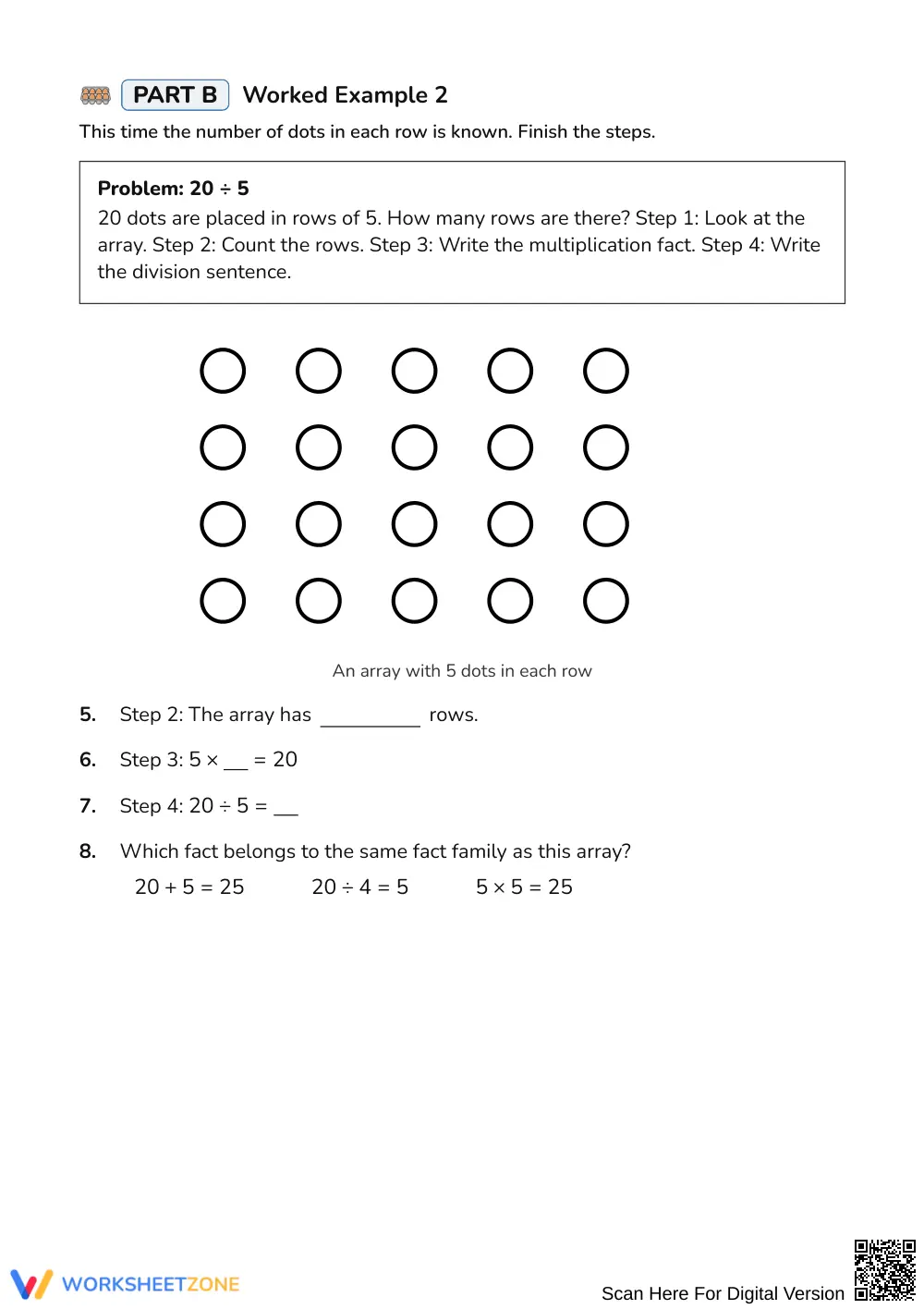
- Supported Practice (Parts B & C): Students complete partially solved examples for 20 ÷ 5 and 14 ÷ 4, identifying fact families and interpreting leftover dots as remainders.
- Independent Practice (Part D): Students independently analyze array descriptions, formulate multiplication facts, and write division equations in a summary table.
This sequence implements gradual release, moving students from guided modeling to independent application.
Standards Alignment
Primary standard: 3.OA.A.2 — Interpret whole-number quotients of whole numbers by partitioning objects into equal shares. Supporting standard: 3.OA.B.6 — Understand division as an unknown-factor problem. Both standard codes can be copied directly into lesson plans, IEP goals, or district curriculum mapping tools.
How to Use It
Use this resource during guided practice following direct instruction on equal grouping, or assign it during targeted intervention. As students complete Parts A and B, observe whether they count individual dots or apply multiplication combinations. Completion takes approximately 25 to 35 minutes.
Who It's For
This worksheet serves Grade 3 learners building foundational division skills and Grade 4 students needing review. English language learners benefit from visual dot arrays and clear reasoning steps. Pair this resource with physical counters and an array anchor chart.
According to research by Fisher & Frey (2014), structured worked examples with faded solution steps optimize cognitive load, enabling novice learners to internalize procedural pathways before undertaking unassisted problem solving. This Grade 3 mathematics resource addresses standard 3.OA.A.2 by providing 19 targeted tasks where students interpret whole-number quotients through concrete array models and step-by-step reasoning prompts. Rather than presenting abstract division algorithms in isolation, the instructional sequence guides third-grade students to connect visual dot arrays with inverse multiplication sentences and formal division equations. Learners analyze pre-partitioned rows, articulate mathematical explanations for why multiplication undoes division, and systematically manage remainders when items cannot be grouped evenly into full rows. This evidence-based progression directly reinforces conceptual division fluency, making the 3-page worksheet an effective instructional tool for elementary classrooms pursuing measurable mastery in algebraic thinking.


