































Divide Using Arrays: Complete Visual Model Practice

Paste this activity's link or code into your existing LMS (Google Classroom, Canvas, Teams, Schoology, Moodle, etc.).
Students can open and work on the activity right away, with no student login required.
You'll still be able to track student progress and results from your teacher account.
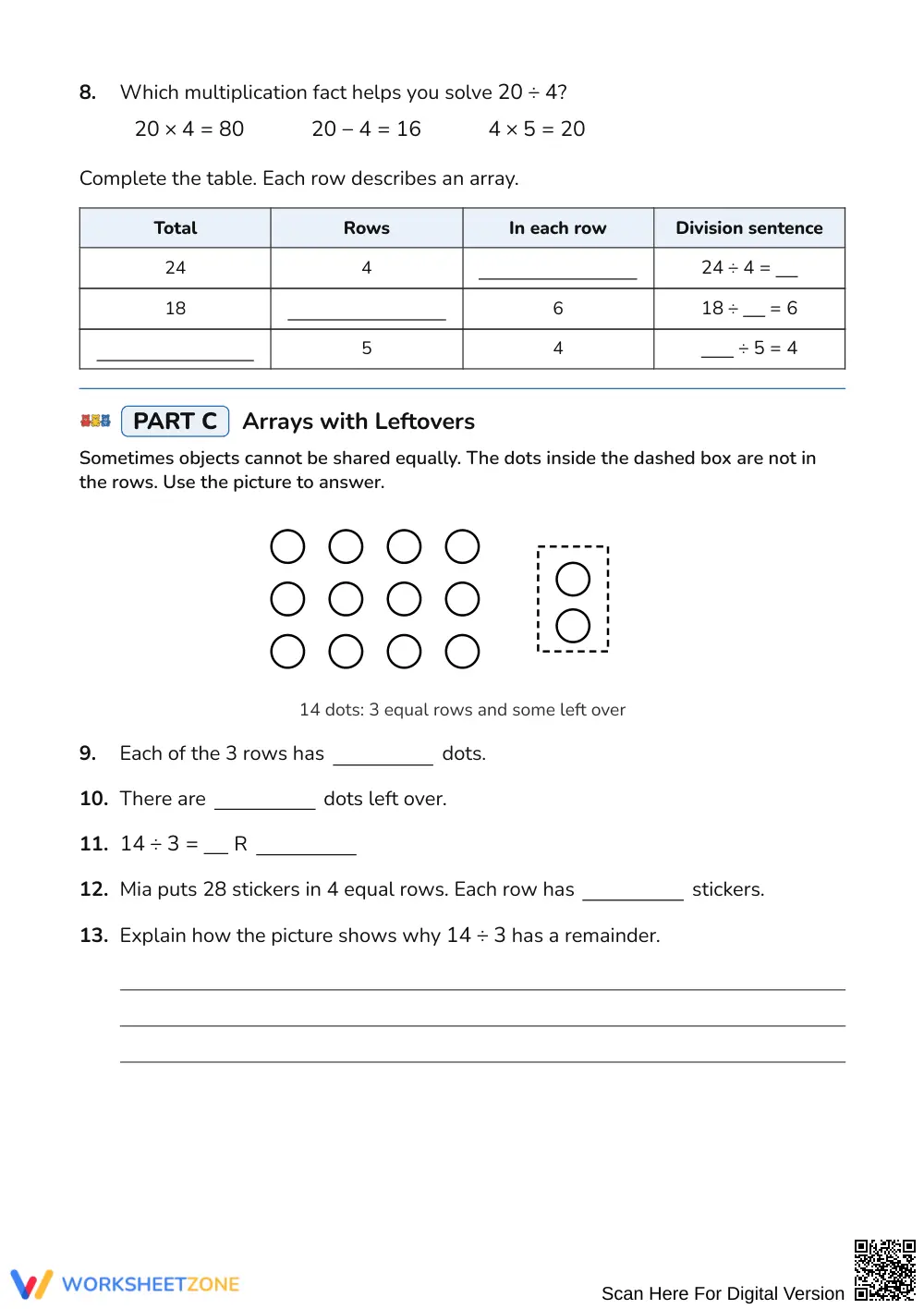
This Grade 4 math worksheet develops division skills by connecting visual array models to multiplication facts and quotients. Students interpret row-and-column arrays, translate dot diagrams into equations, and analyze arrays with leftovers to master division with remainders.
At a Glance
- Grade: 4 · Subject: Math
- Standard:
4.NBT.B.6— Find whole-number quotients and remainders using visual models and multiplication relationships- Skill Focus: Divide Using Arrays: Concrete or Visual Model
- Format: 2 pages · 21 problems · Answer key included · PDF
- Best For: Small group visual math intervention
- Time: 20–30 minutes
What's Inside
The 2-page worksheet includes 21 structured tasks across three scaffolded sections, with a 2-page answer key showing full solutions. Students engage with visual dot arrays, tile grids, and tables linking dividend totals, rows, and quotients. Features include worked examples, visual boundaries, and explanation prompts for remainders.
Skill Progression
- Guided practice (Part A, 4 tasks): Students examine labeled dot arrays to identify rows, items per row, and corresponding multiplication and division equations.
- Supported practice (Part B, 10 tasks): Learners link tile arrays to multiplication facts and complete a data table connecting rows, columns, and division sentences.
- Independent practice (Part C, 7 tasks): Students evaluate arrays with leftover elements, calculate quotients with remainders, and write short explanations explaining leftover dots.
This progression mirrors the gradual-release model, guiding students from initial visual recognition to independent conceptual explanation.
Standards Alignment
This resource aligns directly with `4.NBT.B.6`, which calls for students to find whole-number quotients and remainders using strategies based on place value and multiplication relationships. It also reinforces supporting standard `3.OA.B.5` regarding properties of operations. Both standard codes can be copied directly into lesson plans, IEP goals, or district curriculum mapping tools.
How to Use It
Use this worksheet during guided practice after introducing array division, or assign it for targeted remediation in small groups. During work time, observe whether students connect the array to a known multiplication fact or rely on counting dots individually. Expected completion time is 20 to 30 minutes.
Who It's For
This worksheet is designed for fourth-grade math students developing conceptual division understanding and tier-2 intervention groups needing visual models. Pair it with two-color counters or an array anchor chart to bridge physical manipulatives and abstract division equations.
Mastering division using concrete and visual array models under standard 4.NBT.B.6 establishes foundational algebraic thinking before students encounter complex multi-digit long division algorithms. According to Fisher & Frey (2014), structured visual representations bridge conceptual understanding and procedural fluency through explicit teacher modeling followed by guided collaboration. When fourth-grade students visually partition arrays into equal rows and columns, they connect multiplication inverse operations directly to quotient determination, grounding abstract arithmetic in spatial reasoning. Furthermore, visually isolating leftover items within array boundaries provides an intuitive, non-threatening introduction to the concept of division remainders. Incorporating concrete pictorial scaffolds systematically minimizes cognitive overload, allowing diverse learners to internalize structural relationships between dividends, divisors, and quotients. As evidenced by Fisher & Frey (2014), intentional gradual-release frameworks that leverage visual models significantly accelerate math achievement, ensuring students build reliable conceptual schemas for subsequent fractional division, multi-step problem solving, and higher-level elementary mathematics.


