































Divide Using Arrays: Complete Strategy Comparison

Paste this activity's link or code into your existing LMS (Google Classroom, Canvas, Teams, Schoology, Moodle, etc.).
Students can open and work on the activity right away, with no student login required.
You'll still be able to track student progress and results from your teacher account.
This Grade 4 worksheet helps students compare division strategies by evaluating array models alongside related multiplication facts and skip counting. Through 27 structured problems, fourth graders examine equal groups, interpret remainders visually, and explain strategy efficiency to build deep conceptual understanding and division fact fluency.
At a Glance
- Grade: Grade 4 · Subject: Mathematics
- Standard:
4.NBT.B.6— Find whole-number quotients and remainders using arrays and multiplication relationships- Skill Focus: Comparing division strategies, arrays, and related facts
- Format: 4 student pages · 27 problems · Complete 4-page answer key · Printable PDF
- Best For: Small-group guided instruction, intervention, or skills review
- Time: 35–45 minutes
What's Inside
The 4-page packet contains 27 exercises organized into four progressive parts with visual models and comparison tables. Students examine dual solution methods, fill in tables linking arrays to inverse facts, interpret leftover items with remainders, and defend their strategy selections. A complete 4-page answer key includes step-by-step reasoning for each problem.
Skill Progression
- Guided practice (Part A, 4 problems): Students compare dual solutions from Mia and Leo, using array models to see why multiplication facts give identical quotients.
- Supported practice (Parts B and C, 14 problems): Students complete comparison tables and analyze remainders using dot arrays and inverse multiplication facts.
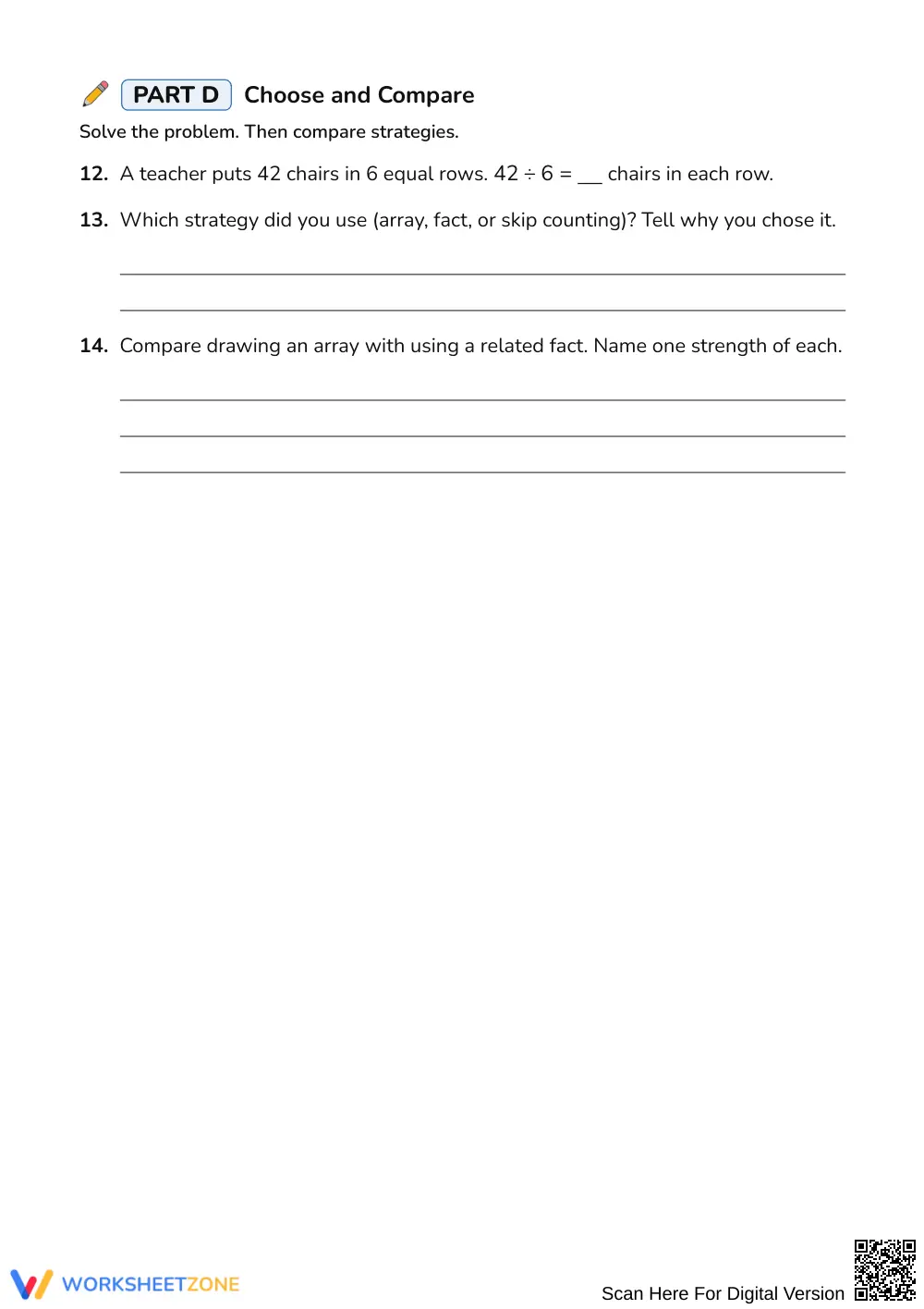
- Independent practice (Part D, 9 problems): Learners solve word problems, select their preferred strategy, and write comparative evaluations analyzing method efficiency.
This sequence mirrors the gradual-release model, transitioning students from guided visual analysis to independent procedural selection.
Standards Alignment
This worksheet aligns directly to `4.NBT.B.6`: Find whole-number quotients and remainders with up to four-digit dividends and one-digit divisors using strategies based on place value and the relationship between multiplication and division. It also supports `4.OA.A.3` through multi-step problem solving with remainders. Both standard codes can be copied directly into lesson plans, IEP goals, or district curriculum mapping tools.
How to Use It
Use this worksheet during small-group intervention after initial instruction to help struggling students connect visual arrays with multiplication facts. Alternatively, assign it for partner work during math workshop rotations to stimulate reasoning discussions. For formative assessment, check whether students recognize why overestimating dividends causes remainders to fail. Expected completion time is 35 to 45 minutes.
Who It's For
This resource serves Grade 4 students building operational fluency, providing essential visual supports and sentence stems for English learners and students with disabilities. Advanced learners practice evaluating efficiency and justifying mathematical claims. Pair this worksheet directly with an anchor chart comparing division models or a targeted lesson on inverse operations.
According to Fisher & Frey (2014), structured gradual-release frameworks significantly strengthen conceptual transfer when students transition methodically from worked exemplar analysis to autonomous strategy selection. Aligned with standard 4.NBT.B.6, this worksheet systematically develops the plain-English skill of finding whole-number quotients and remainders by comparing visual array models with related multiplication facts. When fourth-grade learners examine contrasting peer methods side by side, they transition from rote procedural computation to metacognitive evaluation, recognizing that while physical dot arrays provide concrete verification for equal grouping and remainders, derived multiplication facts optimize operational efficiency. Research demonstrates that pairing explicit visual models with explanatory writing solidifies mathematical reasoning across diverse student populations, ensuring struggling learners grasp the physical meaning of division while proficient students hone comparative problem-solving fluency. The structured sequence of 27 problems guarantees that learners master both representational meaning and calculation speed efficiently.


