































Divide Using Arrays: Complete Reasoning & Justification

Paste this activity's link or code into your existing LMS (Google Classroom, Canvas, Teams, Schoology, Moodle, etc.).
Students can open and work on the activity right away, with no student login required.
You'll still be able to track student progress and results from your teacher account.
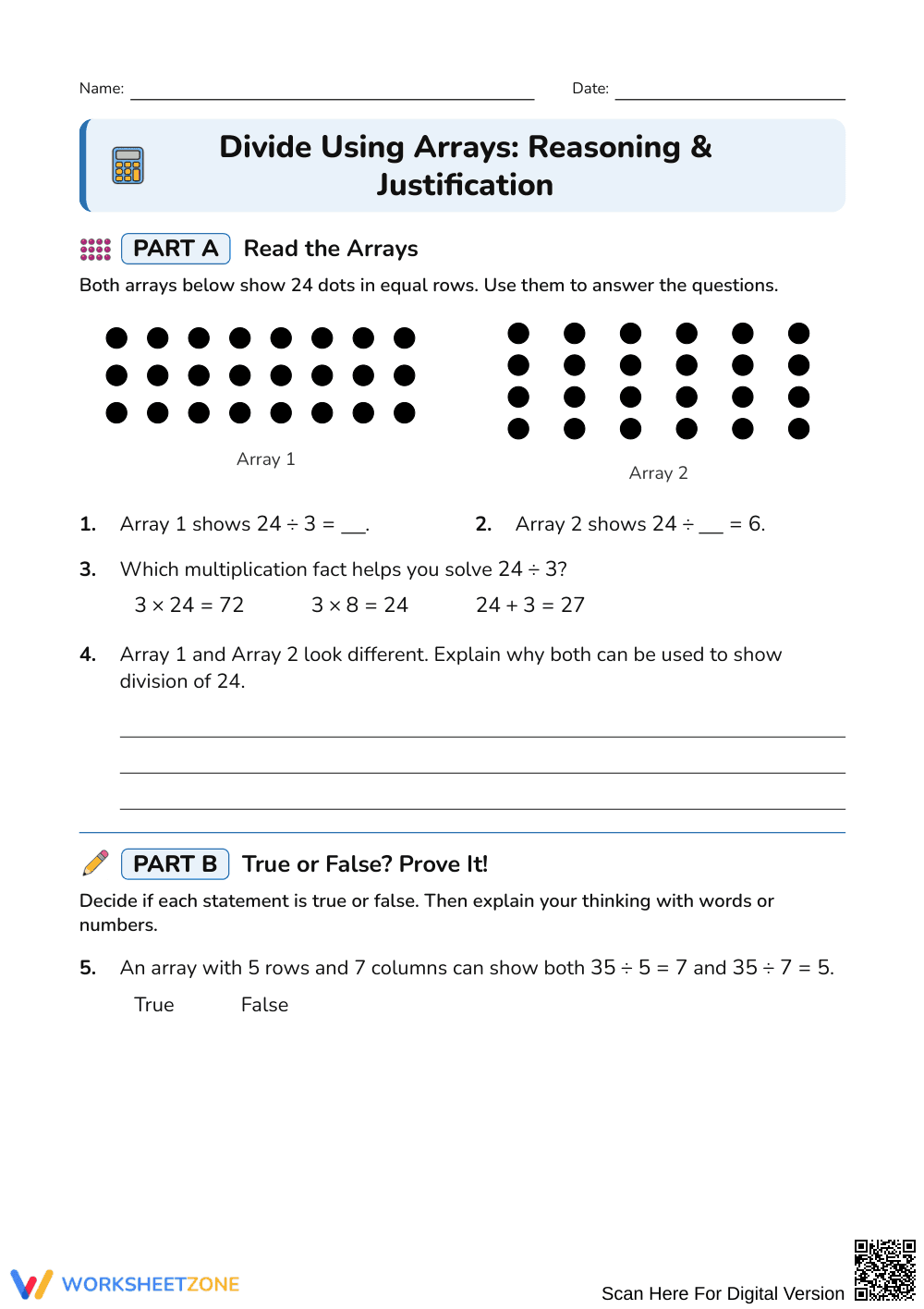
This Grade 4 division worksheet strengthens mathematical reasoning using visual array models. Across 15 non-routine tasks, students connect multiplication facts to quotients, evaluate statements, and explain remainders. Learners move past rote procedures to build conceptual mastery by writing clear, evidence-based mathematical arguments.
At a Glance
- Grade: 4 · Subject: Math
- Standard:
4.NBT.B.6— Find whole-number quotients and remainders using arrays and properties of operations- Skill Focus: Division reasoning, array analysis, and written mathematical justification
- Format: 3 pages · 15 problems · Answer key included · PDF
- Best For: Small group intervention, discourse, and conceptual practice
- Time: 30–45 minutes
What's Inside
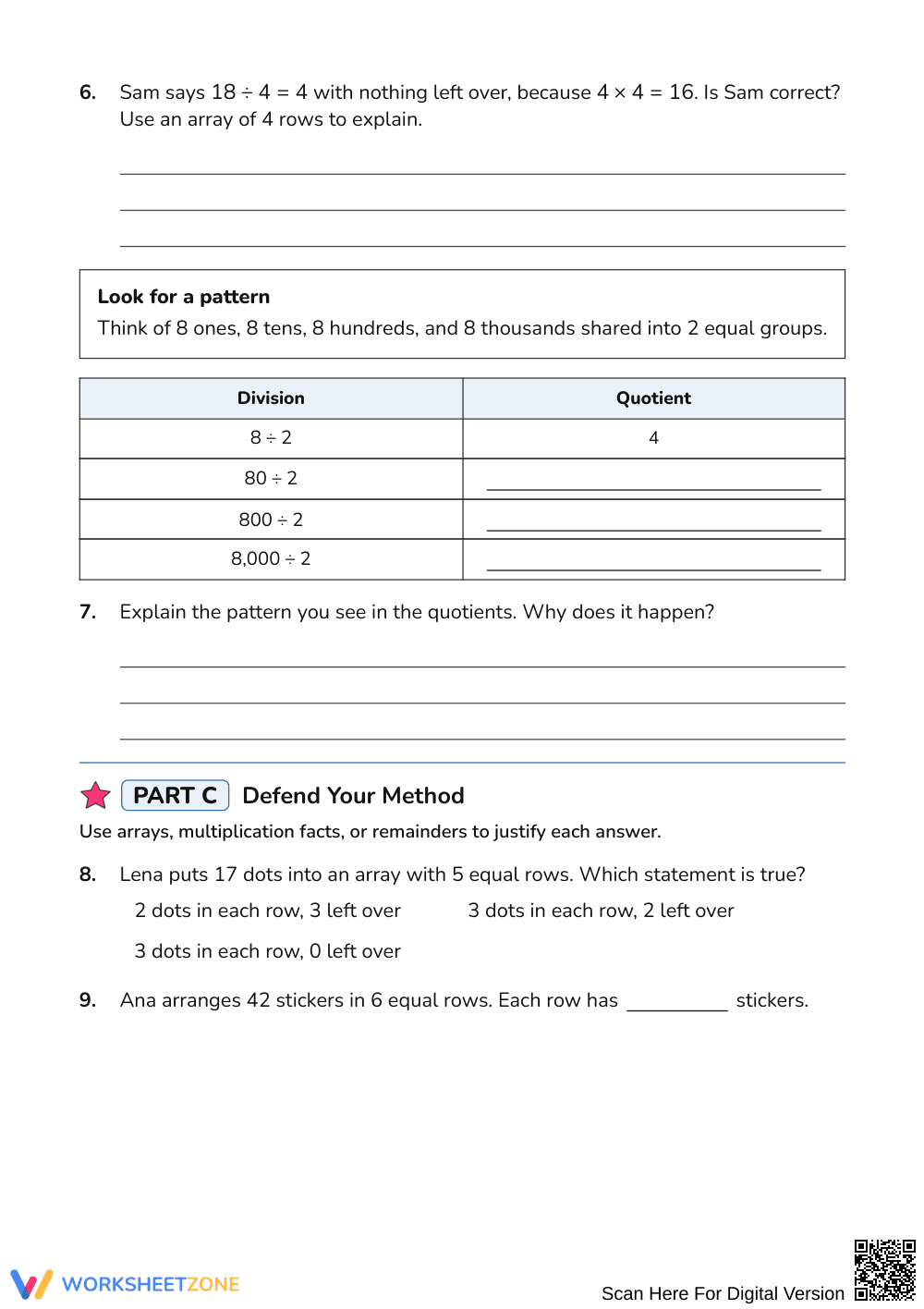
This 3-page resource contains 15 non-routine division problems across three focused sections. Students analyze dot arrays, evaluate true-or-false claims, discover quotient patterns, and justify division methods with remainders. A complete 3-page answer key provides worked explanations and sample written proofs for every item.
Skill Progression
- Guided Practice (Part A — 4 problems): Students examine visual dot arrays, link multiplication facts to division, and explain why distinct arrays represent identical dividends.
- Supported Practice (Part B — 5 problems): Students assess true-or-false division statements, explain remainders using partial arrays, and identify base-ten quotient patterns.
- Independent Practice (Part C — 6 problems): Learners independently defend division solutions, evaluate remainder scenarios, and explain inverse relationships.
This sequence implements a gradual-release model, moving students from guided visual analysis to independent written justification.
Standards Alignment
This worksheet aligns directly to 4.NBT.B.6: Find whole-number quotients and remainders with up to four-digit dividends and one-digit divisors using arrays and properties of operations. It also supports standard 4.OA.A.3 through remainder interpretation and multi-step reasoning. Both standard codes can be copied directly into lesson plans, IEP goals, or district curriculum mapping tools.
How to Use It
Implement this resource during mid-unit practice or immediately after direct instruction on arrays and remainders. Display Part A for whole-class discussion, then have students complete Parts B and C in pairs or independently. During independent work, observe whether students connect remainders to leftover dots outside complete rows. The 15 tasks take approximately 30 to 45 minutes to complete.
Who It's For
This resource supports Grade 4 math classrooms, Tier 2 intervention groups, and students requiring conceptual reinforcement with division. Provide physical counters for learners needing tactile support, and offer extended generalization questions for advanced students. Pair this activity with an anchor chart illustrating inverse multiplication facts and remainder models.
According to Fisher & Frey (2014), purposeful gradual-release instruction combined with structured student justification accelerates conceptual mathematical understanding far more effectively than isolated procedural drills. This Grade 4 mathematics resource directly aligns with standard 4.NBT.B.6, guiding students to compute whole-number quotients and analyze remainders through visual arrays and properties of operations. Rather than executing mechanical long division steps, learners engage in non-routine problem solving where they critique division claims, explain base-ten quotient patterns, and justify why specific configurations yield remainders. The structured shift from guided visual analysis to independent written defense fosters rigorous mathematical reasoning and verbal articulation. By grounding abstract division in concrete dot arrays and inverse multiplication facts, the resource provides educators with actionable diagnostic insight into student conceptual mastery, making it an indispensable asset for standards-aligned Tier 1 core instruction, targeted interventions, and progress monitoring.


