
































Divide Using Arrays: Complete Patterns & Missing Values

Paste this activity's link or code into your existing LMS (Google Classroom, Canvas, Teams, Schoology, Moodle, etc.).
Students can open and work on the activity right away, with no student login required.
You'll still be able to track student progress and results from your teacher account.
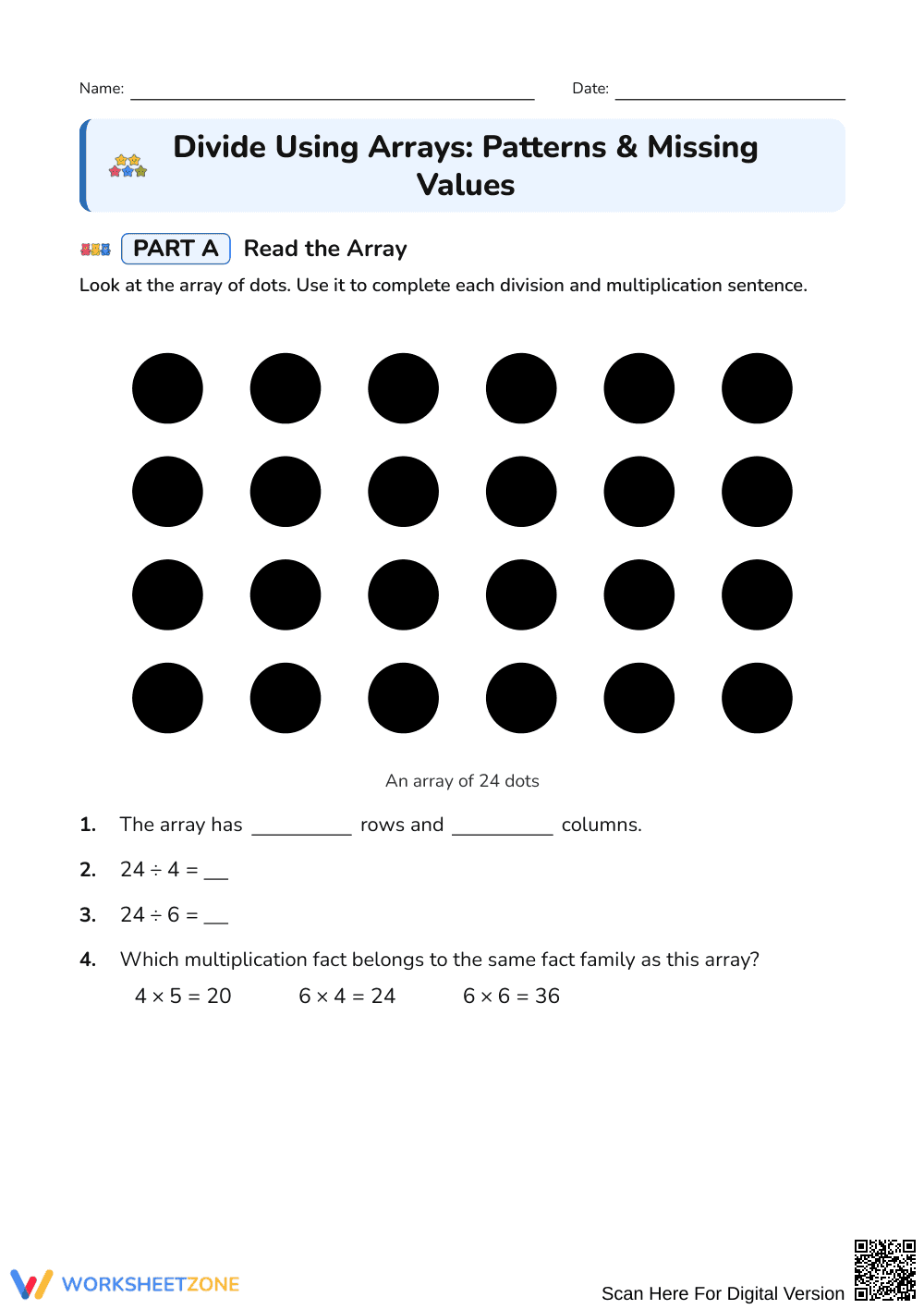
This Grade 4 division worksheet helps students master multi-digit division using visual array models, missing-value tables, and base-ten patterns. Learners connect multiplication fact families to division equations, interpret remainders with concrete arrays, and write mathematical justifications to build lasting procedural fluency.
At a Glance
- Grade: 4 · Subject: Math
- Standard:
4.NBT.B.6— Find whole-number quotients and remainders using arrays and place value strategies- Skill Focus: Array Division & Missing Values
- Format: 3 pages · 24 problems · Answer key included · PDF
- Best For: Small-group guided math and intervention
- Time: 35–45 minutes
What's Inside
Across 3 pages, this resource delivers 24 structured problems covering array interpretation, missing-value tables, base-ten pattern extensions, and remainder analysis. A complete 3-page answer key provides step-by-step solutions and model explanations for efficient review.
Skill Progression
- Guided Practice (Part A & B, 11 problems): High support. Students interpret dot arrays to complete fact families and complete tables showing place-value quotient patterns.
- Supported Practice (Part C, 7 problems): Moderate support. Learners analyze arrays with leftover dots to interpret remainders and verify division with multiplication checks.
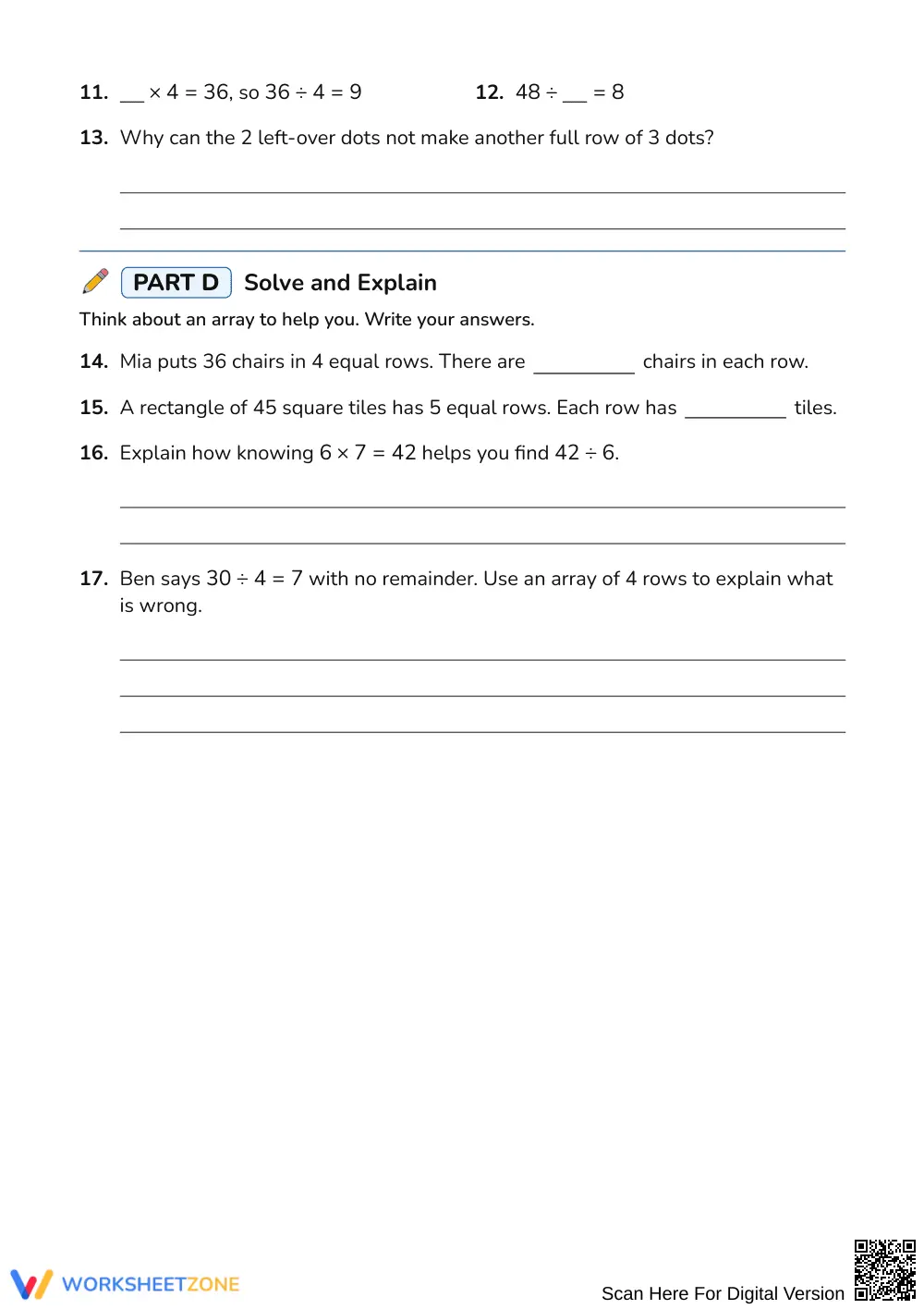
- Independent Practice (Part D, 6 problems): Low support. Students independently solve word problems, sketch tile models, and critique common division errors.
This gradual-release structure transitions learners smoothly from teacher modeling to autonomous problem solving.
Standards Alignment
This worksheet aligns to `4.NBT.B.6`: Find whole-number quotients and remainders with up to four-digit dividends and one-digit divisors using array models and place value properties. It also supports 4.OA.A.3 through multi-step problem solving. Both standard codes can be copied directly into lesson plans, IEP goals, or district curriculum mapping tools.
How to Use It
Use Part A and Part B during guided small-group instruction to reinforce fact families. Assign Part C and Part D as a formative assessment check during independent practice. Observe whether students recognize that remainders must remain smaller than the divisor. Expect completion within 35 to 45 minutes.
Who It's For
This resource supports Grade 4 learners building division fluency and Grade 5 students needing Tier 2 intervention. Visual models provide strong access for English language learners. Pair this printable with physical square tiles or a reference multiplication chart.
According to Fisher & Frey (2014), purposeful gradual-release instruction significantly accelerates student mastery of complex multi-step mathematical procedures. Grounded in standard 4.NBT.B.6, this 3-page Grade 4 mathematics resource targets finding whole-number quotients and remainders using structured array models, place value patterns, and inverse multiplication relationships. By transitioning from concrete dot arrays to semi-abstract missing-value tables and independent written justification, the 24 problems systematically bridge conceptual understanding with procedural fluency. Students investigate why remainders must be strictly less than the divisor, analyze quotient scaling by multiples of 10, and construct written arguments evaluating mathematical statements. The accompanying 3-page answer key supports rigorous formative feedback, ensuring educators can diagnose place-value errors immediately. This structured visual progression validates effective scaffolded design, equipping elementary learners to explain mathematical reasoning clearly while building a resilient foundation for long division algorithms.


