































Divide Using Arrays: Complete Multiple Representations

Paste this activity's link or code into your existing LMS (Google Classroom, Canvas, Teams, Schoology, Moodle, etc.).
Students can open and work on the activity right away, with no student login required.
You'll still be able to track student progress and results from your teacher account.
This Grade 4 math worksheet develops conceptual division understanding by guiding students to translate between visual dot arrays, area models, word descriptions, and equations. Through 26 targeted problems, learners link equal groupings to multiplication and division, interpret remainders visually, and connect spatial dimensions directly to quotients.
At a Glance
- Grade: 4 · Subject: Math
- Standard:
4.NBT.B.6— Find whole-number quotients and remainders with place value strategies using arrays and area models- Skill Focus: Translating dividing using arrays across words, symbols, and equations
- Format: 3 pages · 26 problems · Answer key included · PDF
- Best For: Small-group guided practice, reteaching, and conceptual math intervention
- Time: 35–45 active instructional minutes
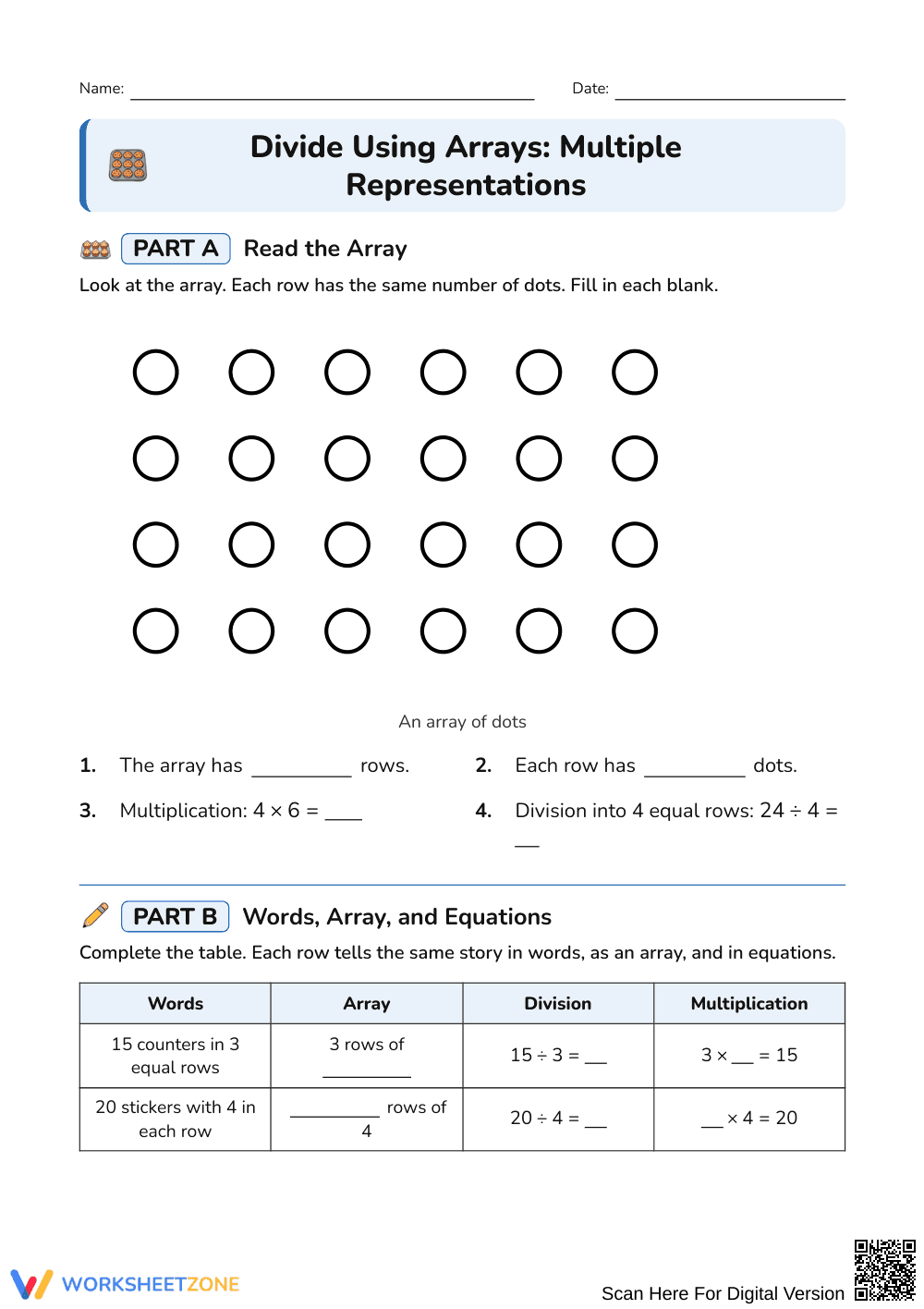
This 3-page printable features 26 problems partitioned into four distinct sections. Part A introduces array reading with dot arrays. Part B provides an equivalence table linking words, arrays, and division equations. Part C covers arrays with remainders alongside area model decompositions. Part D delivers conceptual multiple-choice items and written response questions. A full 3-page answer key provides complete solutions.
Skill Progression
- Guided practice (Part A): Students examine visual dot arrays to identify rows, items per row, and reciprocal division equations with scaffolded blanks.
- Supported practice (Parts B & C): Learners populate multi-representation tables and analyze area models with remainders to decompose two-digit dividends.
- Independent practice (Part D): Students independently select corresponding arrays, write equations for contextual word problems, and explain inverse operations.
This sequence mirrors the gradual release of responsibility model, guiding students smoothly from visual scaffolding to abstract problem-solving.
Standards Alignment
This worksheet aligns directly to 4.NBT.B.6: Find whole-number quotients and remainders with up to four-digit dividends and one-digit divisors, using strategies based on place value, the properties of operations, and the relationship between multiplication and division. The tasks also reinforce supporting standard 4.OA.A.1 by interpreting multiplication equations as comparisons. Both standard codes can be copied directly into lesson plans, IEP goals, or district curriculum mapping tools.
How to Use It
Use this worksheet after direct instruction on rectangular arrays. During small-group instruction, use Parts A and B to assess how students link rows to factors. Then assign Parts C and D for independent practice or partner work. As a formative assessment tip, observe whether learners count individual dots or multiply dimensions when finding totals. Expect completion within 35 to 45 minutes.
Who It's For
This resource targets Grade 4 students learning division concepts and Grade 5 students needing multi-digit intervention. Visual scaffolds support English learners and students with IEP accommodations. Pair this worksheet with two-color counters or an anchor chart showing array dimensions before beginning symbolic long division.
Grade 4 students mastering 4.NBT.B.6 must connect visual arrays, area models, and symbolic equations to understand multi-digit division deeply. According to Fisher & Frey (2014), instructional frameworks that deliberately structure transitions from guided modeling to independent problem-solving significantly increase conceptual retention in elementary mathematics. Translating dividing using arrays across words, symbols, tables, diagrams, and equations prevents the common misconception that division is merely an isolated algorithmic procedure. By grounding partial quotients in spatial area representations and explicit row-and-column arrays, students construct durable mental schemas for how dividends break into equal groups. Furthermore, empirical findings show that multiple representations strengthen problem-solving flexibility and mathematical discourse, enabling fourth graders to justify quotients with remainders with confidence. This targeted practice equips elementary educators with an aligned resource that moves learners systematically from concrete visualization to abstract algebraic reasoning.


