































Divide Using Arrays: Complete Multi-Step Problems

Paste this activity's link or code into your existing LMS (Google Classroom, Canvas, Teams, Schoology, Moodle, etc.).
Students can open and work on the activity right away, with no student login required.
You'll still be able to track student progress and results from your teacher account.
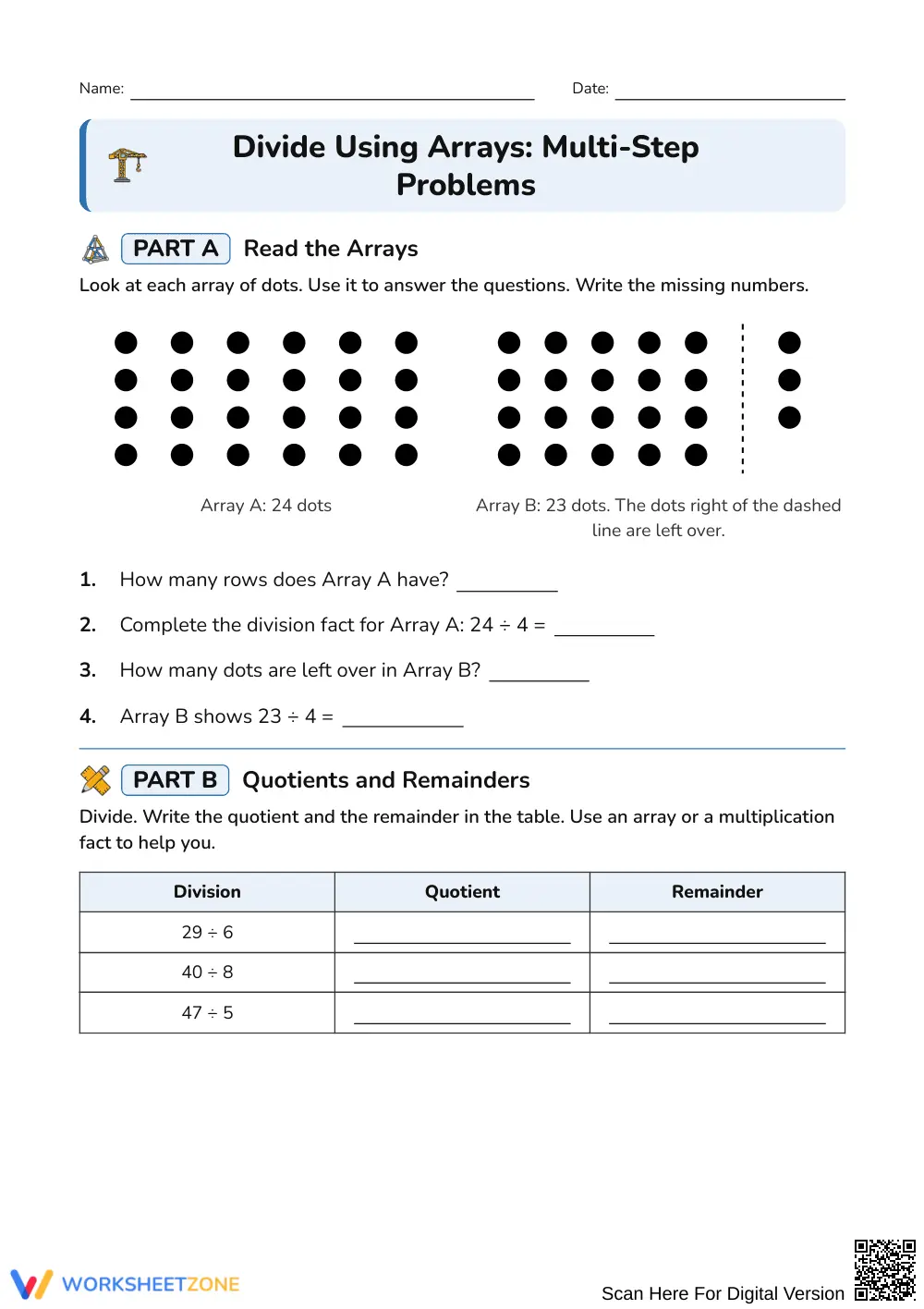
This Grade 4 math worksheet develops division skills by connecting visual dot arrays directly to multi-step word problems with remainders. Students analyze equal rows, compute quotients and remainders in tables, and solve contextual tasks requiring prior addition or multiplication before dividing accurately.
At a Glance
- Grade: 4 · Subject: Math
- Standard:
4.NBT.B.6— Divide whole numbers and find remainders using visual arrays or area models- Skill Focus: Multi-step division problems with arrays
- Format: 2 student pages · 18 total problems · Full answer key included · PDF
- Best For: Guided practice and targeted small group intervention
- Time: 30–45 minutes
What's Inside
This two-page resource contains 18 structured problems across three sections. Part A uses dot arrays to model basic quotients and remainders. Part B provides a computation table for division facts. Part C features multi-step word problems with sketch spaces, remainder interpretations, and mathematical reasoning. A complete two-page answer key provides step-by-step solutions.
Skill Progression
- Guided Practice (Part A, 4 tasks): Students examine visual dot arrays with dashed remainder partitions to identify rows and write division facts.
- Supported Practice (Part B, 6 tasks): Learners fill in quotient-and-remainder tables using multiplication facts and mental arrays.
- Independent Practice (Part C, 8 tasks): Fourth graders solve multi-step problems, sketch models, interpret remainders for bus seating, and critique sample student work.
This progression follows an I Do, We Do, You Do gradual-release model, building independence from visual arrays to multi-step word problems.
Standards Alignment
Aligned to `4.NBT.B.6`: Find whole-number quotients and remainders with up to four-digit dividends and one-digit divisors using arrays or area models. The multi-step word problems also support `4.OA.A.3` by requiring students to solve multi-step problems and interpret practical remainders. Both standard codes can be copied directly into lesson plans, IEP goals, or district curriculum mapping tools.
How to Use It
Use Parts A and B during direct instruction to reinforce visual array representations. Assign Part C after instruction for independent practice or partner problem-solving. During the bus problem, observe whether students round up the remainder to ensure every child gets a seat. Completion takes 30 to 45 minutes.
Who It's For
This worksheet is designed for fourth-grade general math classes, Tier 2 intervention, and special education support. Students needing scaffolds can use physical counters alongside an array anchor chart, while advanced learners can write original multi-step word problems with remainders.
According to Fisher & Frey (2014), structured cognitive scaffolding combined with intentional gradual release accelerates mathematical mastery by bridging concrete representations with abstract problem-solving routines. This Grade 4 instructional resource directly operationalizes standard 4.NBT.B.6 by guiding fourth-grade students through multi-step division problems and quotient calculations using visual dot arrays and area models. By progressing from heavily supported visual models to independent multi-step operational tasks, learners systematically master dividing whole numbers, identifying equal groupings, and interpreting remainders within real-world scenarios. Students not only compute numerical quotients and remainders accurately but also justify their mathematical thinking through multiplication checks and analytical error critique. This purposeful pedagogical sequence prevents premature abstraction, reinforces conceptual place-value understanding, and provides classroom educators with reliable formative assessment data to confirm robust student mastery of multi-step arithmetic across diverse elementary learning environments.


