































Divide Using Arrays: Complete Mixed Review

Paste this activity's link or code into your existing LMS (Google Classroom, Canvas, Teams, Schoology, Moodle, etc.).
Students can open and work on the activity right away, with no student login required.
You'll still be able to track student progress and results from your teacher account.
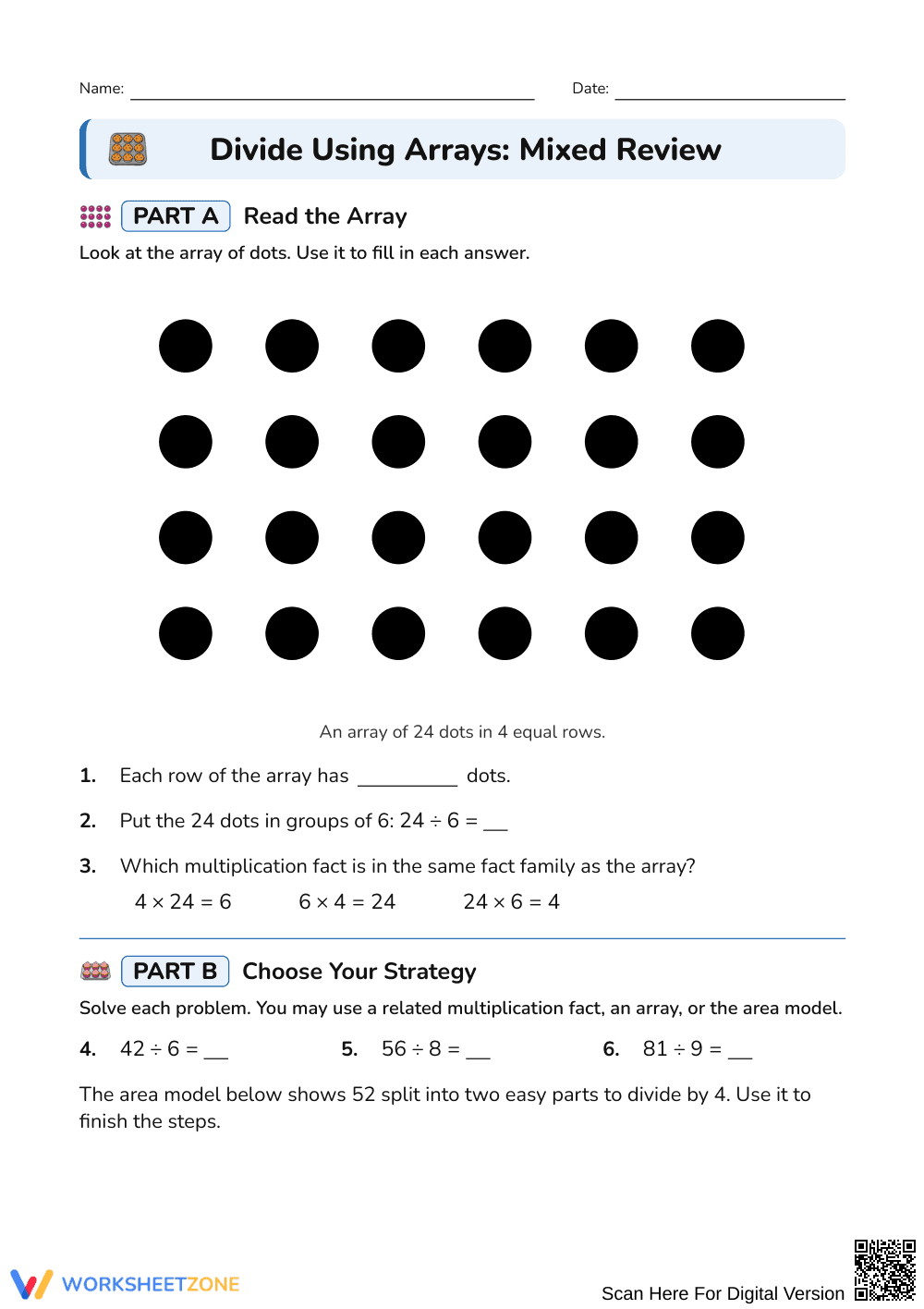
This Grade 4 math worksheet builds conceptual understanding and procedural fluency with division through array representations. Across 18 structured problems, students interpret dot arrays, apply area models to decompose dividends, solve contextual word problems with remainders, and justify their mathematical reasoning in writing.
At a Glance
- Grade: 4 · Subject: Math
- Standard:
4.NBT.B.6— Find whole-number quotients and remainders using arrays, area models, and multiplication equations- Skill Focus: Array-based division review across multiple visual representations
- Format: 3 student pages · 18 structured problems · Full answer key included · PDF
- Best For: Post-instruction review and formative assessment
- Time: 35–45 minutes total completion time
What's Inside
The 3-page printable resource features 18 division tasks across four targeted parts. Students analyze dot arrays, complete decomposing area models, evaluate multiple-choice equations, compute quotients with remainders in real-world contexts, and write error-analysis justifications. A complete 3-page answer key is included.
Skill Progression
- Guided practice (Part A, 4 problems): Students analyze dot arrays to identify equal rows, write division equations, and connect related multiplication facts.
- Supported practice (Parts B & C, 8 problems): Learners choose flexible strategies, complete area models, solve contextual word problems, and calculate quotients with remainders.
- Independent practice (Part D, 6 problems): Students work without visual aids to evaluate calculation errors, justify equal sharing, and explain remainders in writing.
This sequence implements gradual release, transitioning students from visual modeling to independent reasoning.
Standards Alignment
This resource aligns directly with primary standard `4.NBT.B.6`: Find whole-number quotients and remainders with up to four-digit dividends and one-digit divisors, using strategies based on place value, operations, and the multiplication-division relationship; illustrate and explain using equations, arrays, and area models. It also supports standard `3.OA.B.6` through multiplication fact families. Both standard codes can be copied directly into lesson plans, IEP goals, or district curriculum mapping tools.
How to Use It
Use this worksheet after direct instruction for targeted consolidation. During independent practice, observe whether students connect multiplication facts to arrays in Part B or rely on counting individual dots. Alternatively, assign Parts C and D as a diagnostic check. Completion takes approximately 35 to 45 minutes.
Who It's For
This resource supports Grade 4 general education classrooms, math intervention groups, and special education students working toward standards-based IEP goals. Pair this worksheet with physical counters or an array anchor chart for targeted remediation.
Mastering multi-digit division under standard 4.NBT.B.6 requires fourth-grade students to bridge concrete visual representations with abstract algorithmic procedures. By combining dot arrays, decomposing area models, and contextual remainder problems, this worksheet systematically strengthens the conceptual link between multiplication fact families and division operations. According to Fisher & Frey (2014), structured gradual-release frameworks that transition from guided visual modeling to independent written justification produce substantial gains in mathematical fluency and long-term conceptual retention. Students who regularly manipulate arrays and area models develop flexible decomposition strategies that prevent common elementary misconceptions, such as ignoring remainders or misidentifying divisor-quotient relationships. Implementing these 18 targeted tasks during post-instruction consolidation ensures learners articulate mathematical reasoning and evaluate procedural errors. Consequently, systematic practice with multiple visual models equips fourth-grade learners to tackle complex multi-step division problems with measurable confidence.


