































Divide Using Area Models: Complete Accuracy Practice

Paste this activity's link or code into your existing LMS (Google Classroom, Canvas, Teams, Schoology, Moodle, etc.).
Students can open and work on the activity right away, with no student login required.
You'll still be able to track student progress and results from your teacher account.
This Grade 4 math worksheet develops fluency in dividing multi-digit numbers using area models. Learners decompose dividends into partial areas, apply multiplication facts, and compute whole-number quotients with and without remainders. The structured exercises build conceptual understanding across 17 targeted division tasks.
At a Glance
- Grade: 4 · Subject: Math
- Standard:
4.NBT.B.6— Find whole-number quotients and remainders using strategies based on place value and area models- Skill Focus: Dividing multi-digit dividends using area models
- Format: 2 pages · 17 problems · Answer key included · PDF
- Best For: Independent practice and skill reinforcement
- Time: 25–35 minutes
What's Inside
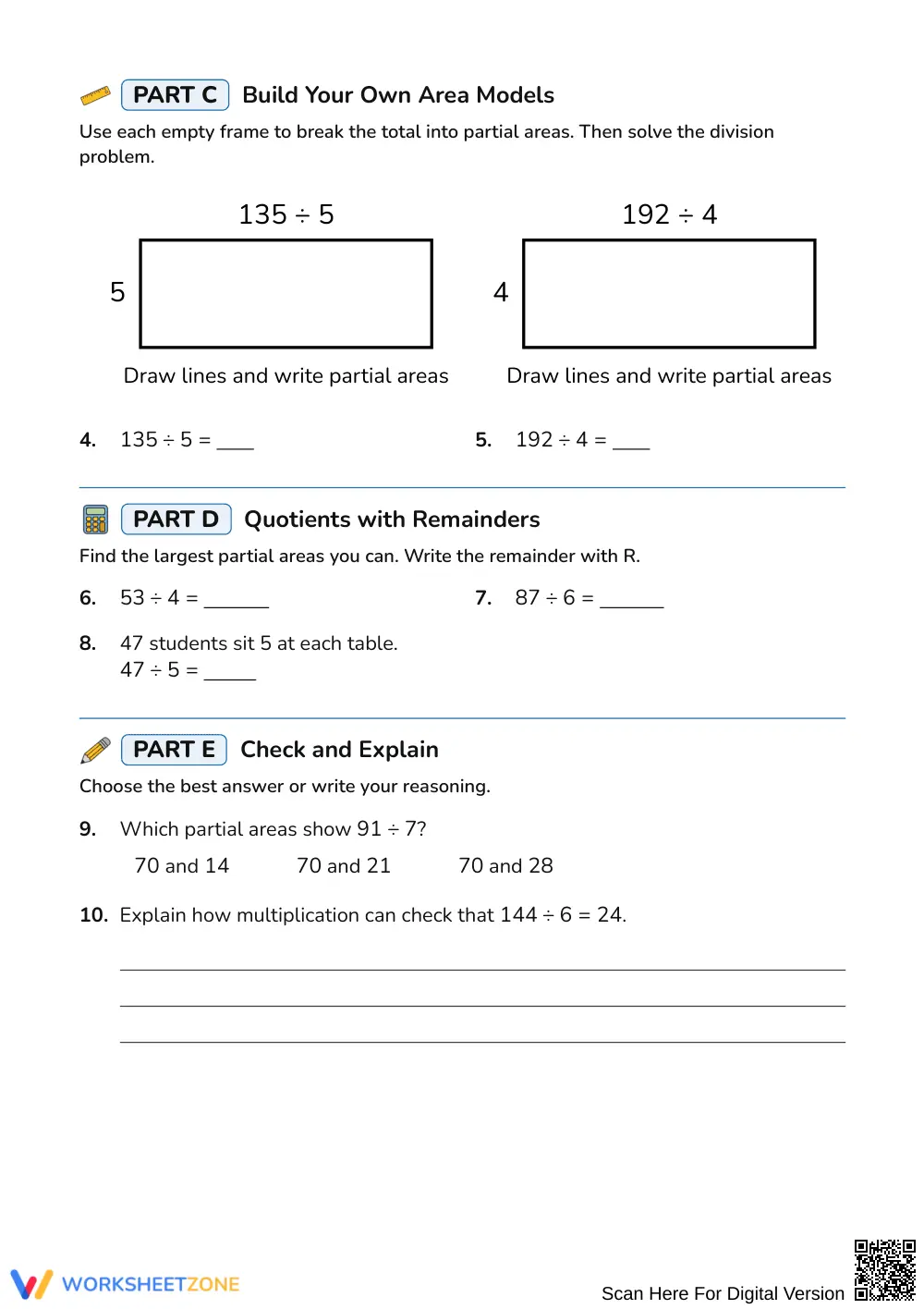
The 2-page worksheet features 17 problems distributed across five sections. Students work with pre-partitioned visual frames, partial area tables, self-drawn rectangular models, and word problems with remainders. A complete 2-page answer key provides step-by-step partial area breakdowns and final quotients for efficient grading.
Skill Progression
- Guided practice (Part A): Students examine an area model, subtracting partial products to calculate remaining area and determine the quotient.
- Supported practice (Parts B and C): Learners complete partial area decomposition tables and sketch area frames for two- and three-digit dividends.
- Independent practice (Parts D and E): Students solve division problems with remainders and explain inverse relationships using multiplication.
This sequence follows a gradual-release instructional model that transitions students from visual scaffolds to independent mastery.
Standards Alignment
This worksheet aligns directly to `4.NBT.B.6`, which requires students to find whole-number quotients and remainders with up to four-digit dividends and one-digit divisors using area models and place value properties. Part D also reinforces `4.OA.A.3` by solving multi-step word problems involving whole numbers and remainders. Both standard codes can be copied directly into lesson plans, IEP goals, or district curriculum mapping tools.
How to Use It
Use this resource during independent practice following direct instruction with base-ten representations. It also works effectively as a mid-unit review before assessments. Formative observation tip: circulate during Part C to verify students choose partial products that are clean multiples of the divisor. Expected completion time is 25 to 35 minutes.
Who It's For
This worksheet is designed for Grade 4 math students solidifying division, as well as Grade 5 students needing targeted intervention. Support emerging learners by providing grid paper before they construct freehand frames. Pair this activity with an anchor chart illustrating common divisor multiplication facts.
According to research by Fisher & Frey (2014) on the gradual release of responsibility, structured shifts from guided visual prompts to independent application significantly enhance student retention and mathematical accuracy. This Grade 4 worksheet operationalizes that instructional framework to master standard 4.NBT.B.6, guiding learners to find whole-number quotients and remainders using rectangular area models and place-value decomposition. By systematically reducing visual supports from pre-partitioned diagrams in early tasks to student-constructed frames in later sections, the resource ensures students internalize the conceptual connection between multi-digit multiplication and division. Empirical findings in elementary mathematics instruction confirm that explicit visual representations prevent the procedural errors commonly observed when students transition to abstract algorithms. Teachers can deploy this verified 17-problem sequence to ensure every student develops both accurate computational fluency and conceptual depth aligned with rigorous state standards.


