


























Views
Downloads
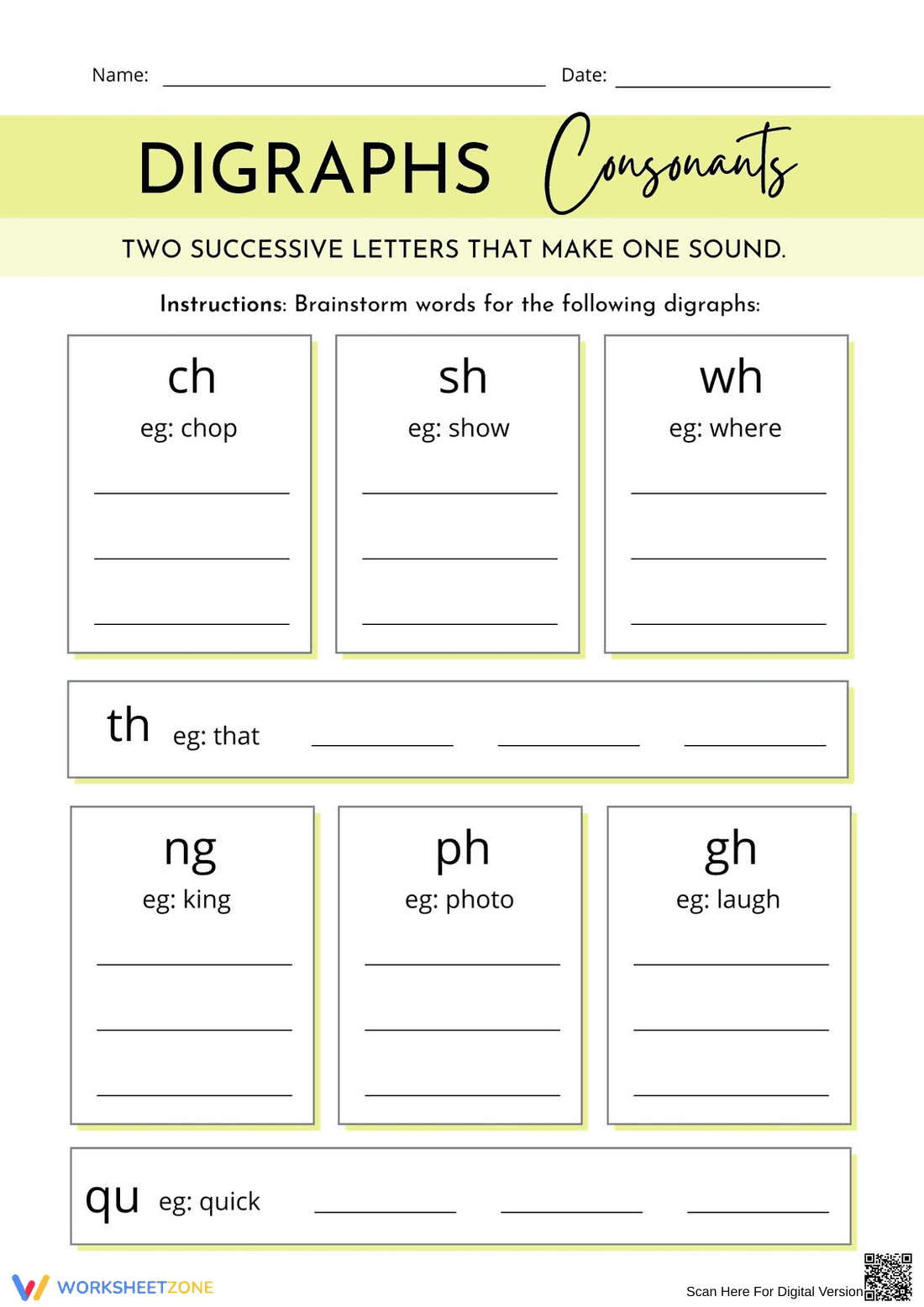

Grade 1 Consonant Digraphs — Printable No-Prep Worksheet
Paste this activity's link or code into your existing LMS (Google Classroom, Canvas, Teams, Schoology, Moodle, etc.).
Students can open and work on the activity right away, with no student login required.
You'll still be able to track student progress and results from your teacher account.
This Grade 1 phonics worksheet prompts students to brainstorm and write words containing common consonant digraphs. By generating their own examples for sounds like "ch," "sh," and "th," early readers actively apply their phonetic knowledge, strengthening both spelling and decoding skills in a single, focused activity.
At a Glance
- Grade: 1 · Subject: ELA
- Standard:
CCSS.ELA-LITERACY.RF.1.3.A— Know spelling-sound correspondences for common consonant digraphs- Skill Focus: Consonant Digraphs
- Format: 1 page · 8 tasks · No answer key · PDF
- Best For: Independent practice
- Time: 10–15 minutes
This single-page resource features eight sections for digraphs: ch, sh, wh, th, ng, ph, gh, and qu. Each provides the target digraph, an example word, and blank lines for brainstormed words. The clean layout minimizes visual clutter, allowing young learners to focus entirely on spelling words that match the phonetic patterns.
Designed for immediate classroom implementation with an efficient workflow:
- Print (1 minute): The single-page PDF format requires minimal ink and prints quickly for the whole class.
- Distribute (1 minute): Hand out the sheets during literacy centers or morning work with no additional materials needed.
- Review (3 minutes): Quickly scan student responses to check for phonetic accuracy and appropriate word choices.
With a total teacher prep time of under two minutes, this worksheet is an excellent addition to emergency sub plans or last-minute phonics review sessions.
This activity is directly aligned to CCSS.ELA-LITERACY.RF.1.3.A, requiring students to know the spelling-sound correspondences for common consonant digraphs. By asking students to produce words rather than just identify them, the task reinforces active recall of these foundational phonetic structures. Both standard codes can be copied directly into lesson plans, IEP goals, or district curriculum mapping tools.
Use this worksheet during independent literacy centers after direct instruction. It serves as an effective application activity where students demonstrate their understanding of newly introduced sounds. Alternatively, use it as a morning work assignment to activate prior knowledge before a phonics lesson. As students work, observe whether they rely on environmental print in the classroom to find words or if they can generate examples from memory. This provides immediate formative data on their phonetic fluency. Expect students to complete the brainstorming process in 10 to 15 minutes.
This worksheet is designed for first-grade students mastering foundational reading skills. It also serves as a valuable review tool for second graders needing reinforcement. For students requiring extra support, allow the use of decodable texts or picture dictionaries to help generate ideas. Pair this activity with a classroom anchor chart displaying common digraphs to provide a visual scaffold during independent work.
Mastering the spelling-sound correspondences for common consonant digraphs, as outlined in CCSS.ELA-LITERACY.RF.1.3.A, is a critical milestone in early literacy development. When students know spelling-sound correspondences for common consonant digraphs, they transition from decoding single letters to recognizing multi-letter chunks, significantly increasing their reading fluency and comprehension. According to Fisher & Frey (2014), providing students with structured opportunities to generate their own examples of phonetic patterns deepens cognitive engagement and improves long-term retention compared to passive identification tasks. This brainstorming worksheet facilitates that active generation, requiring learners to retrieve and apply their phonics knowledge independently without relying on a word bank. By integrating this targeted practice into daily literacy routines, educators can effectively support students in building the automaticity necessary for proficient reading and spelling, ensuring a strong foundation for future academic success across all subject areas.


