


























0
Views
0
Downloads

0.0
0
Save
0 Likes
Share
Different Ways to Start a Story
0 Views
0 Downloads
Paste this activity's link or code into your existing LMS (Google Classroom, Canvas, Teams, Schoology, Moodle, etc.).
Students can open and work on the activity right away, with no student login required.
You'll still be able to track student progress and results from your teacher account.
Information
Description
What It Is:
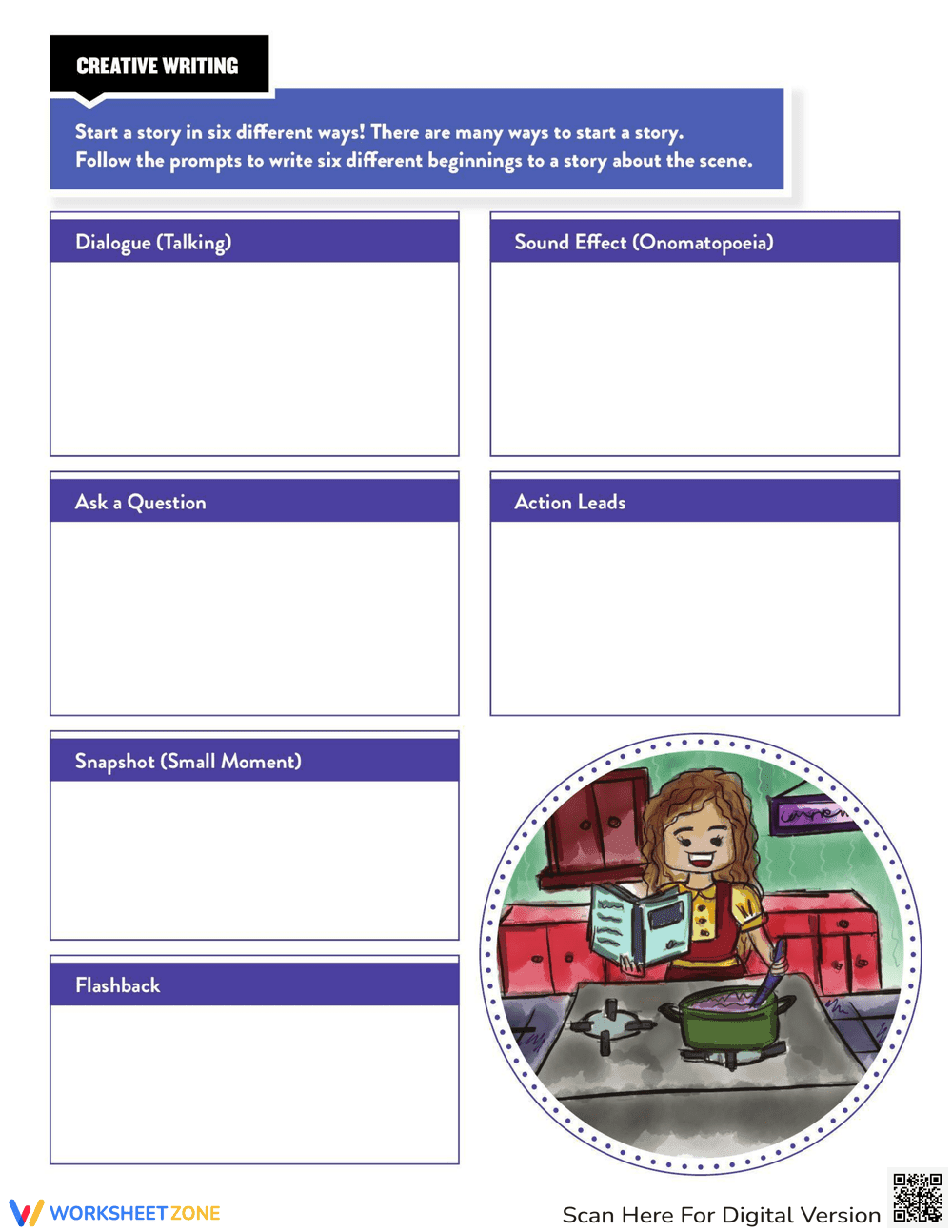
This is a creative writing worksheet designed to help students explore different ways to begin a story. It provides six prompts: Dialogue (Talking), Sound Effect (Onomatopoeia), Ask a Question, Action Leads, Snapshot (Small Moment), and Flashback. Each prompt has a blank space for students to write their story beginnings. The worksheet also includes a picture of a girl in a kitchen setting, seemingly cooking.
Grade Level Suitability:
This worksheet is suitable for grades 3-6. The prompts are simple enough for younger students to understand and use, while still offering a creative challenge for older elementary students. The focus on different story beginnings makes it a good tool for teaching narrative writing techniques.
Why Use It:
Using this worksheet encourages students to think creatively and experiment with various writing styles. It helps them understand that there are multiple ways to start a story and allows them to practice different techniques like using dialogue, onomatopoeia, questions, and action to engage the reader. It also helps with descriptive writing by prompting students to create snapshots.
How to Use It:
Students should read the instructions and the six prompts provided. For each prompt, they should write a short story beginning based on the image or their own imagination. Encourage students to use vivid language and descriptive details in their writing. Each box corresponds to a different type of beginning.
Target Users:
This worksheet is ideal for elementary school students, particularly those in grades 3-6, who are learning about creative writing and narrative techniques. It can be used in the classroom or as a homework assignment to enhance writing skills. It is also beneficial for students who need help with brainstorming and generating ideas for story beginnings.
This is a creative writing worksheet designed to help students explore different ways to begin a story. It provides six prompts: Dialogue (Talking), Sound Effect (Onomatopoeia), Ask a Question, Action Leads, Snapshot (Small Moment), and Flashback. Each prompt has a blank space for students to write their story beginnings. The worksheet also includes a picture of a girl in a kitchen setting, seemingly cooking.
Grade Level Suitability:
This worksheet is suitable for grades 3-6. The prompts are simple enough for younger students to understand and use, while still offering a creative challenge for older elementary students. The focus on different story beginnings makes it a good tool for teaching narrative writing techniques.
Why Use It:
Using this worksheet encourages students to think creatively and experiment with various writing styles. It helps them understand that there are multiple ways to start a story and allows them to practice different techniques like using dialogue, onomatopoeia, questions, and action to engage the reader. It also helps with descriptive writing by prompting students to create snapshots.
How to Use It:
Students should read the instructions and the six prompts provided. For each prompt, they should write a short story beginning based on the image or their own imagination. Encourage students to use vivid language and descriptive details in their writing. Each box corresponds to a different type of beginning.
Target Users:
This worksheet is ideal for elementary school students, particularly those in grades 3-6, who are learning about creative writing and narrative techniques. It can be used in the classroom or as a homework assignment to enhance writing skills. It is also beneficial for students who need help with brainstorming and generating ideas for story beginnings.


