


























Views
Downloads

Complete Decimal Mastery: Expand, Convert, Order | Grade 5
Paste this activity's link or code into your existing LMS (Google Classroom, Canvas, Teams, Schoology, Moodle, etc.).
Students can open and work on the activity right away, with no student login required.
You'll still be able to track student progress and results from your teacher account.
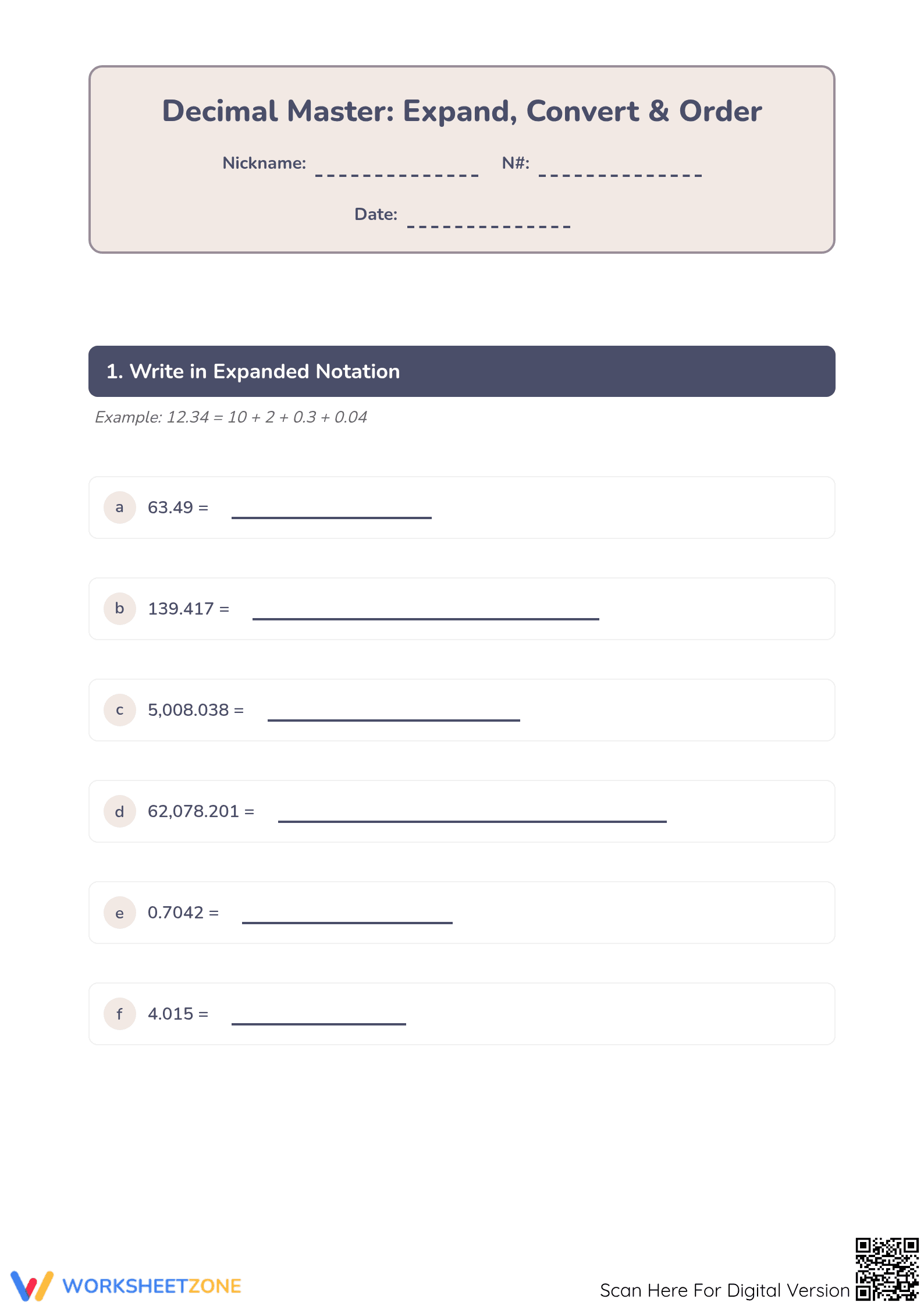
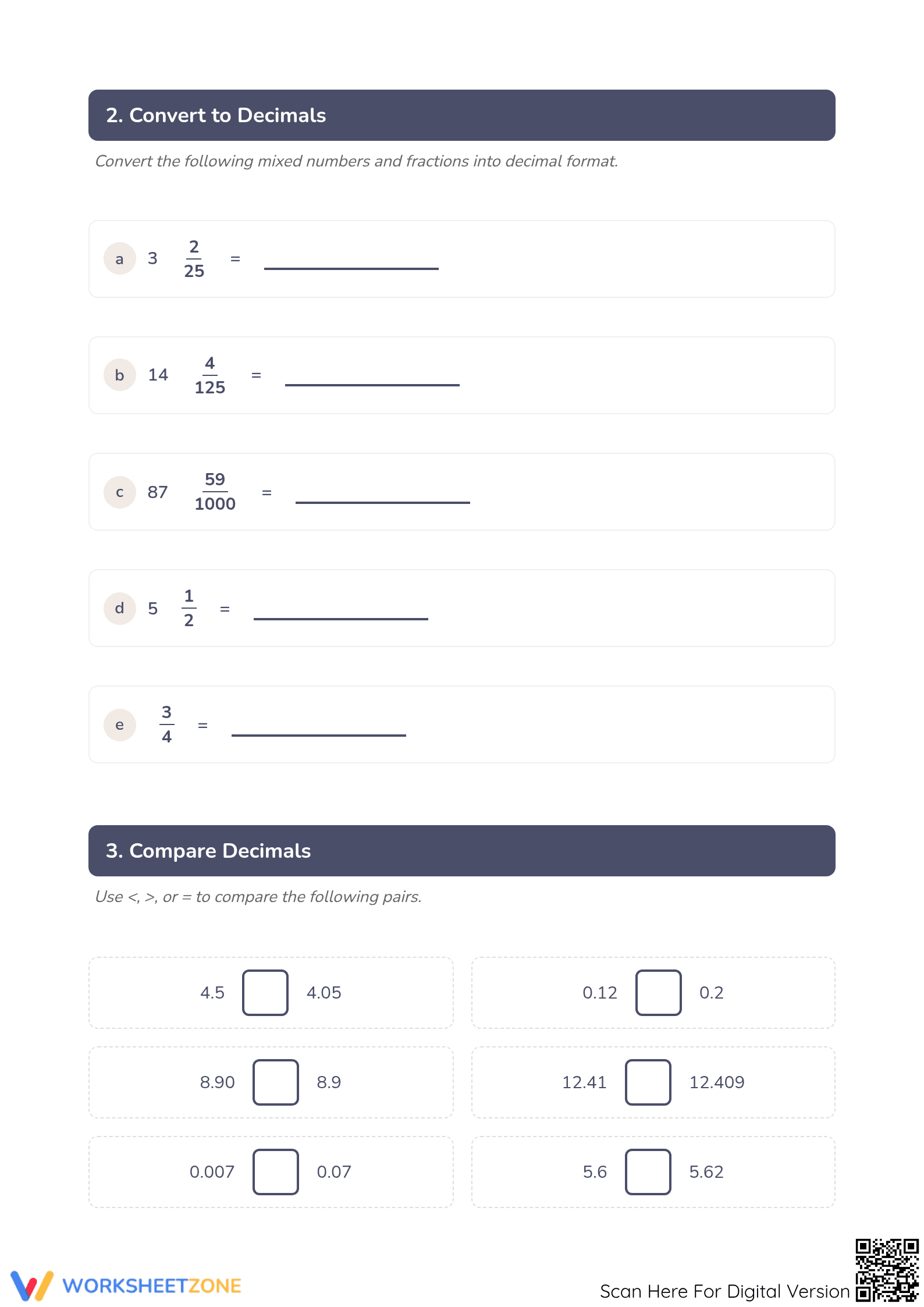
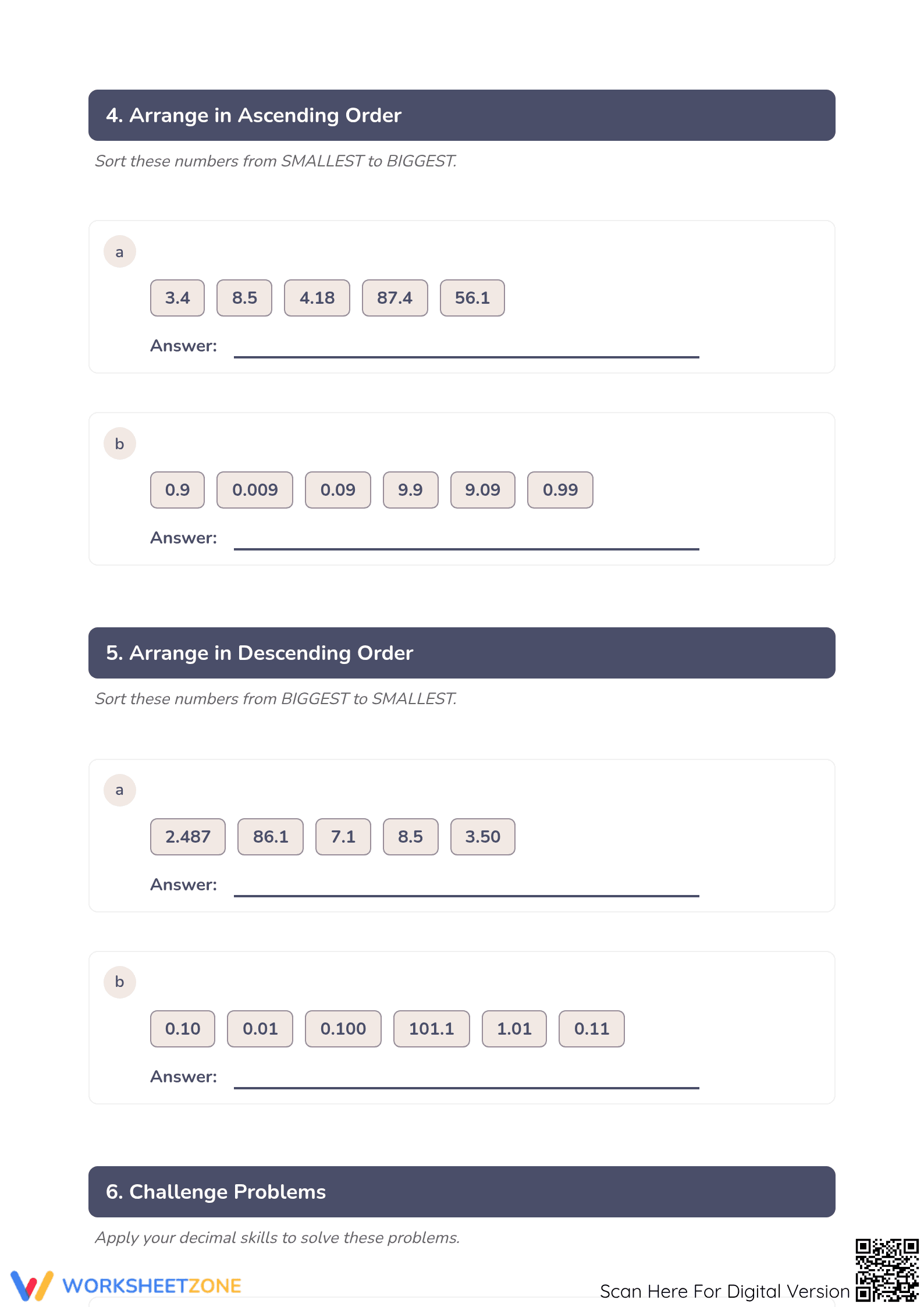
This comprehensive decimal packet provides students with focused practice in the essential 5th-grade skills of expanded form, fraction-to-decimal conversion, and numerical ordering. By engaging with 54 varied problems across four structured pages, learners build a robust understanding of place value and decimal relationships, ensuring proficiency in foundational mathematical concepts before moving toward operations.
At a Glance
- Grade: 5 · Subject: Math
- Standard:
CCSS.MATH.CONTENT.5.NBT.A.3— Read, write, and compare decimals to thousandths using expanded form and inequality symbols- Skill Focus: Decimal Place Value and Comparison
- Format: 4 pages · 54 problems · Answer key included · PDF
- Best For: Small group instruction and independent practice
- Time: 45–60 minutes
What's Inside
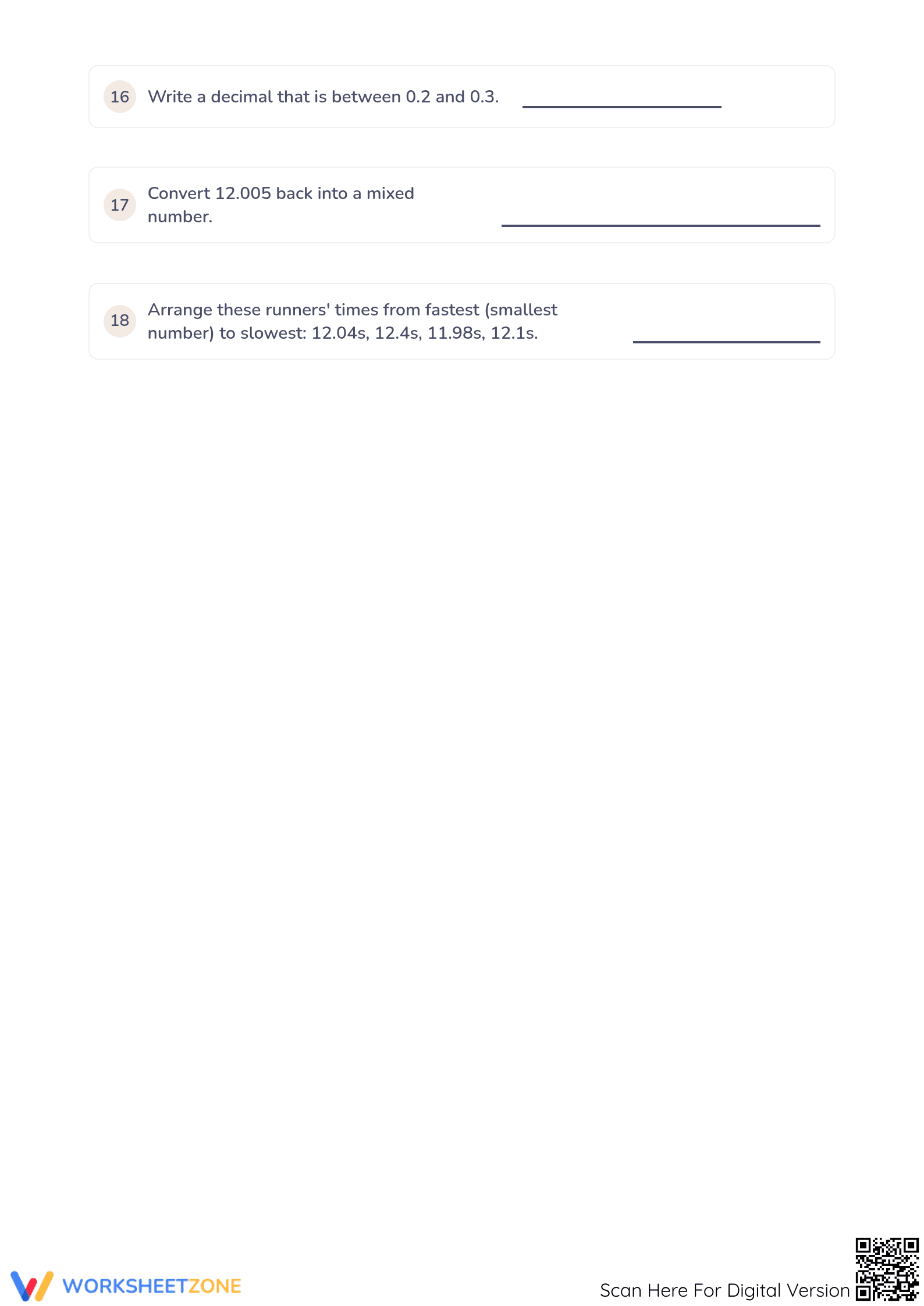
This four-page PDF resource includes a multi-faceted approach to decimal mastery. Students transition from writing decimals in expanded notation to converting between fractions and decimals, concluding with complex ordering tasks. The layout is clean and distraction-free, providing ample white space for student calculations and place value charts. A full four-page answer key is included for rapid grading or student self-correction.
Skill Progression
- Guided Practice: The first page features 12 problems focused on expanded form, allowing students to break down decimals into their constituent place values using addition.
- Supported Practice: Pages two and three move into conversion and ordering, providing 30 problems where students apply their knowledge of tenths and hundredths to compare magnitudes.
- Independent Practice: The final 12 problems challenge students to synthesize their skills by converting between number names, expanded forms, and standard notation.
This gradual-release model follows the proven "I Do, We Do, You Do" instructional framework, moving students from basic identification to higher-order application.
Standards Alignment
This worksheet is primarily aligned with CCSS.MATH.CONTENT.5.NBT.A.3, which requires students to read, write, and compare decimals to thousandths. Specifically, it addresses sub-standard 3.a regarding expanded form and 3.b regarding the comparison of decimal magnitudes using place value reasoning. Both standard codes can be copied directly into lesson plans, IEP goals, or district curriculum mapping tools.
How to Use It
Use this packet as a formative assessment after introducing decimal place value concepts. Assign one page per day over a four-day instructional cycle to monitor student progress. Alternatively, use it as a comprehensive review packet before a unit test. Observe students during the ordering tasks to identify common misconceptions regarding longer decimals with smaller values (e.g., 0.125 versus 0.5). The estimated completion time is 45 to 60 minutes for the entire set.
Who It's For
This resource is designed for Grade 5 students, though it serves as excellent remediation for Grade 6 or enrichment for Grade 4. It pairs naturally with place value anchor charts or a direct instruction lesson on the relationship between powers of ten and decimal placement in the base-ten system.
According to the ScienceDirect TpT Analysis (2024), structured worksheet packets that emphasize the transition between multiple representations of decimals—such as expanded form, fractions, and standard notation—significantly improve long-term retention of place value concepts. This Grade 5 worksheet addresses the cognitive demands of CCSS.MATH.CONTENT.5.NBT.A.3 by requiring students to decode decimal values beyond simple surface-level recognition. Research indicates that when students practice comparing decimals through ordering tasks, they develop a more sophisticated mental number line, which is a critical predictor of success in middle school rational number operations. By providing 54 targeted tasks that bridge the gap between abstract notation and numerical magnitude, this resource supports the scaffolding necessary for students to master the complexities of the base-ten system. This evidence-based approach ensures that learners are prepared for more advanced topics in the mathematical curriculum.


