


























Views
Downloads

Natural Selection Worksheet | Essential Grade 9-12 Biology
Paste this activity's link or code into your existing LMS (Google Classroom, Canvas, Teams, Schoology, Moodle, etc.).
Students can open and work on the activity right away, with no student login required.
You'll still be able to track student progress and results from your teacher account.
This comprehensive biology resource facilitates a deep understanding of how environmental pressures drive evolutionary change within populations. By analyzing specific data sets involving mouse fur color and habitat shifts, students learn to calculate allele frequencies and explain the mechanisms of natural selection. This worksheet ensures students can connect genetic variation to survival outcomes effectively.
At a Glance
- Grade: 9-12 · Subject: Biology
- Standard:
HS-LS4-4— Construct evidence-based explanations for how natural selection leads to population adaptation- Skill Focus: Allele Frequency & Evolution
- Format: 3 pages · 18 problems · Data Analysis · PDF
- Best For: High school evolution unit assessment
- Time: 45–60 minutes
What's Inside
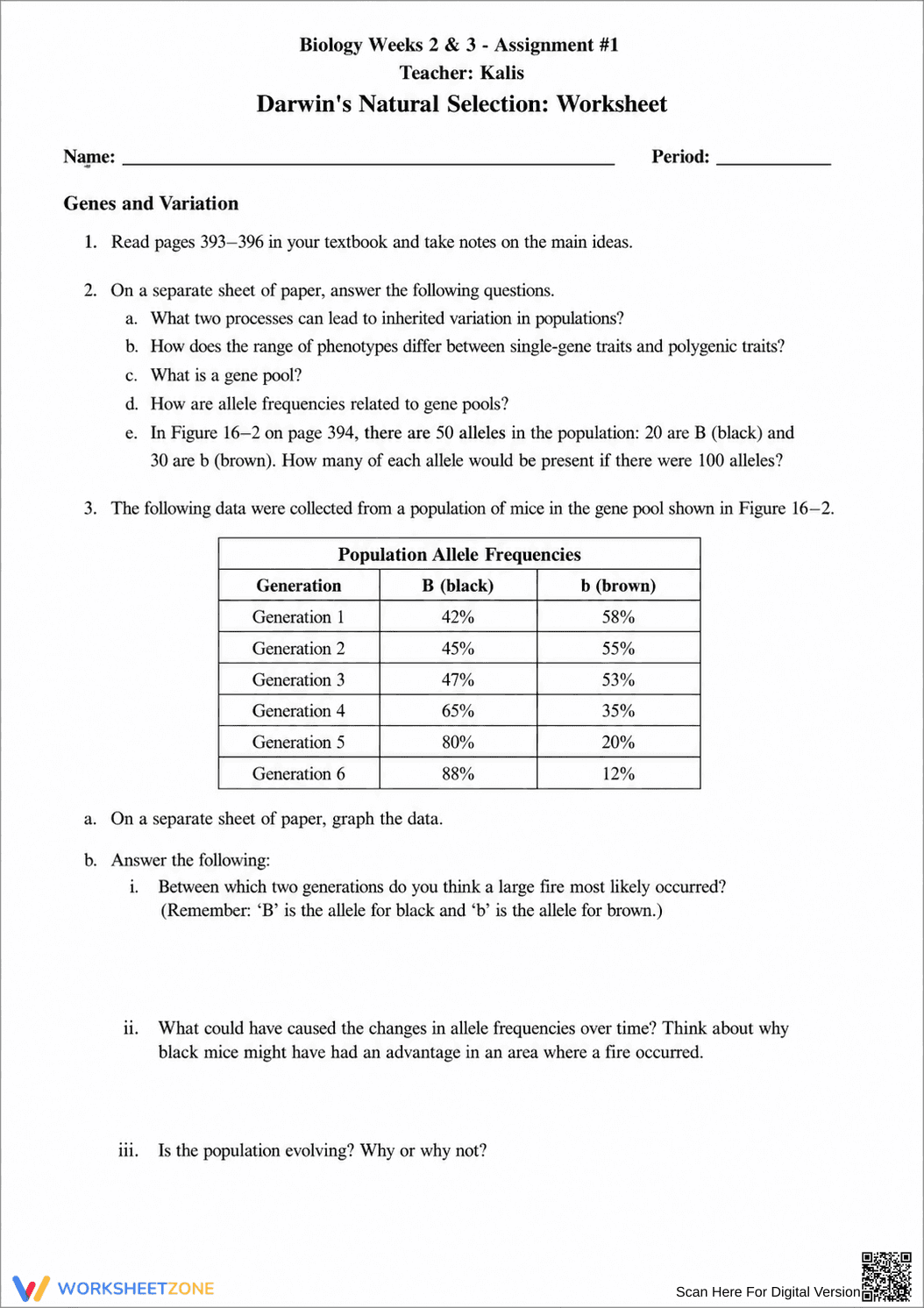
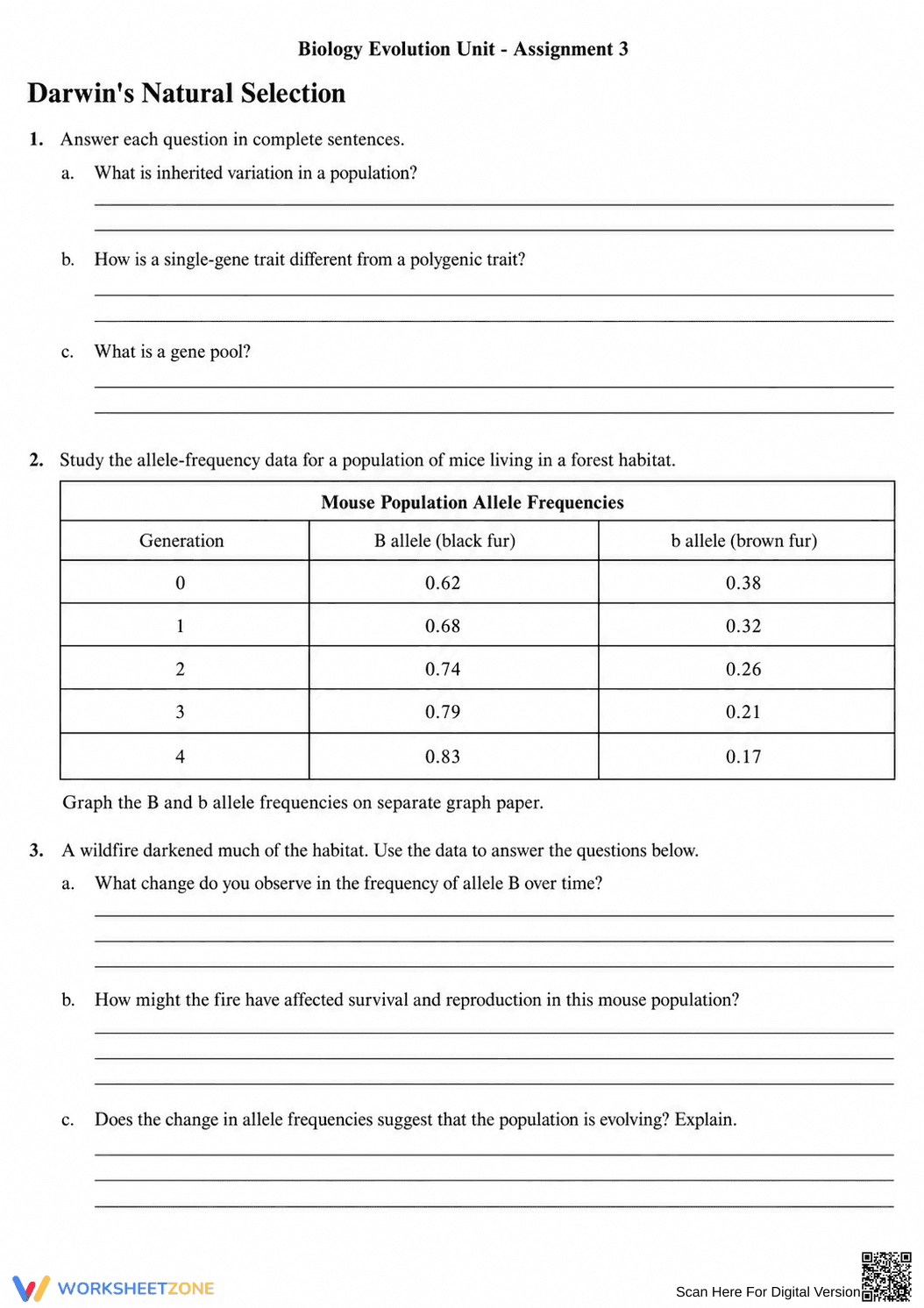
This packet contains three distinct assignments that explore the relationship between genes and variation. Each page includes structured data tables showing population allele frequencies across multiple generations. Students are required to interpret these tables, create visual graphs on separate paper, and provide written justifications for how specific environmental events, such as a wildfire, impact the genetic makeup of a population over time.
Level Descriptions
- Assignment #1 (Scaffolded): Provides specific textbook references and guided questions to help students define gene pools and calculate basic allele percentages for a population of 100 individuals.
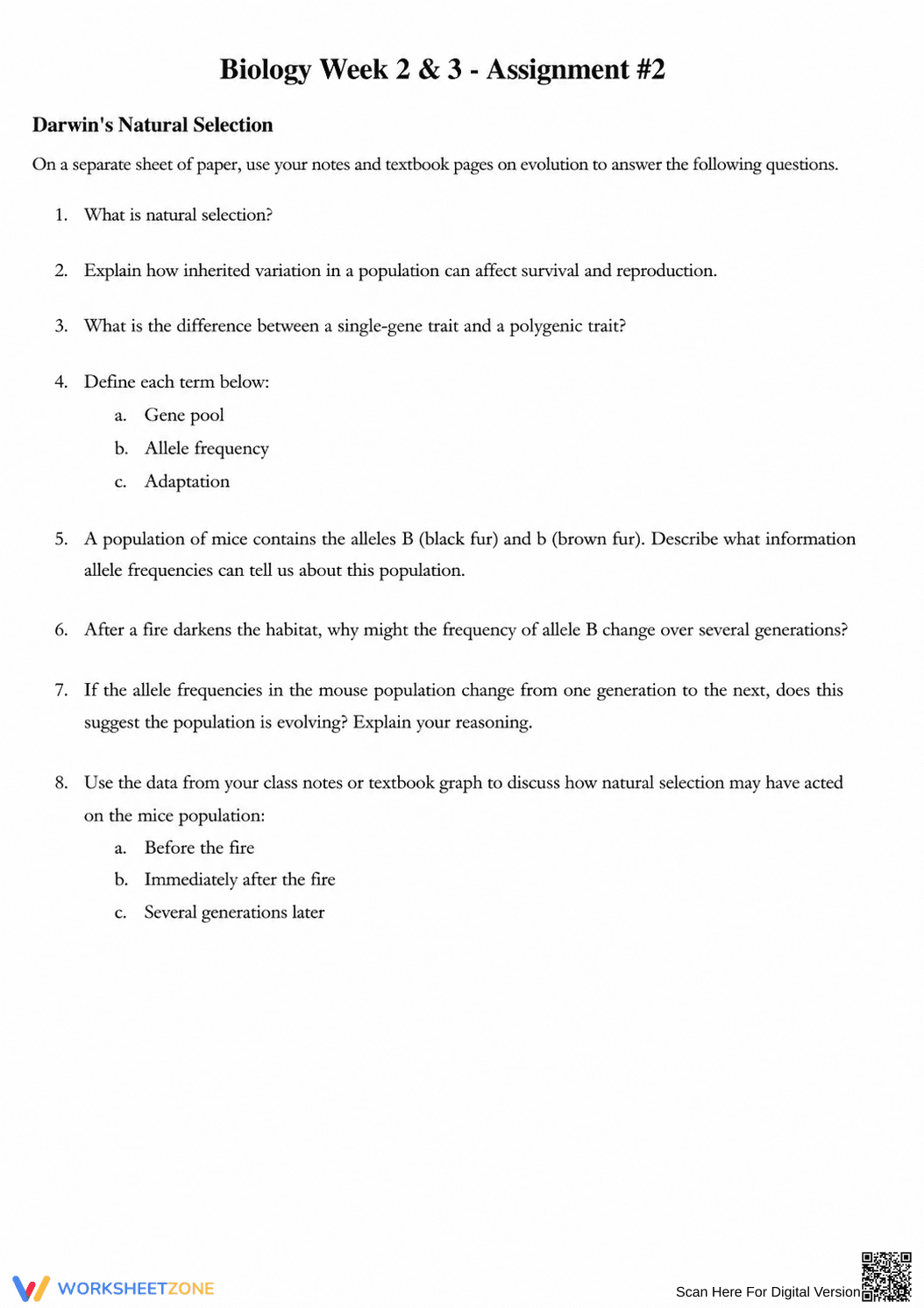
- Assignment #2 (Standard): A comprehensive review of natural selection mechanisms, requiring students to define key terminology and explain the impact of environmental changes on survival and reproduction.
- Assignment #3 (Advanced/Assessment): Focuses on independent data interpretation and graphing, challenging students to justify evolutionary claims using decimal-based allele frequency tables and complete sentence responses.
Standards Alignment
This resource is aligned with HS-LS4-4: Construct an explanation based on evidence for how natural selection leads to adaptation of populations. It also supports HS-LS4-3 by examining the statistics and probability of phenotypic distributions. Both standard codes can be copied directly into lesson plans, IEP goals, or district curriculum mapping tools.
How to Use It
Use this worksheet as a summative assessment at the conclusion of an evolution unit or as a structured data-analysis lab. For a formative approach, assign one of the three versions based on current student mastery levels during direct instruction. Teachers should observe how students translate the tabular data into graphical form, as this reveals their ability to visualize evolutionary trends. Completion typically ranges from 45 to 60 minutes.
Who It's For
This material is designed for high school biology students in grades 9-12. It is particularly effective for learners who require concrete data to understand abstract concepts like genetic drift and adaptation. It pairs naturally with a standard biology textbook chapter on evolution or an anchor chart detailing the four postulates of Darwinian selection.
Fisher & Frey (2014) highlight that interpreting complex biological data is a cornerstone of scientific literacy. This worksheet aligns with the HS-LS4-4 standard, which demands that students construct explanations based on evidence for how natural selection leads to the adaptation of populations. By tracking allele frequency shifts in a mouse population after a wildfire, students move beyond rote memorization to active analysis. The RAND AIRS 2024 study on science education suggests that providing multiple versions of a task—as seen in these three distinct assignments—allows for targeted intervention and ensures that students at different readiness levels can engage with the core curriculum. This resource bridges the gap between abstract concepts like gene pools and the concrete reality of phenotypic distribution. It serves as a robust tool for demonstrating how genetic variation and environmental factors interact to produce evolutionary change over multiple generations.


