


























Views
Downloads

Grade 7 Natural Selection — Printable No-Prep Worksheet
Paste this activity's link or code into your existing LMS (Google Classroom, Canvas, Teams, Schoology, Moodle, etc.).
Students can open and work on the activity right away, with no student login required.
You'll still be able to track student progress and results from your teacher account.
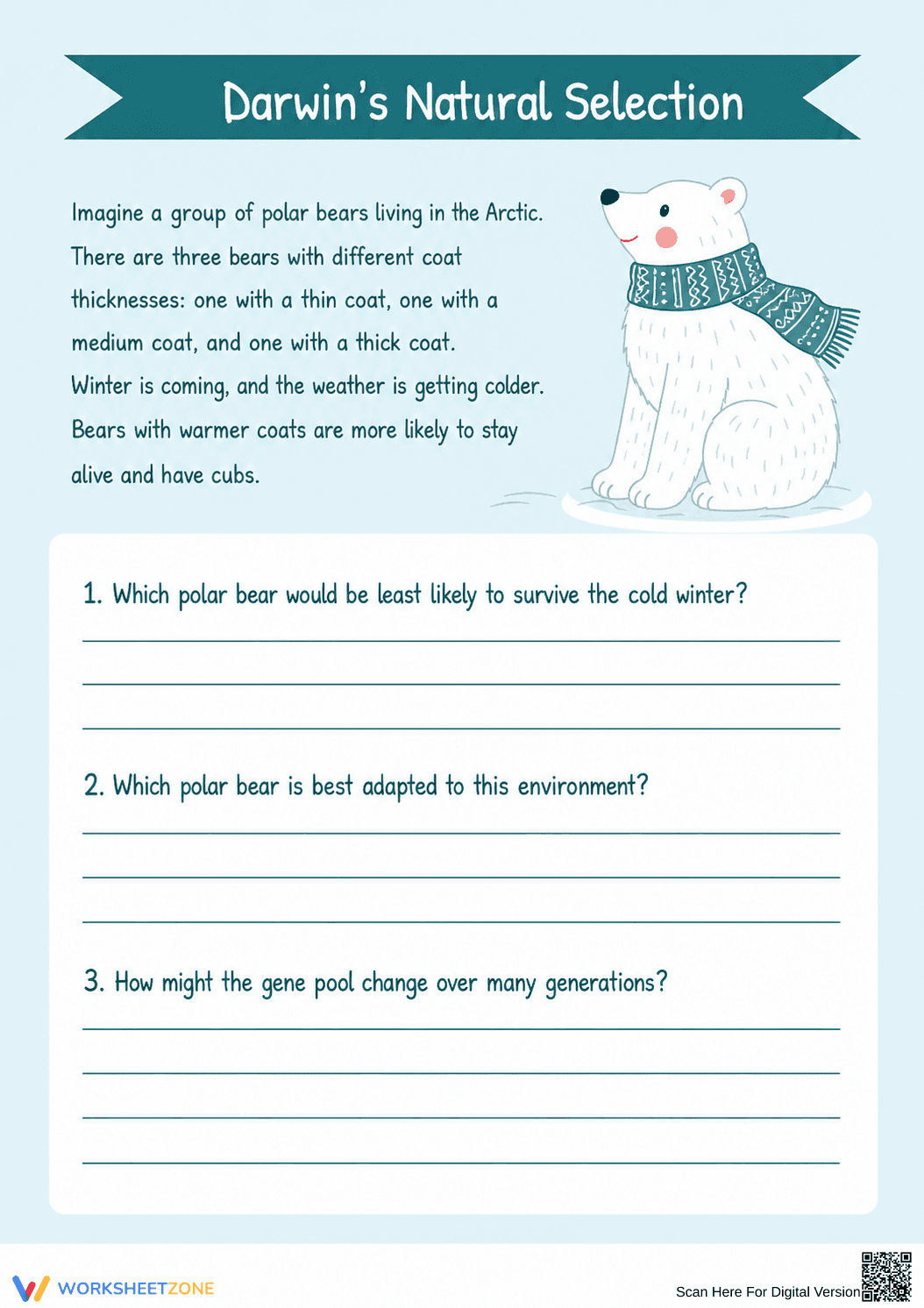
This Grade 7 science worksheet introduces students to Darwin's theory of natural selection. By analyzing a scenario involving polar bear adaptations, students evaluate how specific traits influence survival, predicting long-term changes within a population's gene pool.
At a Glance
- Grade: 7 · Subject: Science
- Standard:
MS-LS4-4— Explain how genetic variations increase survival probability.- Skill Focus: Natural Selection and Adaptation
- Format: 1 page · 3 problems · Answer key included · PDF
- Best For: Independent practice or homework
- Time: 15–20 minutes
This single-page resource features a short reading passage about polar bears facing a changing climate. Students then respond to three open-ended questions. The layout provides ample writing space for students to articulate their reasoning. An answer key ensures educators can quickly verify comprehension of fitness and adaptation.
Designed for immediate classroom implementation with a zero-prep workflow.
- Print (1 min): Download the PDF and print a class set.
- Distribute (1 min): Hand out as a warm-up or homework task. Instructions are self-explanatory.
- Review (3 mins): Use the answer key to assess responses or facilitate discussion.
Total teacher preparation time is under two minutes, making this an excellent option for sub plans.
Aligned to the Next Generation Science Standards, focusing on MS-LS4-4: Construct an explanation based on evidence that describes how genetic variations of traits in a population increase some individuals' probability of surviving and reproducing in a specific environment. Both standard codes can be copied directly into lesson plans, IEP goals, or district curriculum mapping tools.
Deploy this worksheet during direct instruction as a guided application activity. After introducing "survival of the fittest," have students complete the questions to solidify understanding. Alternatively, assign it as independent homework. As a formative assessment observation tip, review answers to the third question; this reveals if students grasp that populations evolve over generations, not individuals. Expected completion time is 15 to 20 minutes.
Designed for middle school science students beginning their unit on evolution. To support learners requiring differentiation, provide sentence starters for the short-answer questions. It pairs perfectly with an introductory lesson on Charles Darwin or an anchor chart detailing physical adaptations.
Teaching the mechanisms of evolution requires students to connect abstract concepts to concrete, observable phenomena in the natural world. This resource directly aligns with MS-LS4-4, challenging students to explain how genetic variations increase survival probability in specific environments. According to a ScienceDirect TpT Analysis, instructional materials that embed scientific principles within relatable, real-world scenarios significantly improve student retention and conceptual transfer. By evaluating the polar bear population's response to a cooling climate, learners move beyond rote memorization to actively apply the core principles of natural selection. They must articulate exactly why certain physical traits are advantageous and predict the subsequent, long-term shifts in the population's gene pool. This targeted, scenario-based practice ensures students develop the critical thinking skills necessary to understand complex biological systems and the continuous, dynamic process of environmental adaptation over time.


