


























Views
Downloads
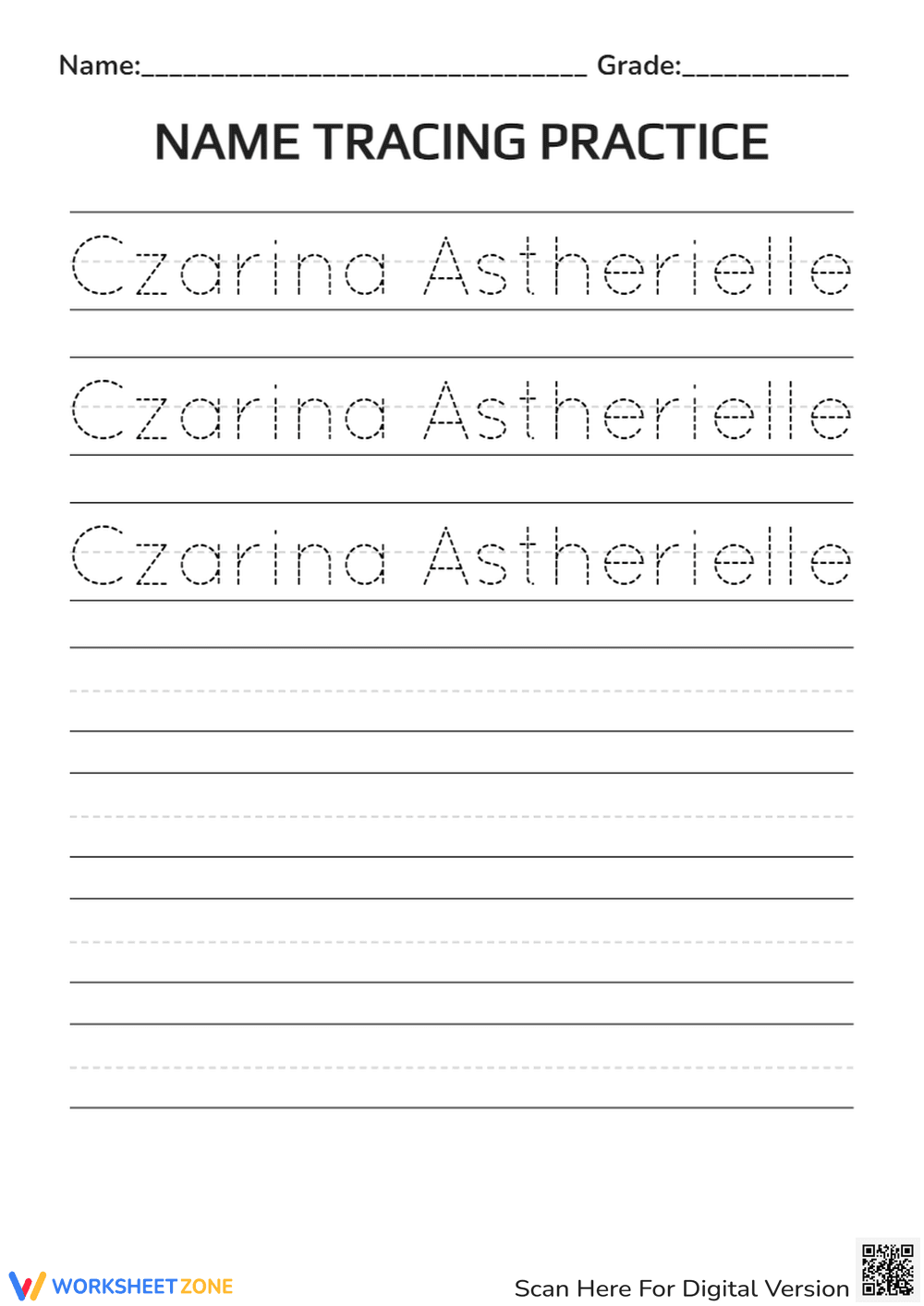


Grade 1 Name Tracing — Printable No-Prep Worksheet
Paste this activity's link or code into your existing LMS (Google Classroom, Canvas, Teams, Schoology, Moodle, etc.).
Students can open and work on the activity right away, with no student login required.
You'll still be able to track student progress and results from your teacher account.
This Grade 1 handwriting worksheet provides targeted practice for students learning to write the name Czarina Astherielle. By combining guided tracing with independent writing lines, early learners develop essential fine motor skills, proper letter formation, and pen control. This resource ensures students build confidence in their daily writing tasks.
At a Glance
- Grade: 1 · Subject: Handwriting
- Standard:
CCSS.ELA-LITERACY.L.1.1.A— Print all upper- and lowercase letters- Skill Focus: Name Tracing and Letter Formation
- Format: 2 pages · 8 practice lines · No answer key · PDF
- Best For: Morning work and handwriting centers
- Time: 10–15 minutes
What's Inside
This two-page printable includes a structured progression for handwriting practice. The first page features three dashed-line examples of the target name for guided tracing, followed by four blank primary-ruled lines for independent attempts. The second page offers an additional primary-ruled line with ample blank space for drawing. The clear layout helps young learners focus entirely on letter formation.
Zero-Prep Workflow
This resource is designed for immediate classroom implementation with a zero-prep workflow.
- Print (1 minute): Download the PDF and print the required copies. The design is printer-friendly.
- Distribute (1 minute): Hand out during morning routines. Instructions are self-evident, requiring no teacher setup.
- Review (1 minute): Quickly scan student work to check for proper letter sizing on the primary lines.
Total teacher preparation time is under two minutes, making this an excellent addition to any sub plan.
Standards Alignment
This worksheet aligns directly with CCSS.ELA-LITERACY.L.1.1.A, requiring students to print all upper- and lowercase letters accurately. By practicing a specific name, students apply this standard to meaningful, everyday vocabulary. Both standard codes can be copied directly into lesson plans, IEP goals, or district curriculum mapping tools.
How to Use It
Teachers can integrate this worksheet into morning work routines, allowing students to practice their handwriting as soon as they enter the classroom. It also serves well as a focused activity during small-group literacy centers. While students work, observe their pencil grip and stroke direction to provide immediate formative feedback on their penmanship. Expected completion time ranges from 10 to 15 minutes, depending on the student's fine motor development.
Who It's For
This resource is ideal for first and second-grade students who need reinforced practice with letter formation and spatial awareness on primary lines. It provides excellent scaffolding for occupational therapy students or those requiring fine motor interventions. Pair this worksheet with a tactile alphabet anchor chart or a direct instruction lesson on proper pencil grip to maximize student success.
Developing automaticity in handwriting is a foundational component of early literacy that directly impacts a young student's ability to produce written text efficiently. Aligned with CCSS.ELA-LITERACY.L.1.1.A, this resource helps students print all upper- and lowercase letters through targeted, meaningful name tracing. According to Fisher & Frey (2014), providing structured, repetitive practice with immediate application—such as writing a specific, recognizable name—significantly improves both pen control and long-term letter memory. When students do not have to expend excessive cognitive energy on the physical act of forming letters, they can better focus their attention on higher-order tasks like spelling, sentence structure, and creative composition. This worksheet effectively bridges the gap between guided tracing and independent production, ensuring early learners develop the essential muscle memory required for fluent, legible handwriting across all of their daily academic subjects.


