


























Views
Downloads
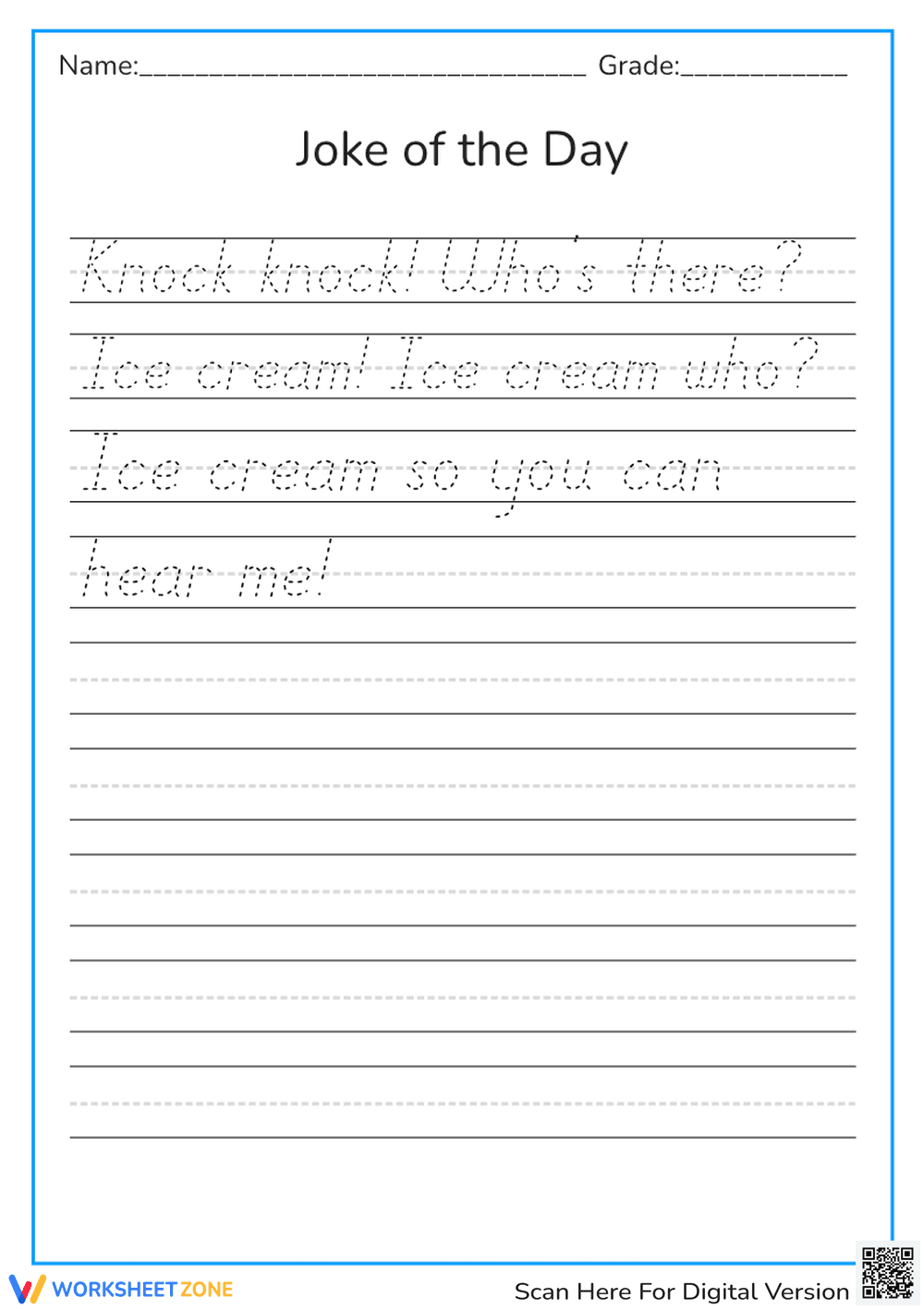

Essential Cursive Writing Practice: Knock Knock Joke
Paste this activity's link or code into your existing LMS (Google Classroom, Canvas, Teams, Schoology, Moodle, etc.).
Students can open and work on the activity right away, with no student login required.
You'll still be able to track student progress and results from your teacher account.
This Grade 2 cursive writing worksheet provides students with a fun, engaging way to master letter connections and sentence flow. By tracing and rewriting a humorous knock-knock joke, learners develop the fine motor control necessary for legible penmanship while reinforcing standard English conventions. State-aligned and ready for immediate classroom use.
At a Glance
- Grade: 2 · Subject: Handwriting
- Standard:
CCSS.ELA-LITERACY.L.2.1— Demonstrate command of the conventions of standard English grammar and usage when writing- Skill Focus: Cursive Tracing & Independent Writing
- Format: 1 page · 12 lines · Answer key N/A · PDF
- Best For: Morning work or handwriting centers
- Time: 10–15 minutes
The worksheet features a single-page layout titled "Joke of the Day." It includes four lines of dotted-line cursive text for tracing a complete knock-knock joke about ice cream. Below the tracing section, students find eight additional sets of primary-ruled lines for independent transcription and practice, totaling 12 lines of focused handwriting work.
Teachers can implement this resource in under 2 minutes. Simply print the PDF, distribute it to students during morning arrival or transition periods, and allow them to work through the tracing and writing phases independently. The self-contained joke format makes it an ideal sub-plan filler or a quick formative check for letter formation and spacing.
This resource aligns with `CCSS.ELA-LITERACY.L.2.1`, focusing on the legible production of letters and words to demonstrate a command of written English conventions. While cursive is often a state-specific requirement, this practice supports the broader goal of fluid, automatic writing. Both standard codes can be copied directly into lesson plans, IEP goals, or district curriculum mapping tools.
Use this worksheet during the independent practice phase of a handwriting lesson to reinforce specific letter joins. It also serves as an excellent formative assessment tool; observe students as they transition from tracing to independent writing to identify common errors in slant or spacing. Completion typically takes 10 to 15 minutes depending on student proficiency.
This is designed for second-grade students beginning their cursive journey, though it serves as a helpful review for third graders. It pairs naturally with a cursive alphabet anchor chart or a direct instruction lesson on lowercase letter connections. The humorous content ensures high engagement for reluctant writers.
Research by Fisher & Frey (2014) emphasizes the importance of the gradual release of responsibility, moving from highly scaffolded tasks like tracing to independent production. This worksheet utilizes that model by providing four lines of guided tracing before requiring students to replicate the text on empty lines. According to the RAND AIRS 2024 report on foundational skills, engaging content—such as humor or jokes—increases student persistence during repetitive motor tasks like handwriting. By aligning with CCSS.ELA-LITERACY.L.2.1, this resource ensures that students are not just practicing isolated letters but are applying their skills to full sentence structures. This integrated approach to penmanship and grammar helps solidify the connection between physical writing and cognitive language processing, making it a vital component of a comprehensive Grade 2 ELA curriculum.


