


























Views
Downloads
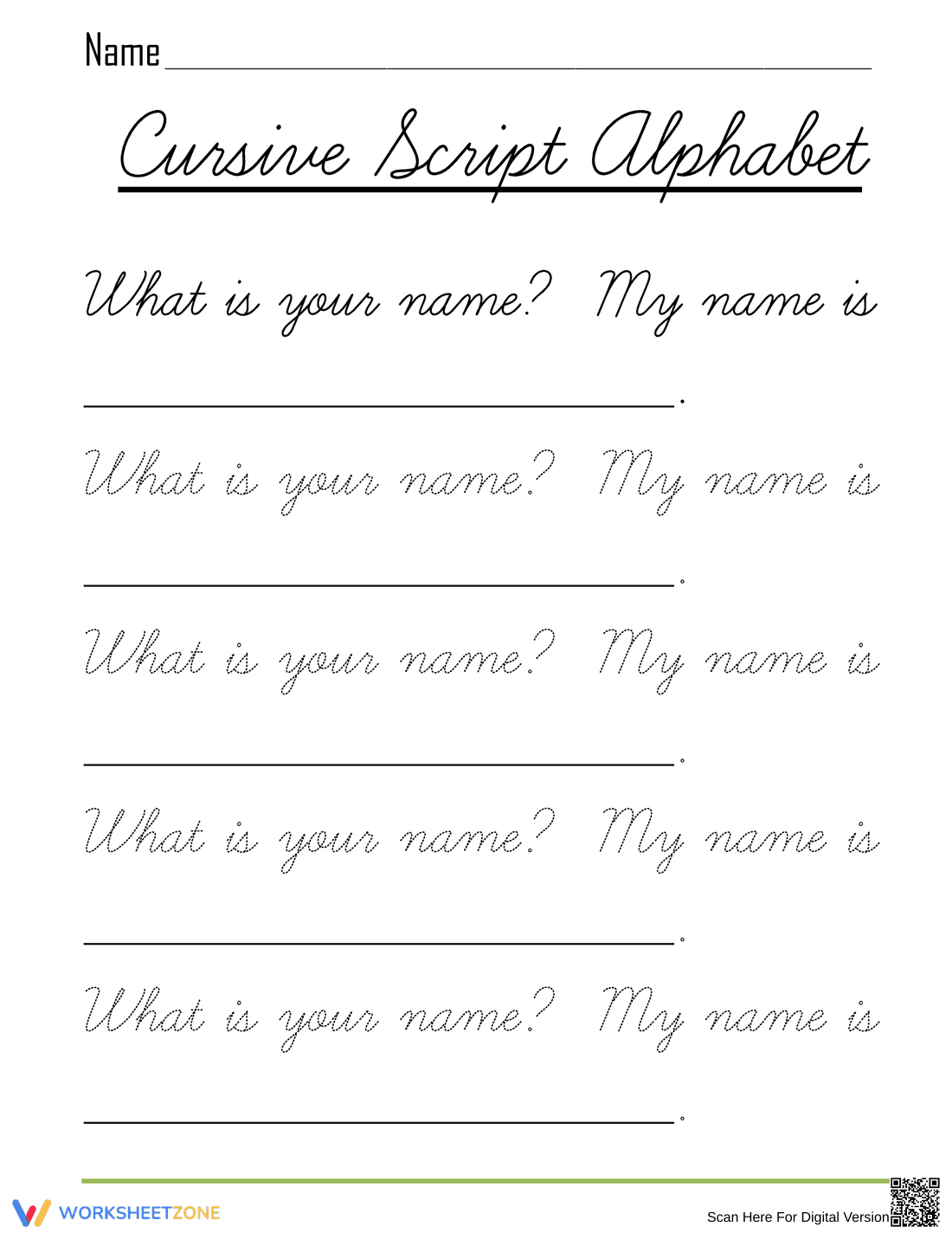

Printable Cursive Name Writing Worksheet | Grade 2
Paste this activity's link or code into your existing LMS (Google Classroom, Canvas, Teams, Schoology, Moodle, etc.).
Students can open and work on the activity right away, with no student login required.
You'll still be able to track student progress and results from your teacher account.
This Grade 2 cursive handwriting worksheet provides students with structured tracing practice to master writing their own names in cursive script. By repeatedly tracing the sentence frames, young learners develop fine motor control, proper letter formation, and confidence in their penmanship skills.
At a Glance
- Grade: 2 · Subject: Handwriting
- Standard:
CCSS.ELA-LITERACY.L.2.2— Apply capitalization and punctuation conventions in writing- Skill Focus: Cursive letter formation
- Format: 1 page · 5 problems · No answer key · PDF
- Best For: Independent morning work
- Time: 10–15 minutes
Inside this single-page printable, educators will find five identical tracing tasks designed for repetitive motor memory building. Each line features a dotted cursive sentence asking "What is your name?" followed by "My name is" and a blank line. The worksheet includes clear baseline guides to help students maintain consistent letter sizing.
Zero-Prep Workflow
This resource is designed for immediate classroom implementation.
- Print (1 minute): Print the PDF directly. The black-and-white design ensures minimal ink usage.
- Distribute (1 minute): Hand out the worksheets as students enter the classroom.
- Review (0 minutes): Because the task focuses on personal name writing, no formal grading is necessary.
With a total teacher prep time of under two minutes, this worksheet is an excellent addition to any sub plan.
Standards Alignment
This practice aligns with CCSS.ELA-LITERACY.L.2.2, requiring students to demonstrate command of standard English capitalization and punctuation when writing. Tracing complete sentences reinforces starting with capital letters and ending with proper punctuation. Both standard codes can be copied directly into lesson plans, IEP goals, or district curriculum mapping tools.
How to Use It
Assign this worksheet as a morning warm-up activity before direct instruction to help students focus their fine motor skills. Alternatively, use it as a quiet transition task. While students work, teachers can conduct quick formative assessments by observing pencil grip and stroke direction. Expected completion time is 10 to 15 minutes.
Who It's For
This resource is designed for second-grade students beginning their cursive journey. It serves as a foundational tool for general education and occupational therapy sessions focusing on fine motor development. For extra support, teachers can highlight the dotted lines. This pairs naturally with a classroom alphabet anchor chart.
Developing fluent handwriting is a critical component of early literacy that extends far beyond simple aesthetics. According to a comprehensive review by Fisher & Frey (2014), explicit instruction in handwriting and letter formation significantly reduces the cognitive load required for transcription, allowing young writers to allocate more mental resources to ideation, vocabulary selection, and complex sentence structure. This specific worksheet targets CCSS.ELA-LITERACY.L.2.2, helping students apply capitalization and punctuation conventions in writing through guided tracing. By repeatedly practicing the physical movements required for cursive script, students build the automaticity necessary for fluent written expression. The structured repetition of the sentence frames ensures that learners internalize the spatial relationships between letters on the baseline. Integrating this type of targeted motor practice into daily routines supports broader literacy goals and fosters greater confidence in independent writing tasks across all academic subjects.


