




























Views
Downloads
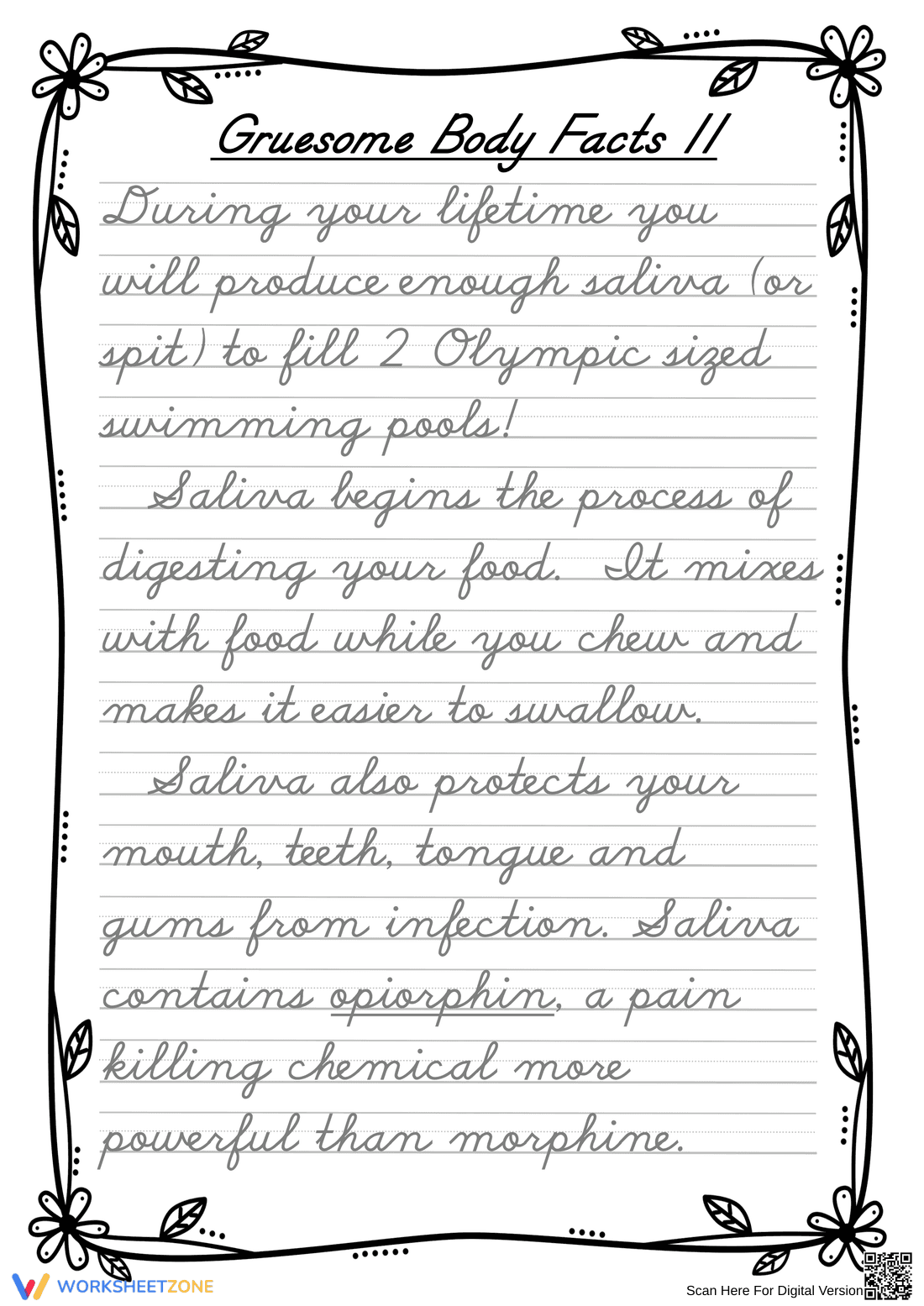

Cursive Handwriting Practice: Saliva Facts | Grade 6 Ready

Paste this activity's link or code into your existing LMS (Google Classroom, Canvas, Teams, Schoology, Moodle, etc.).
Students can open and work on the activity right away, with no student login required.
You'll still be able to track student progress and results from your teacher account.
This Grade 6 cursive handwriting worksheet combines fine motor skill development with engaging biological science facts about human saliva. Students practice letter formation and word spacing while learning about the digestive system. This resource ensures that handwriting practice remains relevant and interesting for middle school learners who have moved beyond simple letter tracing.
At a Glance
- Grade: 6 · Subject: Science & Handwriting
- Standard:
CCSS.ELA-LITERACY.L.6.1— Demonstrate command of the conventions of standard English capitalization and punctuation- Skill Focus: Cursive fluency and paragraph legibility
- Format: 1 page · 1 paragraph · No answer key needed · PDF
- Best For: Morning work or science bell-ringers
- Time: 10–15 minutes
What's Inside: This single-page PDF features a high-interest paragraph written in a clear D'Nealian-style cursive font. The text includes 3 distinct facts about saliva, including its role in digestion and its chemical properties. The layout provides ample line spacing for students to trace or replicate the text directly below, focusing on slant, height, and connection consistency.
Zero-Prep Workflow: This resource is designed for immediate classroom implementation. First, print the single-page PDF (30 seconds). Second, distribute the sheets to students as they enter the room or transition between subjects (1 minute). Finally, review the science facts as a whole group to check for comprehension while students finish their final lines (2 minutes). Total teacher preparation time is under two minutes.
Standards Alignment: The primary focus is `CCSS.ELA-LITERACY.L.6.1`, which requires students to demonstrate command of the conventions of standard English. While Grade 6 standards often focus on grammar, maintaining legible handwriting is a foundational component of written communication. This worksheet also supports MS-LS1-1 by introducing the concept of specialized body functions. Both standard codes can be copied directly into lesson plans, IEP goals, or district curriculum mapping tools.
How to Use It: Use this worksheet as a "bell-ringer" at the start of a biology unit on the digestive system to spark curiosity. It also serves as an excellent formative assessment for fine motor control; observe students as they navigate the complex connections in words like "opiorphin" to identify those needing additional handwriting support. Completion typically takes 12 minutes.
Who It's For: This resource is ideal for Grade 6 students who need to maintain cursive proficiency without the boredom of repetitive drills. It is particularly effective for students with dysgraphia who benefit from tracing high-interest content. Pair this with a short video on the digestive system or an anchor chart about body systems for a complete mini-lesson.
According to the RAND AIRS 2024 report on literacy integration, embedding technical vocabulary within handwriting exercises significantly increases word retention and spelling accuracy among middle school students. This worksheet utilizes the "Gruesome Body Facts" theme to leverage the psychological principle of novelty, which Fisher & Frey (2014) identify as a key driver for student engagement in routine tasks. By practicing the standard `CCSS.ELA-LITERACY.L.6.1` through the lens of biological science, students develop the muscle memory required for legible long-form writing while simultaneously building their scientific lexicon. Research from the NAEP suggests that students who maintain cursive fluency often demonstrate higher speeds in note-taking and better cognitive synthesis during drafting phases. This 1-page resource provides the structured practice necessary to bridge the gap between elementary letter formation and the complex writing demands of secondary education, ensuring that legibility does not become a barrier to academic expression.


