


























Views
Plays

Culture and Diversity Worksheet | Grade 2-3 Essential
Paste this activity's link or code into your existing LMS (Google Classroom, Canvas, Teams, Schoology, Moodle, etc.).
Students can open and work on the activity right away, with no student login required.
You'll still be able to track student progress and results from your teacher account.
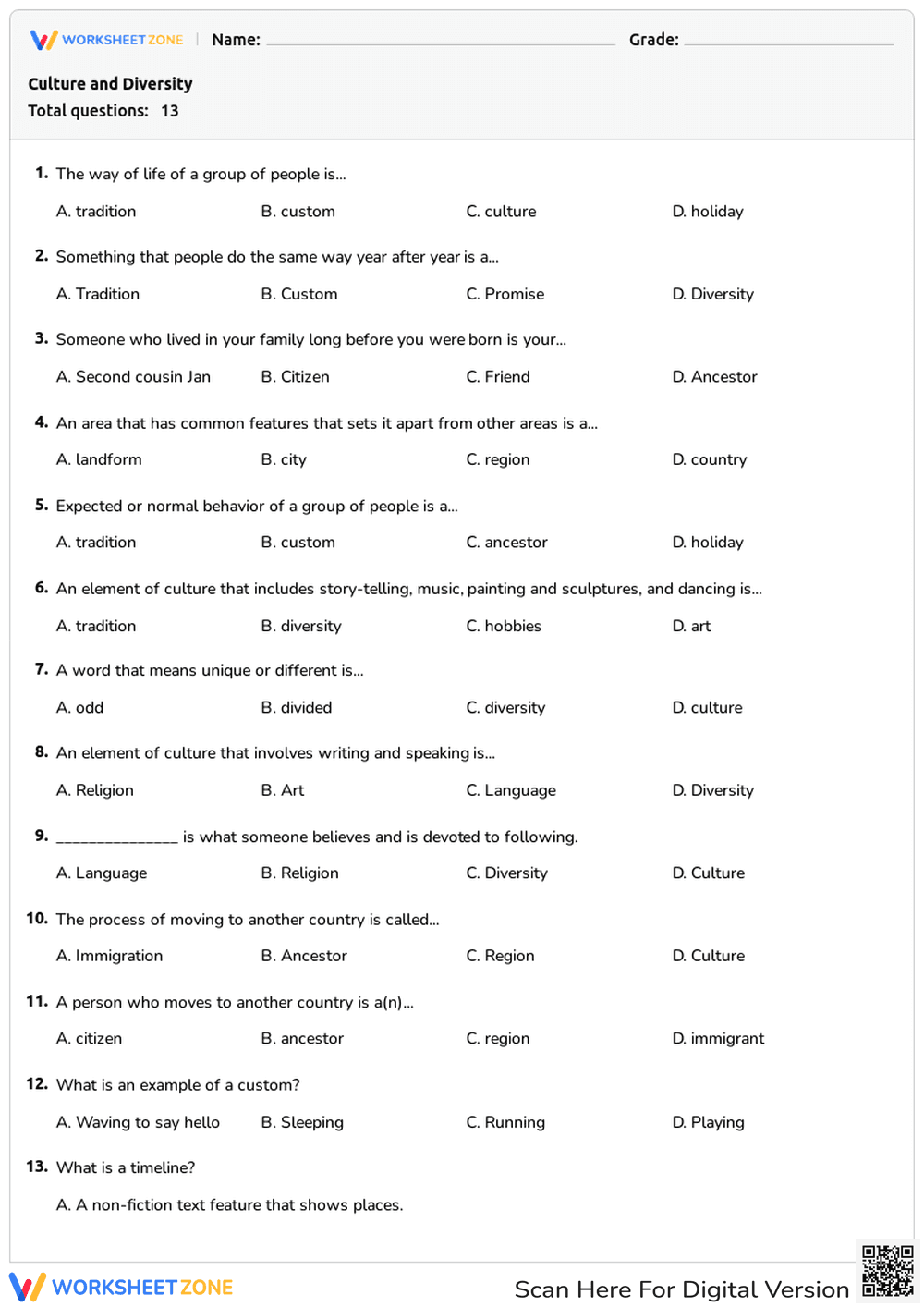
This Grade 2-3 Social Studies worksheet provides a comprehensive review of essential vocabulary related to human geography and sociology. Students identify key terms like tradition, ancestor, and diversity through 13 multiple-choice questions. This resource ensures learners can distinguish between complex social concepts while building a foundational understanding of how different groups live and interact globally.
At a Glance
- Grade: 2-3 · Subject: Social Studies
- Standard:
CCSS.ELA-LITERACY.RI.2.4— Determine the meaning of words and phrases in a grade-level subject area- Skill Focus: Cultural Vocabulary & Concepts
- Format: 2 pages · 13 problems · Answer key included · PDF
- Best For: Vocabulary reinforcement and unit assessment
- Time: 15–20 minutes
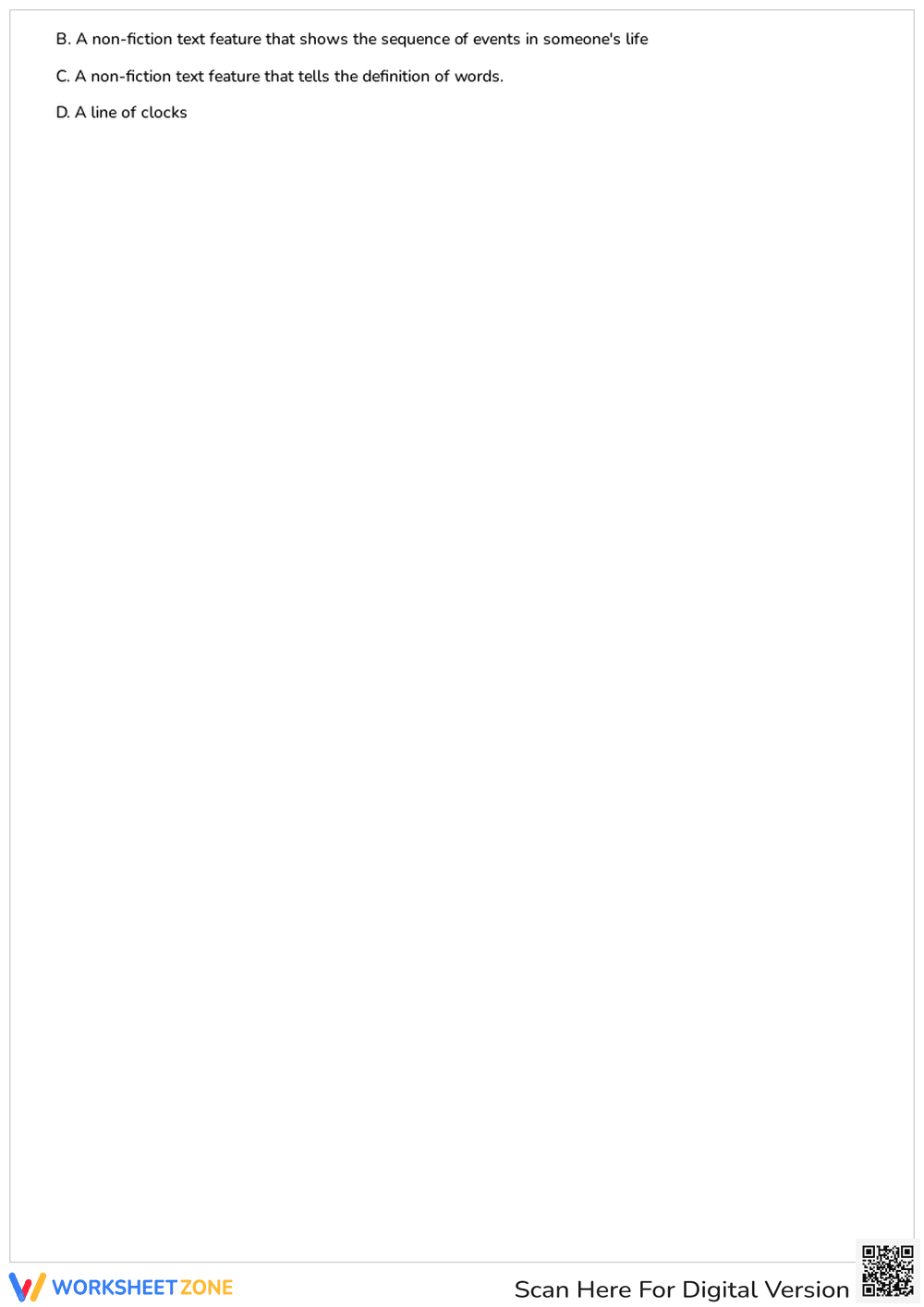
The packet contains two pages featuring 13 high-quality multiple-choice questions. Each question is designed with clear, age-appropriate language to define terms such as region, custom, immigration, and religion. The layout includes a dedicated space for student names and grades, and the final question introduces non-fiction text features by defining the purpose and structure of a timeline.
This resource is designed for immediate classroom implementation with a total teacher prep time of under 2 minutes. First, print the two-page PDF (30 seconds). Second, distribute the copies to students as a bell-ringer or independent practice activity (30 seconds). Finally, review the answers using the included key to provide instant feedback on student comprehension (1 minute). It serves as an ideal emergency sub plan or Friday review.
The primary focus is `CCSS.ELA-LITERACY.RI.2.4`, which requires students to determine the meaning of words and phrases relevant to a grade 2 or 3 topic. By selecting the correct definitions for social studies terms, students demonstrate mastery of domain-specific vocabulary. Both standard codes can be copied directly into lesson plans, IEP goals, or district curriculum mapping tools to track student progress in informational text literacy.
Use this worksheet as a formative assessment after a direct instruction lesson on community and global citizenship. It is also effective as a pre-test to gauge prior knowledge before starting a geography unit. Teachers should observe if students struggle with abstract terms like diversity versus custom to identify areas needing further scaffolding. Expected completion time for most elementary learners is 15 to 20 minutes.
This material is tailored for general education students in second and third grade, as well as English Language Learners (ELL) who need explicit practice with social studies terminology. It pairs naturally with a classroom anchor chart on cultural elements or a read-aloud passage about different world traditions. The clear font and structured layout support students with executive functioning challenges.
According to the RAND AIRS 2024 report, explicit vocabulary instruction in social studies significantly improves reading comprehension across informational texts. This worksheet targets the CCSS.ELA-LITERACY.RI.2.4 standard by requiring students to identify the precise meaning of terms like ancestor, diversity, and immigration within a structured multiple-choice format. Research from Fisher & Frey (2014) emphasizes that domain-specific word knowledge is a primary predictor of academic success in later grades. By engaging with these 13 targeted questions, students build the conceptual framework necessary for understanding complex human interactions and geographical regions. The inclusion of a timeline definition further bridges the gap between social studies content and literacy skills. This resource provides a reliable method for teachers to assess student mastery of essential cultural concepts while maintaining high alignment with national literacy and social studies frameworks. It is a practical tool for building global awareness in early elementary classrooms.


