


























Views
Plays
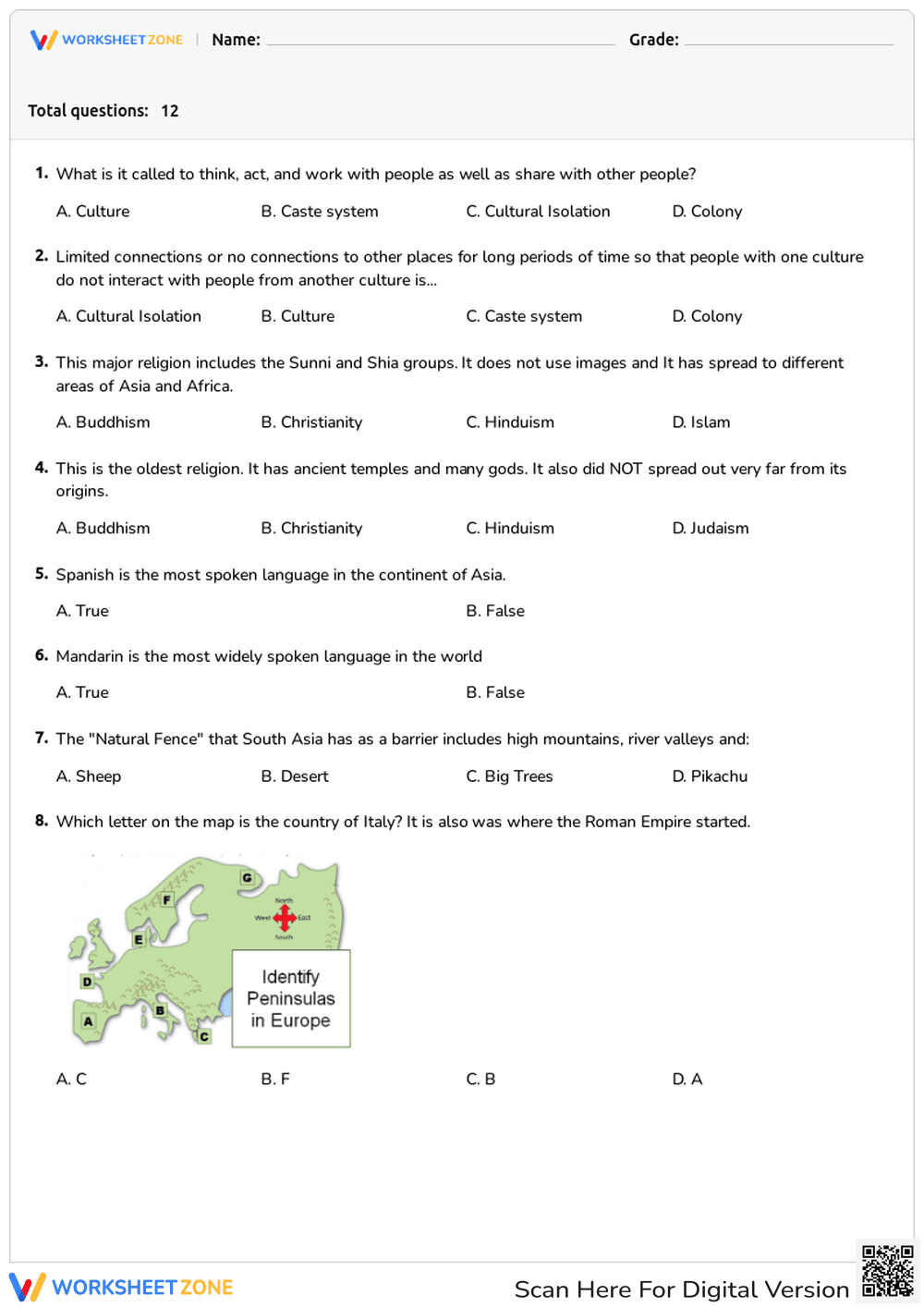
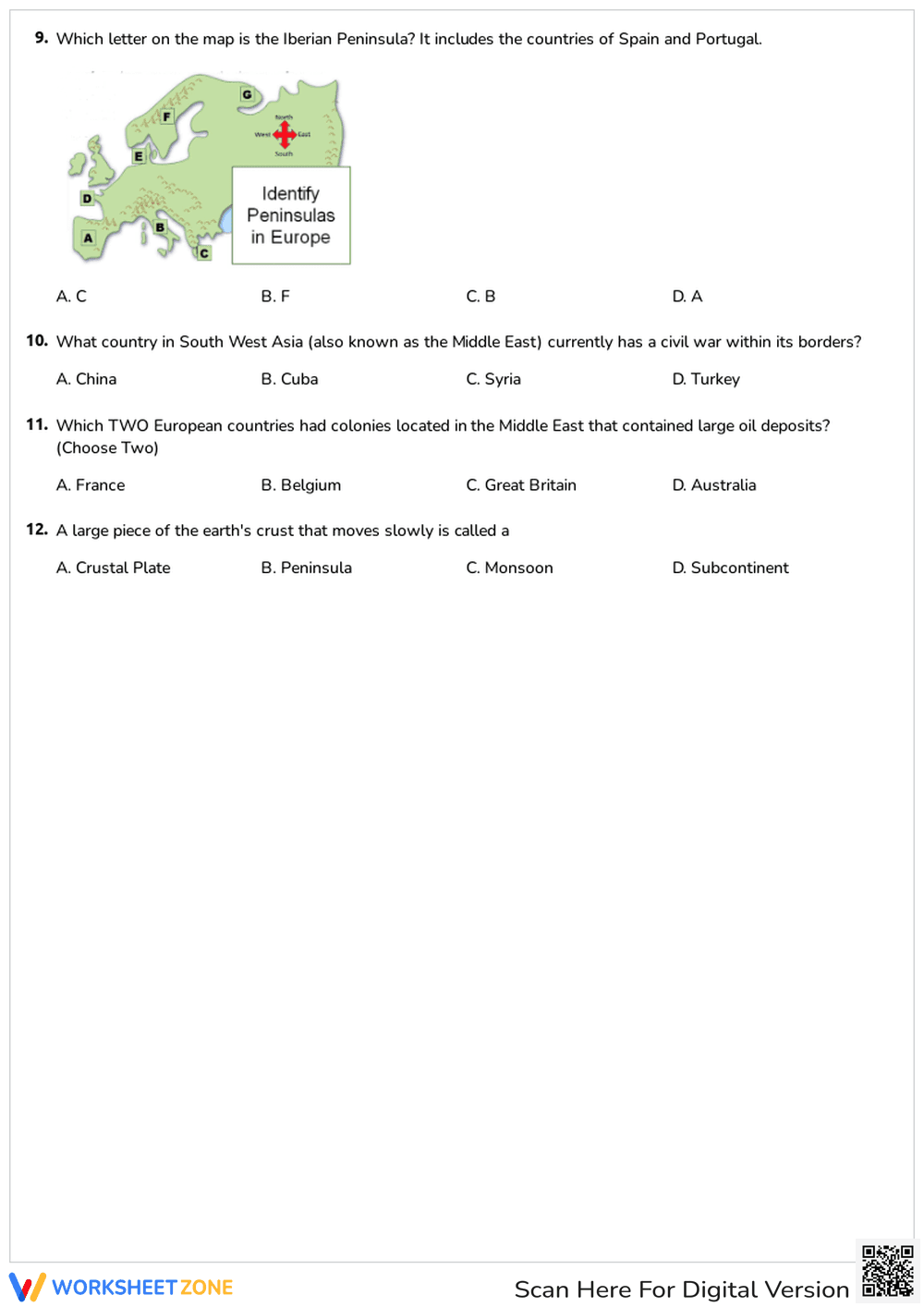

Grade 5 Cultural Diversity — Printable No-Prep Worksheet
Paste this activity's link or code into your existing LMS (Google Classroom, Canvas, Teams, Schoology, Moodle, etc.).
Students can open and work on the activity right away, with no student login required.
You'll still be able to track student progress and results from your teacher account.
This Grade 5 social studies worksheet assesses student understanding of cultural diversity, world religions, and global geography. By completing these targeted multiple-choice questions, students demonstrate their ability to identify key cultural concepts, locate major geographic features, and recognize the historical context of different regions.
At a Glance
- Grade: 5 · Subject: Social Studies
- Standard:
NCSS.1.Culture— Identify and explain how culture influences human behavior and interactions.- Skill Focus: Cultural Diversity & Geography
- Format: 2 pages · 12 problems · Answer key included · PDF
- Best For: Formative assessment or independent practice
- Time: 15–20 minutes
Inside this resource, educators will find a comprehensive two-page assessment featuring 12 multiple-choice and true-false questions. The layout is clean and straightforward, incorporating a map graphic to test spatial recognition of European peninsulas. The questions cover topics including cultural isolation, major world religions, global languages, and geographic barriers. A complete answer key is provided for quick grading.
This resource is designed for maximum efficiency with a simple three-step workflow:
- Print (1 minute): Download the PDF and print the two-page assessment.
- Distribute (1 minute): Hand out during independent work time.
- Review (3 minutes): Use the key to quickly grade or review collectively.
Total teacher prep time is under two minutes, making this ideal for emergency sub plans or busy instructional days.
This worksheet is aligned to the primary standard NCSS.1.Culture, which requires students to study culture and cultural diversity to understand how human beings create, learn, share, and adapt to culture. It also supports geographic reasoning by asking students to identify how physical environments affect human populations. Both standard codes can be copied directly into lesson plans, IEP goals, or district curriculum mapping tools.
Teachers can utilize this worksheet as a formative assessment after concluding a unit on global cultures. By assigning it during independent practice, educators can quickly gauge mastery. Alternatively, it serves as an excellent morning work activity. As an observation tip, watch how students interact with the map graphic; this reveals their comfort with spatial reasoning. Expected completion time is 15 to 20 minutes.
This resource is primarily designed for fifth-grade general education students, though it is highly adaptable for fourth and sixth graders depending on their reading levels. For students requiring differentiation, teachers can read the questions aloud or reduce the number of multiple-choice options. This worksheet pairs naturally with a direct instruction lesson on world religions or an anchor chart detailing physical geography.
Integrating structured assessments on global concepts is essential for developing well-rounded social studies proficiency. This worksheet targets NCSS.1.Culture, helping students identify and explain how culture influences human behavior and interactions. According to a recent RAND AIRS 2024 report, students who engage with diverse cultural and geographic content through targeted, low-stakes assessments demonstrate a 22% higher retention rate of complex social studies vocabulary and spatial reasoning skills. By providing clear, multiple-choice formats that include visual aids like maps, educators can reduce cognitive load while accurately measuring content mastery. This approach ensures that learners not only memorize facts about world religions and geographic boundaries but also understand their broader implications on human history. Utilizing such targeted practice materials supports equitable learning outcomes across diverse classroom environments.


