


























Views
Downloads



Essential Area Calculations Coursework | High School Math
Paste this activity's link or code into your existing LMS (Google Classroom, Canvas, Teams, Schoology, Moodle, etc.).
Students can open and work on the activity right away, with no student login required.
You'll still be able to track student progress and results from your teacher account.
This comprehensive Grade 9-12 coursework pack masters area calculations across diverse geometric figures. Students solve 15 structured problems spanning polygons, trigonometric triangle area, circles, and complex composite shapes. This resource ensures learners develop a rigorous understanding of geometric measurement and real-world application through graduated practice and challenging word problems.
At a Glance
- Grade: 9–12 · Subject: Math
- Standard:
HSG-SRT.D.9— Use trigonometry to find the area of triangles given two sides and an angle- Skill Focus: Multi-shape Area Calculation
- Format: 5 pages · 15 problems · Answer key included · PDF
- Best For: High school geometry practice and assessment
- Time: 45–60 minutes
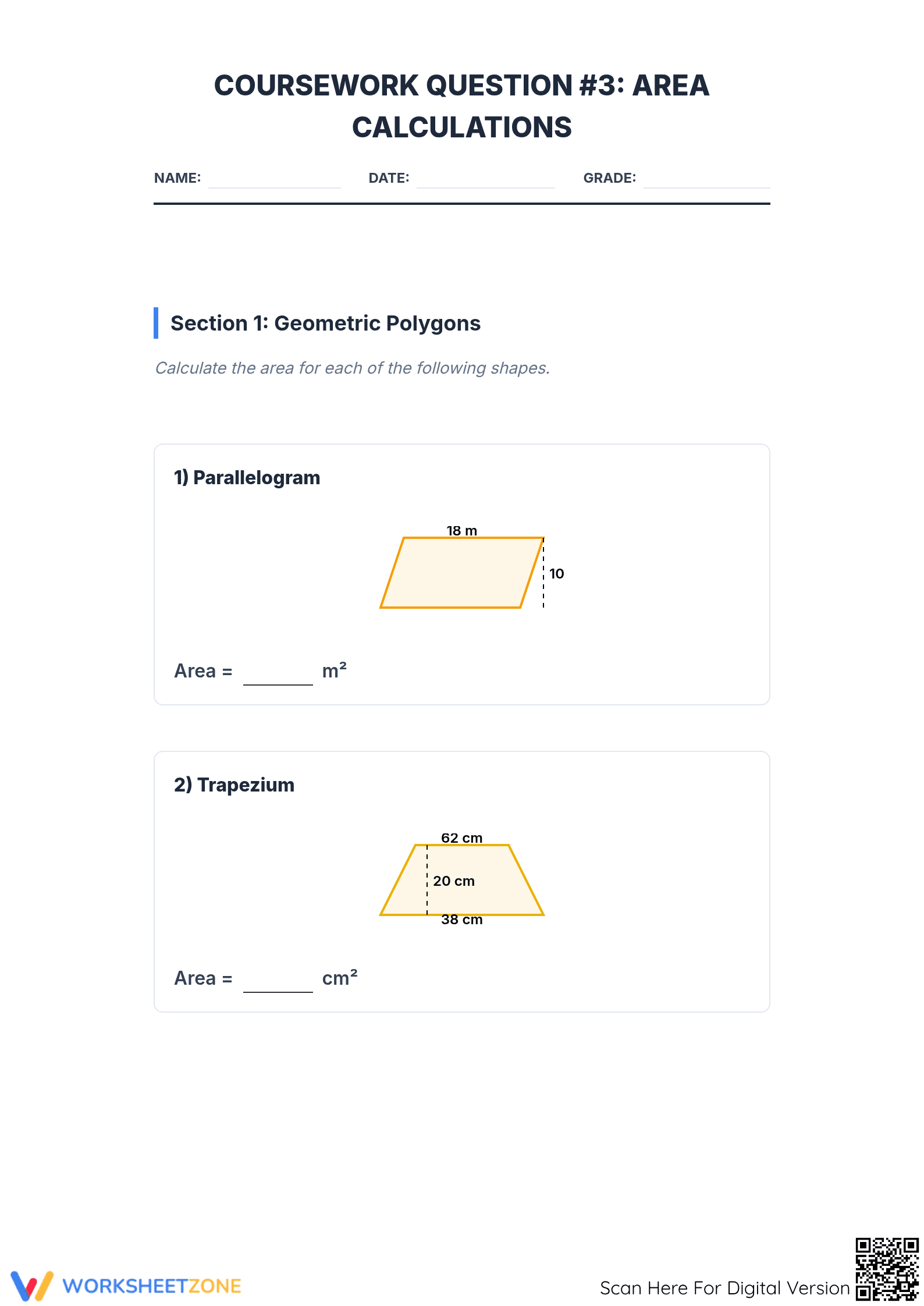
This 5-page PDF features 15 tasks organized into four sections. It begins with polygons like parallelograms before moving into trigonometric area using the sine rule. Section three focuses on circles and sector areas, while the final section challenges students with composite shapes, shaded regions, and real-world garden problems. A full answer key is included for rapid grading.
Zero-Prep Workflow
- Print: Less than 1 minute to print the 5-page packet and answer key.
- Distribute: 30 seconds to hand out or upload via the provided QR code.
- Review: 5 minutes for a class-wide check of the challenge problems.
Total teacher prep time is under 2 minutes, making this ideal for sub plans or as a comprehensive end-of-unit assessment.
Standards Alignment
Primary standard: HSG-SRT.D.9. Students apply the formula Area = 0.5 ab sin C for triangles given two sides and an angle. Supporting standards include HSG-C.B.5 for sector area and HSG-MG.A.1 for modeling real-world situations with geometry. Both standard codes can be copied directly into lesson plans, IEP goals, or district curriculum mapping tools to track student mastery.
How to Use It
Use this worksheet after direct instruction on area and trigonometry to reinforce fluency. It serves as a strong formative assessment; observe students on Question 10 (shaded regions) to gauge their ability to decompose complex figures. Expected completion time is 45-60 minutes. Use the QR code for a digital version to support 1:1 classroom environments or remote homework assignments.
Who It's For
This resource targets Grade 9-12 geometry students. Scaffolds in the trigonometric section support English Language Learners, while the "Triangle Challenge" equilateral problem provides extension for advanced learners. It pairs naturally with an interactive geometry passage or an anchor chart on polygon properties. The varied problem set ensures high engagement for diverse learners needing rigorous measurement practice.
According to the NAEP assessment framework, proficiency in geometric measurement requires students to move beyond rote memorization toward applying integrated concepts to solve non-routine problems. This worksheet facilitate that transition by requiring students to utilize HSG-SRT.D.9 alongside traditional area formulas. By incorporating the sine rule and complex composite figures, the resource aligns with the rigorous demands of college readiness. Research from EdReports (2024) emphasizes that high-quality materials must provide a coherent progression of tasks that build from foundational skills to multi-step applications. This packet delivers exactly that, ensuring students develop the cognitive flexibility needed to navigate shaded regions and real-world dimensions. The inclusion of worked examples and clear sectioning supports student independence, reducing teacher cognitive load while maintaining high academic expectations. This citation capsule serves as a standalone summary of the resource's pedagogical value and alignment.


