


























Views
Plays

Counting Numbers 1-10 Printable Quiz | Kindergarten Math
Paste this activity's link or code into your existing LMS (Google Classroom, Canvas, Teams, Schoology, Moodle, etc.).
Students can open and work on the activity right away, with no student login required.
You'll still be able to track student progress and results from your teacher account.
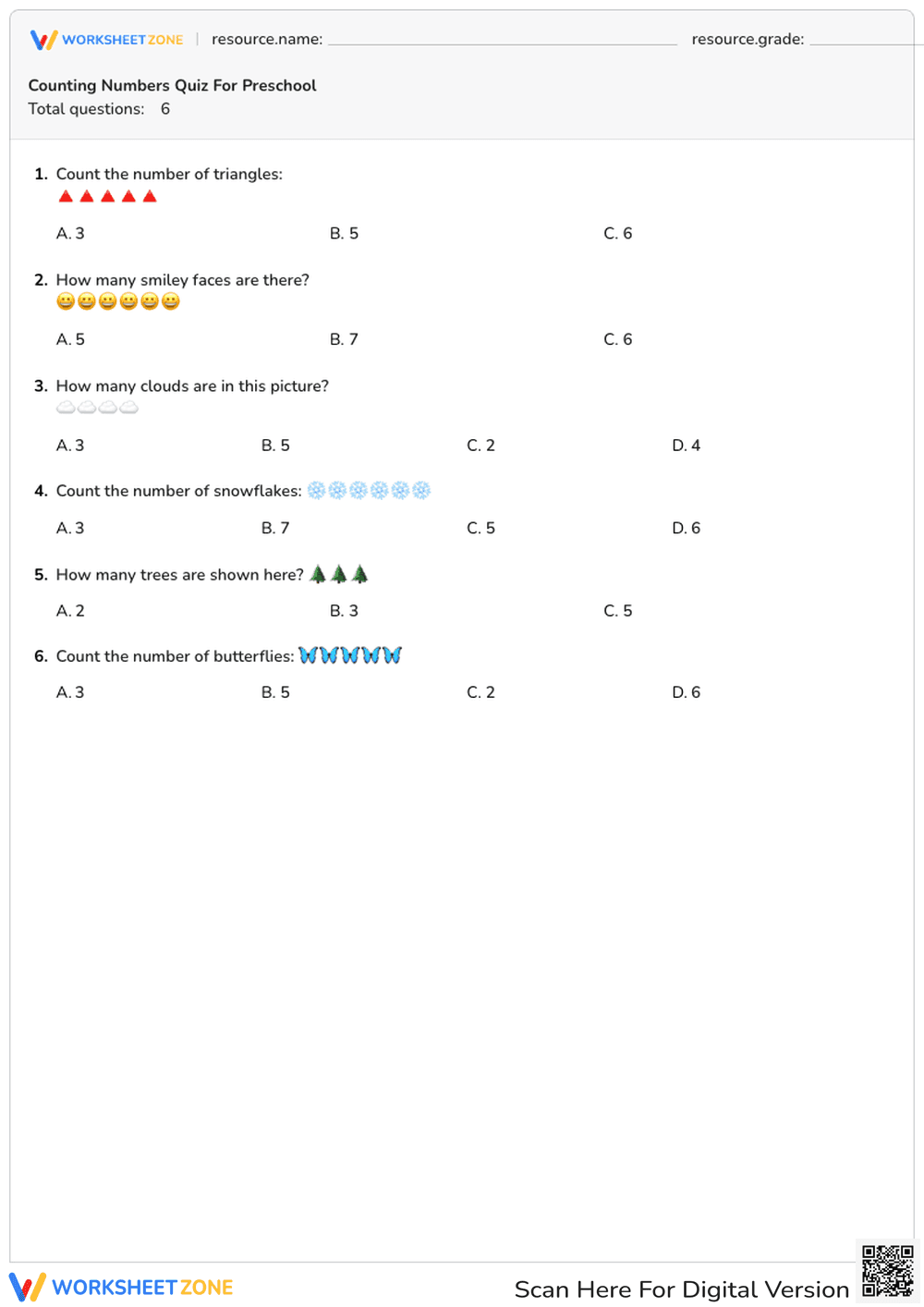
This Kindergarten counting worksheet helps students master one-to-one correspondence by identifying the quantity of various objects. Students practice counting triangles, clouds, and emojis to select the correct numerical representation. It provides a clear, visual assessment of early numeracy skills, ensuring young learners can confidently connect physical sets to their written number symbols.
At a Glance
At a Glance
- Grade: Kindergarten · Subject: Math
- Standard:
CCSS.MATH.CONTENT.K.CC.B.5— Count to answer how many questions about objects arranged in a line- Skill Focus: One-to-one correspondence 1-10
- Format: 1 page · 6 problems · Answer key included · PDF
- Best For: Quick formative assessment or morning work
- Time: 5–10 minutes
What's Inside
This single-page PDF features 6 multiple-choice questions designed for early childhood learners. Each task presents a row of colorful icons—including snowflakes, trees, and butterflies—followed by three or four numerical options. The layout is clean and distraction-free, featuring a dedicated header for student names and grades, alongside a clear answer key for rapid grading.
Zero-Prep Workflow
The workflow for this resource is designed for maximum efficiency. First, print the single-page PDF (30 seconds). Second, distribute the sheets to students for a quick warm-up or exit ticket (1 minute). Finally, review the multiple-choice answers using the included key to identify students needing intervention (30 seconds). Total teacher preparation time is under 2 minutes, making it an ideal sub-plan or last-minute addition.
Standards Alignment
This resource is primary aligned to `CCSS.MATH.CONTENT.K.CC.B.5`, which requires students to count to answer "how many?" questions about as many as 20 things arranged in a line, a rectangular array, or a circle. It also supports `CCSS.MATH.CONTENT.K.CC.B.4.A` by reinforcing the concept that the last number name said tells the number of objects counted. Both standard codes can be copied directly into lesson plans, IEP goals, or district curriculum mapping tools.
How to Use It
Use this worksheet as a formative assessment after a hands-on counting lesson with manipulatives. Observe if students are touching each object as they count or if they are struggling with cardinality (knowing the last number is the total). It is also effective as a quiet "bell-ringer" activity. Most Kindergarten students will complete the 6 tasks within 5 to 10 minutes.
Who It's For
This quiz is tailored for preschool, Kindergarten, and Grade 1 students who are developing foundational number sense. It is particularly helpful for English Language Learners (ELLs) due to the heavy visual support and minimal text. Pair this worksheet with a counting song or a physical number line anchor chart to reinforce the sequence of numbers 1 through 10.
Early numeracy skills, specifically the ability to count objects with one-to-one correspondence, are the strongest predictors of later mathematical achievement. This worksheet aligns with `CCSS.MATH.CONTENT.K.CC.B.5`, focusing on the essential skill of counting objects in a linear arrangement to determine "how many." According to the RAND AIRS 2024 report, frequent, low-stakes formative assessments in early childhood settings help educators identify gaps in cardinality and subitizing before they impact more complex operations like addition. By utilizing 6 targeted multiple-choice questions, this resource provides a structured environment for students to practice the transition from concrete objects to abstract numerical symbols. Research from Fisher & Frey (2014) emphasizes that such guided practice is vital for the gradual release of responsibility, moving students toward independent mastery of the number system. This printable PDF serves as a reliable tool for tracking progress in foundational math standards.


