


























Views
Downloads



Printable Fraction Conversion Worksheet | Grade 5 Math
Paste this activity's link or code into your existing LMS (Google Classroom, Canvas, Teams, Schoology, Moodle, etc.).
Students can open and work on the activity right away, with no student login required.
You'll still be able to track student progress and results from your teacher account.
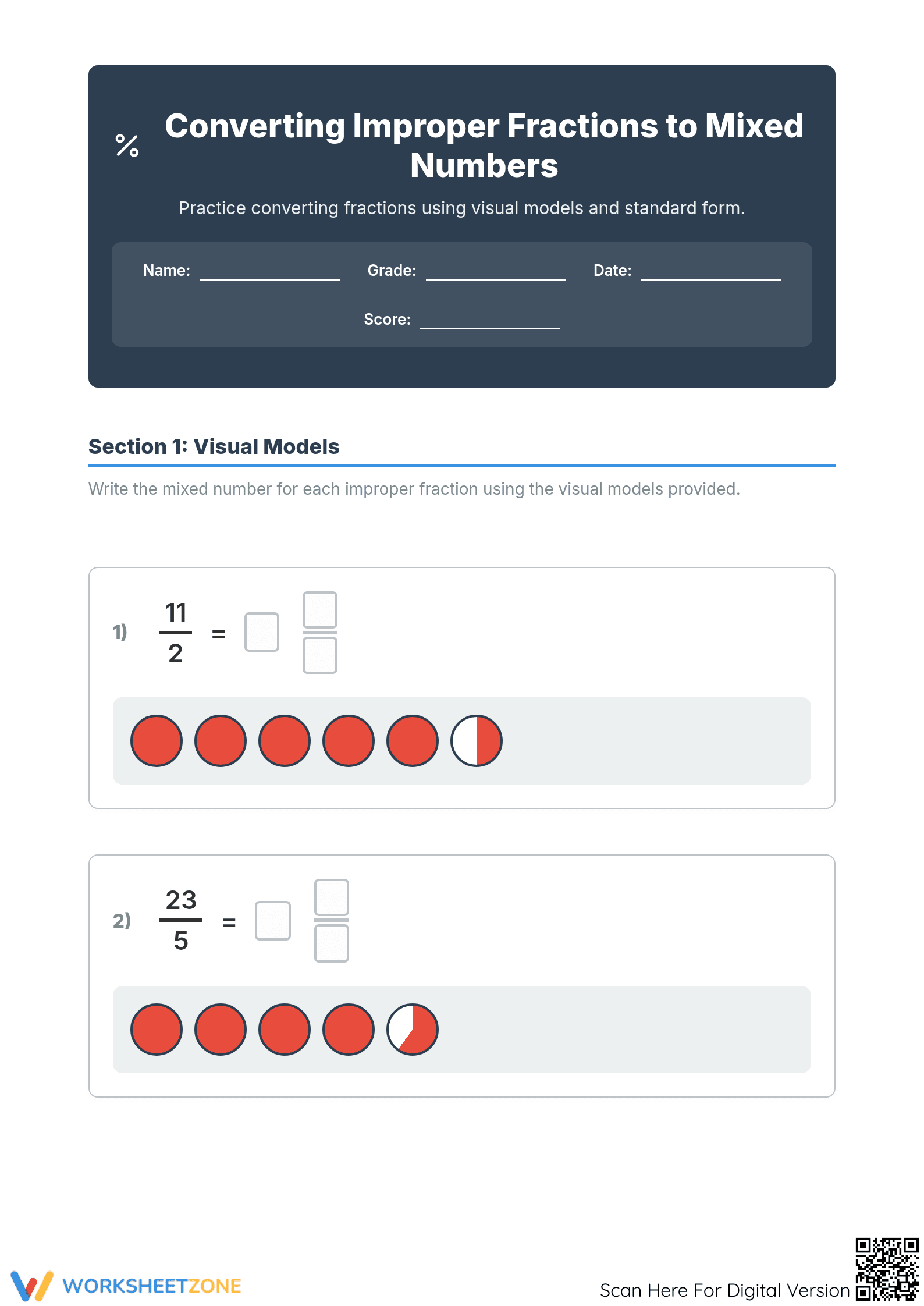
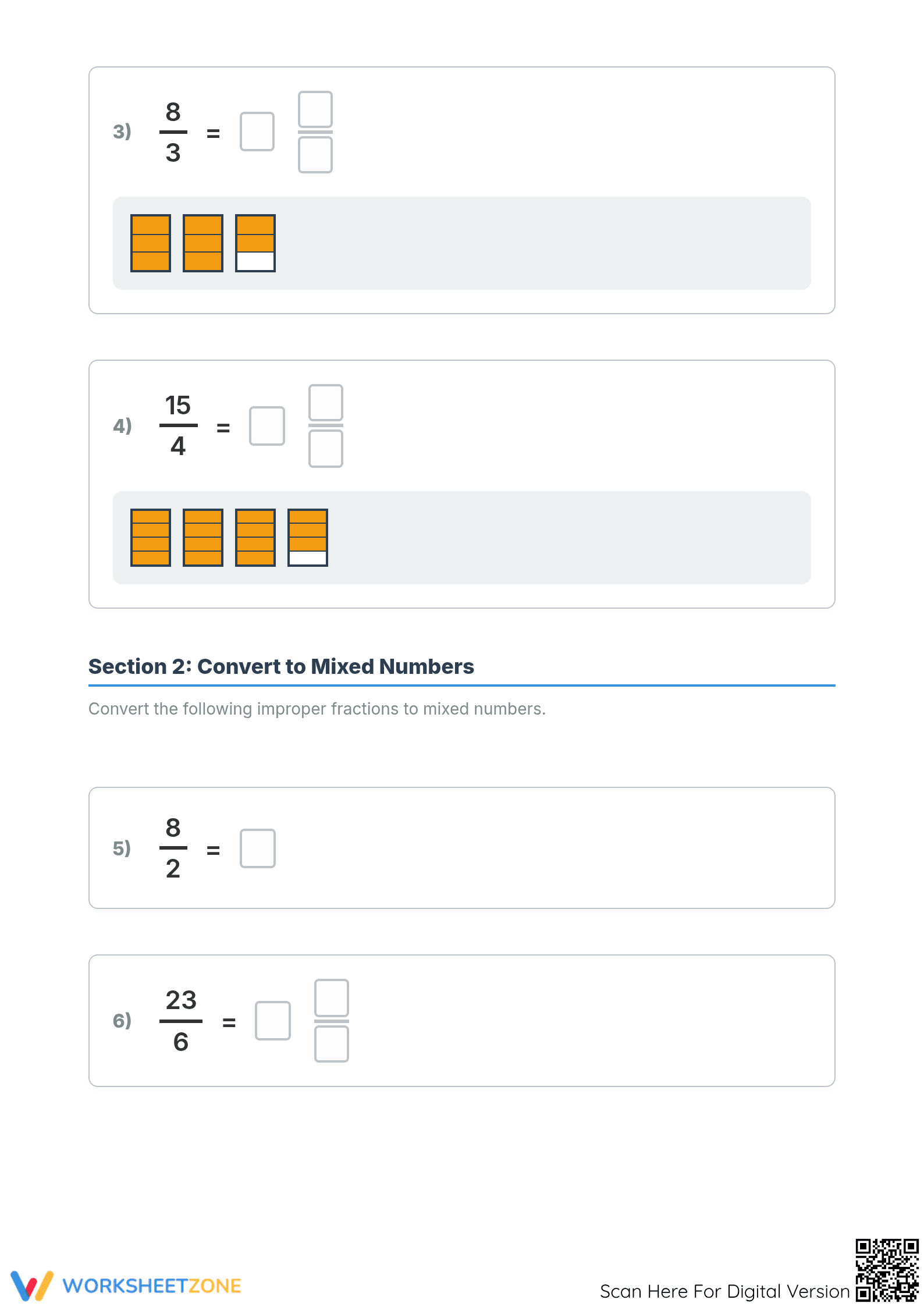
Provide essential, focused practice on a core fraction skill with this comprehensive worksheet. Designed for Grade 5 students, this resource guides learners through the process of converting improper fractions to mixed numbers and vice versa. With a high volume of problems, it’s ideal for building fluency and confidence for more complex fraction operations.
At a Glance
- Grade: 5 · Subject: Math
- Standard:
CCSS.MATH.CONTENT.4.NF.B.3— Understand a fraction a/b with a > 1 as a sum of fractions 1/b.- Skill Focus: Converting Improper Fractions to Mixed Numbers
- Format: 5 pages · 120 problems · Answer key included · PDF
- Best For: Fluency practice, homework, or formative assessment
- Time: 25–40 minutes
What's Inside
This five-page resource includes a full answer key. Each worksheet is split into two sections: 12 problems converting improper fractions to mixed numbers, and 12 problems converting mixed numbers to improper fractions. The consistent format provides predictability, allowing students to focus on the mathematical process of converting fractions.
Skill Progression
This set supports mastery through high-volume practice. The consistent task format reduces cognitive load so students can build procedural fluency.
- Guided Practice: Use the first page (24 problems) for direct instruction, modeling the division and multiplication/addition methods for conversion.
- Supported Practice: The next two pages (48 problems) are well-suited for partner work, where students can collaborate and solidify their understanding.
- Independent Practice: The final two pages (48 problems) serve as an excellent tool for independent work, homework, or formative assessment to gauge individual student mastery.
Standards Alignment
This worksheet aligns with CCSS.MATH.CONTENT.4.NF.B.3, which requires students to understand the composition of fractions. This skill is a critical prerequisite for CCSS.MATH.CONTENT.5.NF.A.1 (adding and subtracting fractions with unlike denominators). Both standard codes can be copied directly into lesson plans, IEP goals, or district curriculum mapping tools.
How to Use It
Use this resource after a direct lesson for immediate guided practice or assign pages for homework. For a quick formative assessment, have students complete one 12-problem section as a class warm-up. Teachers can quickly scan for common errors to inform the day's instruction. Expect students to complete one full page in 15-20 minutes.
Who It's For
Primarily for 5th-grade students, this is also an effective intervention tool for middle schoolers needing practice before tackling complex algebra. The worksheet pairs well with a visual anchor chart that shows the conversion steps, providing a constant reference point for students as they work.
Procedural fluency in fraction operations is a critical gateway to higher-level mathematics. This worksheet provides extensive practice aligned with CCSS.MATH.CONTENT.4.NF.B.3, focusing on the conversion between improper fractions and mixed numbers. Research underscores the importance of such practice; a comprehensive RAND AIRS 2024 review highlights that computational fluency frees up cognitive resources for students to engage in more complex problem-solving. By offering 120 targeted problems, this resource helps students move beyond step-by-step execution to achieve automaticity. This mastery is essential for future success in algebra, where the ability to manipulate rational expressions mirrors the skills developed here. This targeted practice directly addresses the need for strong foundational skills, which studies have repeatedly shown to be a key predictor of long-term mathematical achievement for students.


