


























Views
Downloads



Essential Improper to Mixed Fractions Grade 3 Worksheet
Paste this activity's link or code into your existing LMS (Google Classroom, Canvas, Teams, Schoology, Moodle, etc.).
Students can open and work on the activity right away, with no student login required.
You'll still be able to track student progress and results from your teacher account.
Empower Grade 3 students to master fraction transitions with this comprehensive set. The resource focuses on converting improper fractions to mixed numbers, effectively bridging the gap between abstract values and tangible representations. Students develop deep conceptual understanding through structured, multi-page practice that builds confidence before introducing complex word problems.
At a Glance
- Grade: 3 · Subject: Math
- Standard:
CCSS.MATH.CONTENT.3.NF.A.1— Understand fractions as parts of a whole and represent values greater than one- Skill Focus: Improper to Mixed Fraction Conversion
- Format: 4 pages · 24 problems · Answer key included · PDF
- Best For: Small group instruction or independent math centers
- Time: 25–40 minutes
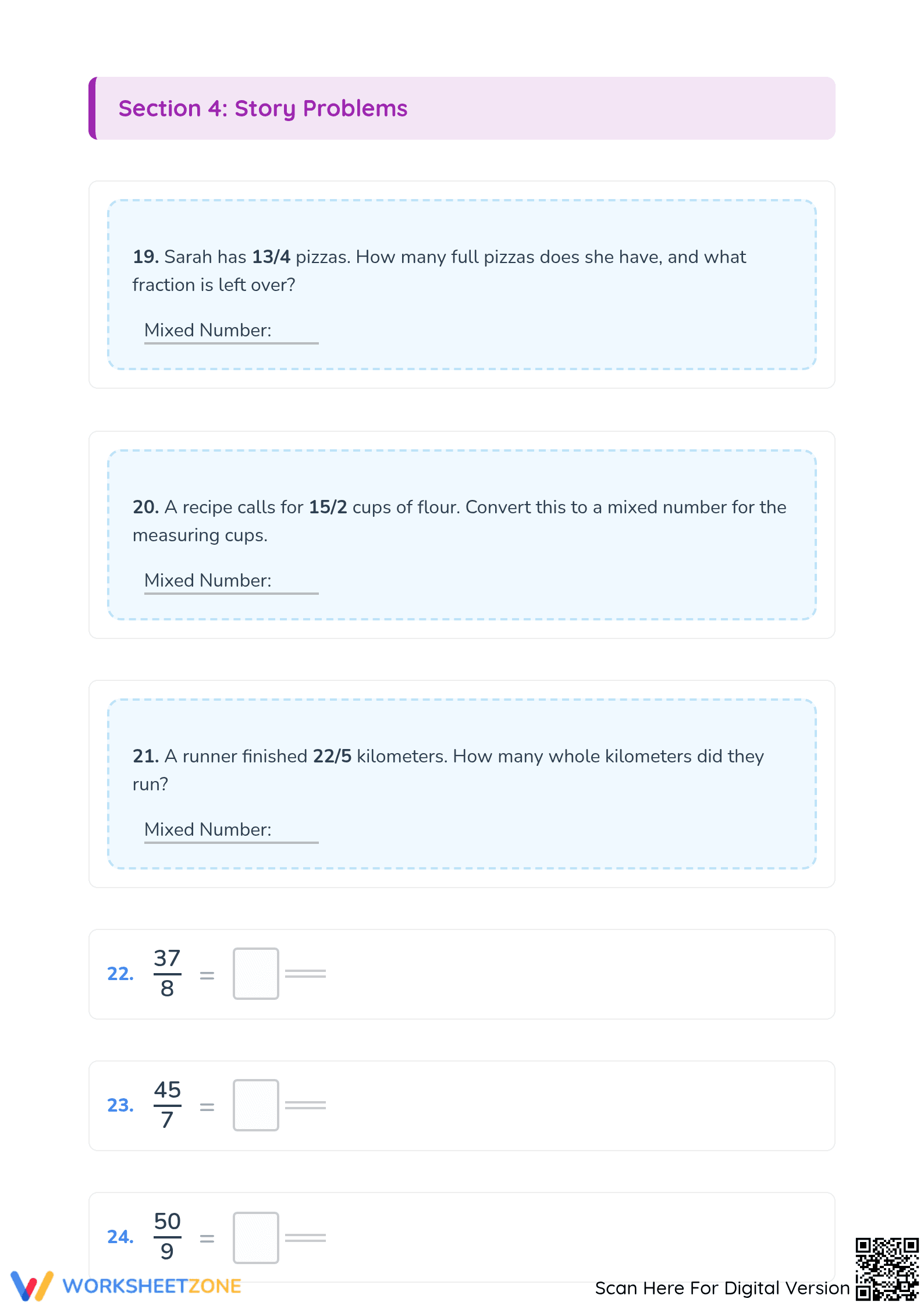
This four-page collection includes 24 problems across four distinct sections. Page one introduces basics with a visual example. Pages two and three build fluency through the 'Practice Zone' and 'Applied Math' sections. The final page challenges students with story problems involving real-world contexts like pizza and distance. A full answer key ensures efficient review.
- Guided Practice: Section 1 provides a visual model and worked example (13/4) to ground students in the concept before attempting the first four problems.
- Supported Practice: Sections 2 and 3 offer 13 problems in a consistent format, allowing students to refine division and remainder skills with varied denominators.
- Independent Application: 'Story Problems' require students to translate real-world scenarios into fraction notation and final mixed numbers.
Aligned with `CCSS.MATH.CONTENT.3.NF.A.1`, students understand fractions as quantities of parts. Converting values where the numerator is greater than the denominator demonstrates a grasp of values greater than one. Standard codes can be copied into lesson plans or IEP goals.
Introduce this after using fraction tiles. Use page one for guided practice to ensure students handle remainders correctly. Observe if students identify whole number results without remainders for formative assessment. Expected completion is 30 minutes.
Ideal for Grade 3 students or Grade 4 intervention. Differentiation occurs through the progression from numeric tasks to word problems. Pair with a number line anchor chart to visualize mixed numbers relative to integers.
Educational research emphasizes that students often struggle with fractions when they view them as two separate integers rather than a single numerical value. According to Fisher & Frey (2014), the gradual release of responsibility—moving from the worked examples on page one to the independent word problems on page four—is critical for internalizing complex mathematical transformations. By requiring students to 'show their thinking' and apply conversions to story-based contexts, this worksheet supports the development of both procedural fluency and conceptual depth. Standardized assessments, including NAEP metrics, frequently highlight the ability to convert improper fractions as a gateway skill for successful operations with fractions in later grades. This resource provides the high-repetition, low-anxiety practice necessary for students to achieve mastery in alignment with CCSS.MATH.CONTENT.3.NF.A.1. Fisher & Frey (2014) highlights that scaffolding numeric fluency before application in word problems significantly improves retention for diverse learners.


