


























Views
Downloads

Essential Constant of Proportionality Worksheet | Grade 7
Paste this activity's link or code into your existing LMS (Google Classroom, Canvas, Teams, Schoology, Moodle, etc.).
Students can open and work on the activity right away, with no student login required.
You'll still be able to track student progress and results from your teacher account.
Mastering the constant of proportionality is a foundational requirement for success in middle school algebra. This comprehensive packet provides structured practice for students to identify the unchanging ratio between directly proportional values across multiple representations. By the end of these exercises, learners will confidently calculate the unit rate from data sets and apply it to real-world mathematical models.
At a Glance
- Grade: 7 · Subject: Math
- Standard:
7.RP.A.2b— Identify the constant of proportionality in tables, graphs, equations, and verbal descriptions- Skill Focus: Unit rate and proportional relationships
- Format: 5 pages · 13 problems · Answer key included · PDF
- Best For: Independent practice or homework review
- Time: 40–50 minutes
What's Inside
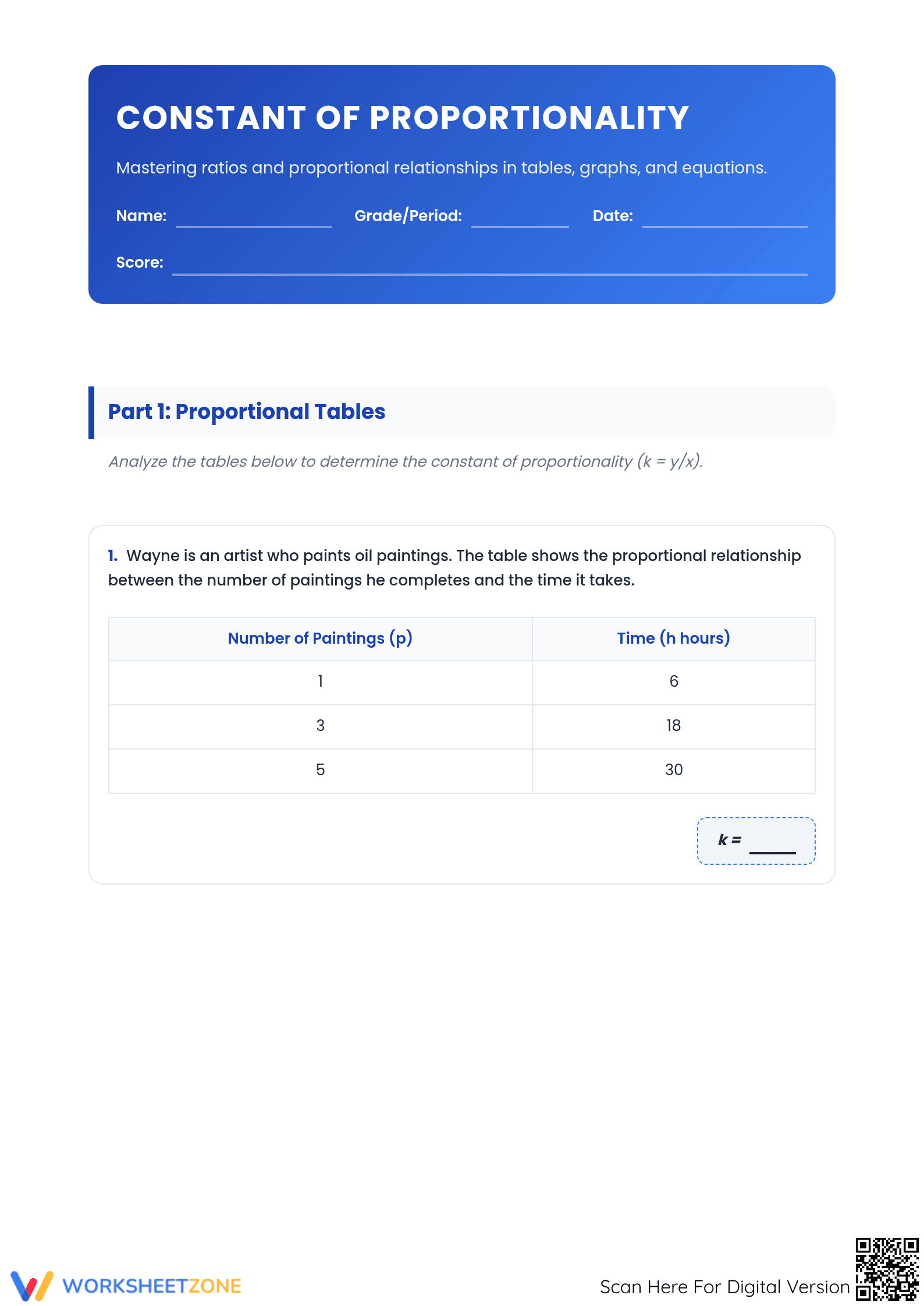
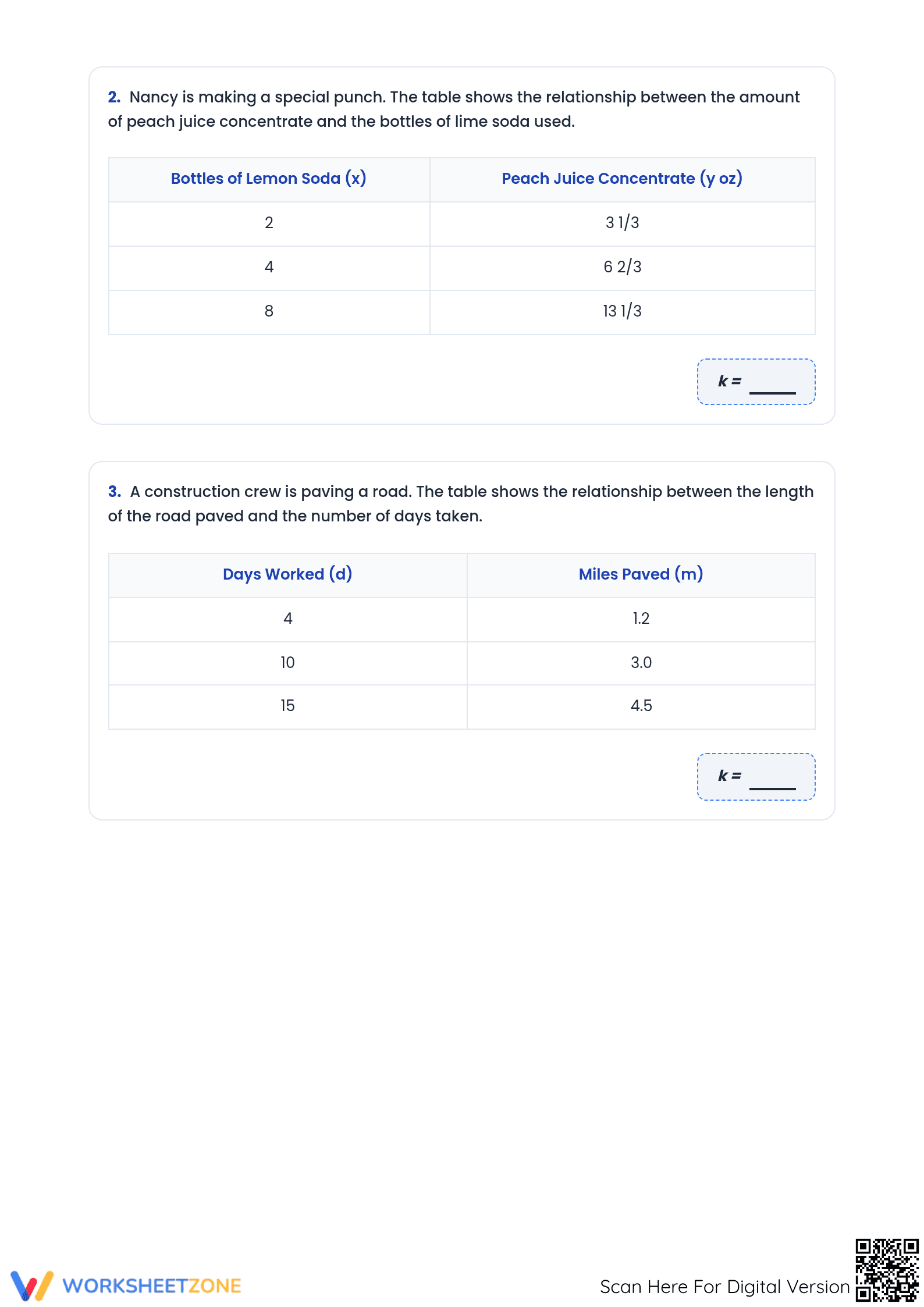
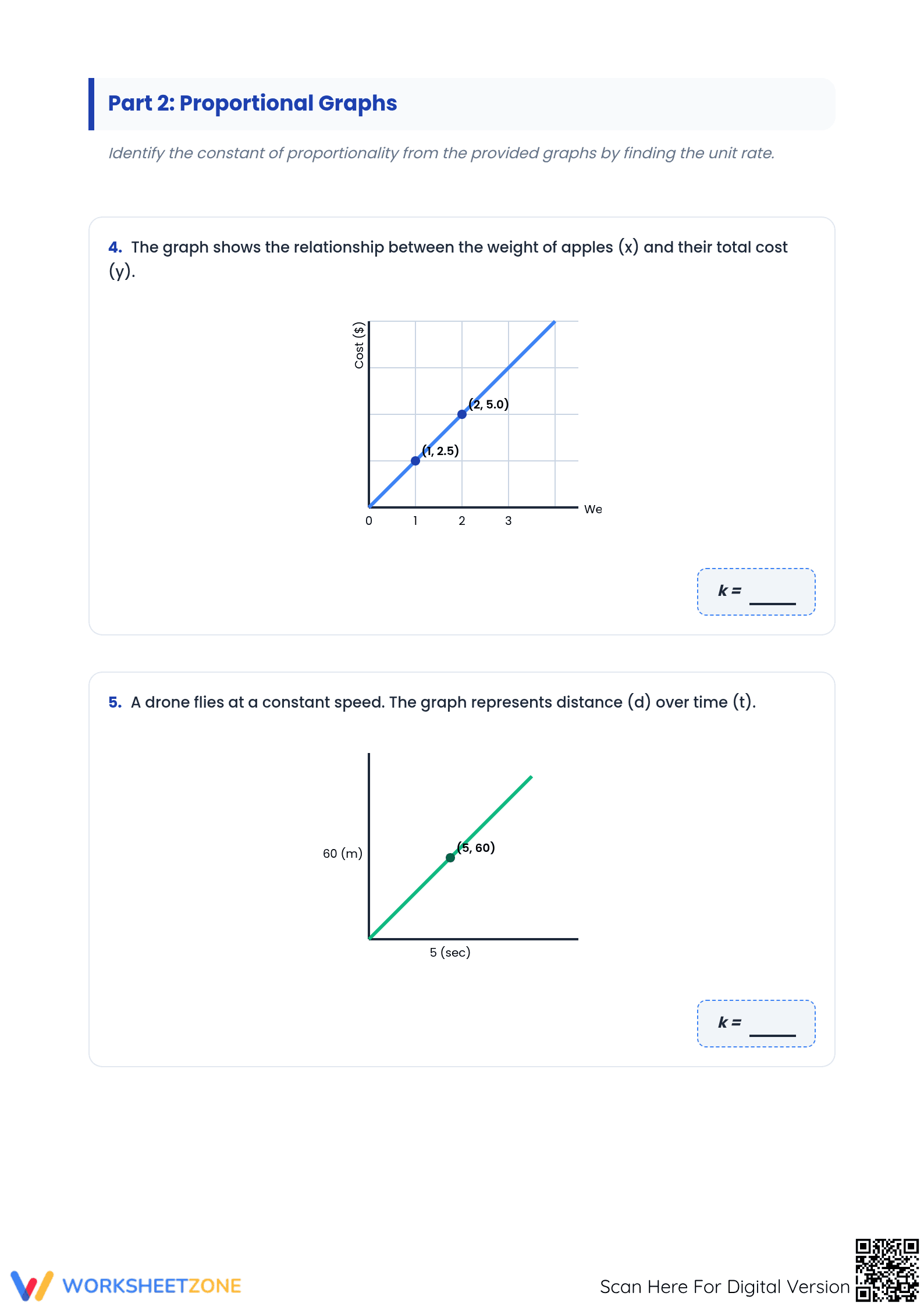
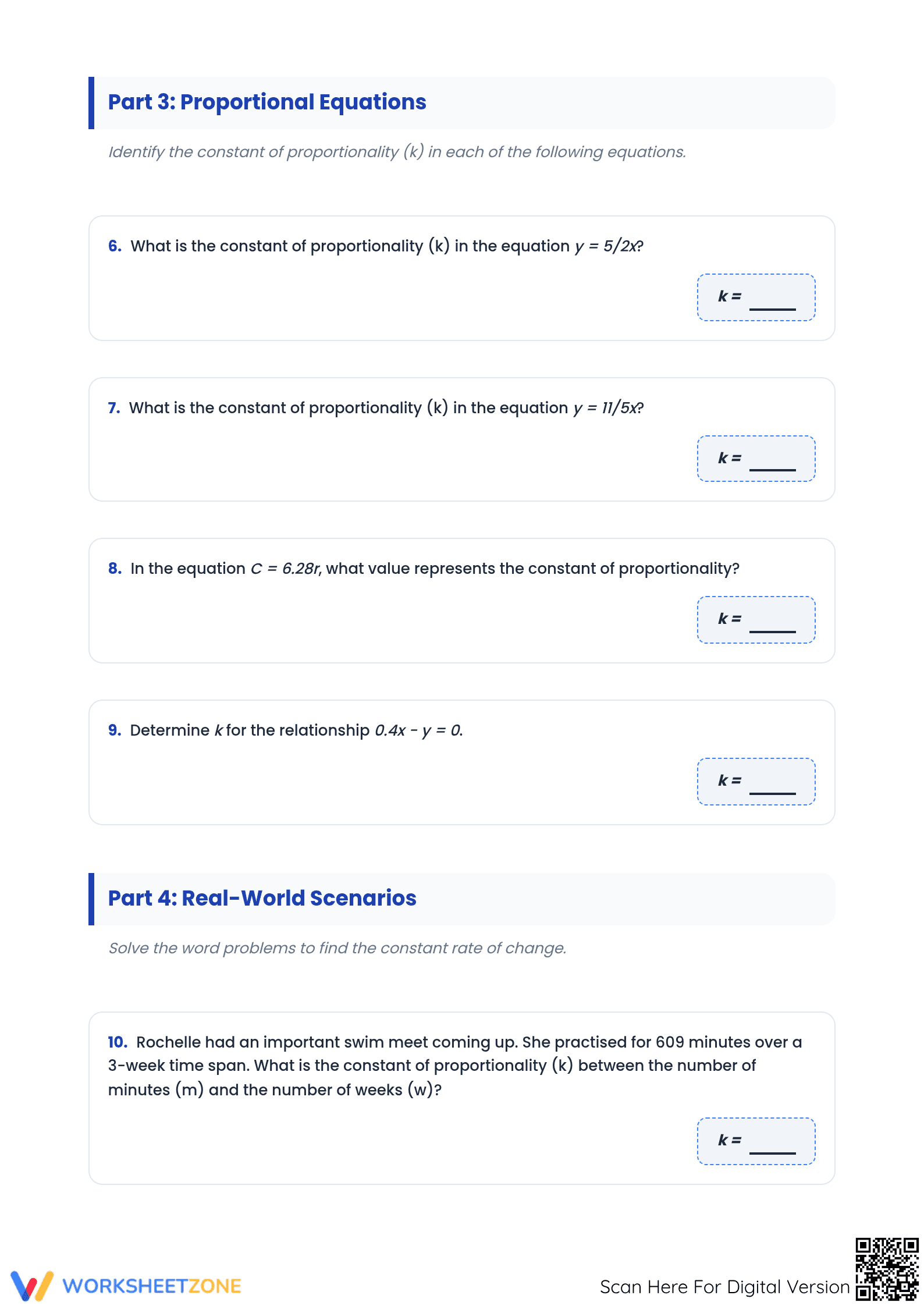
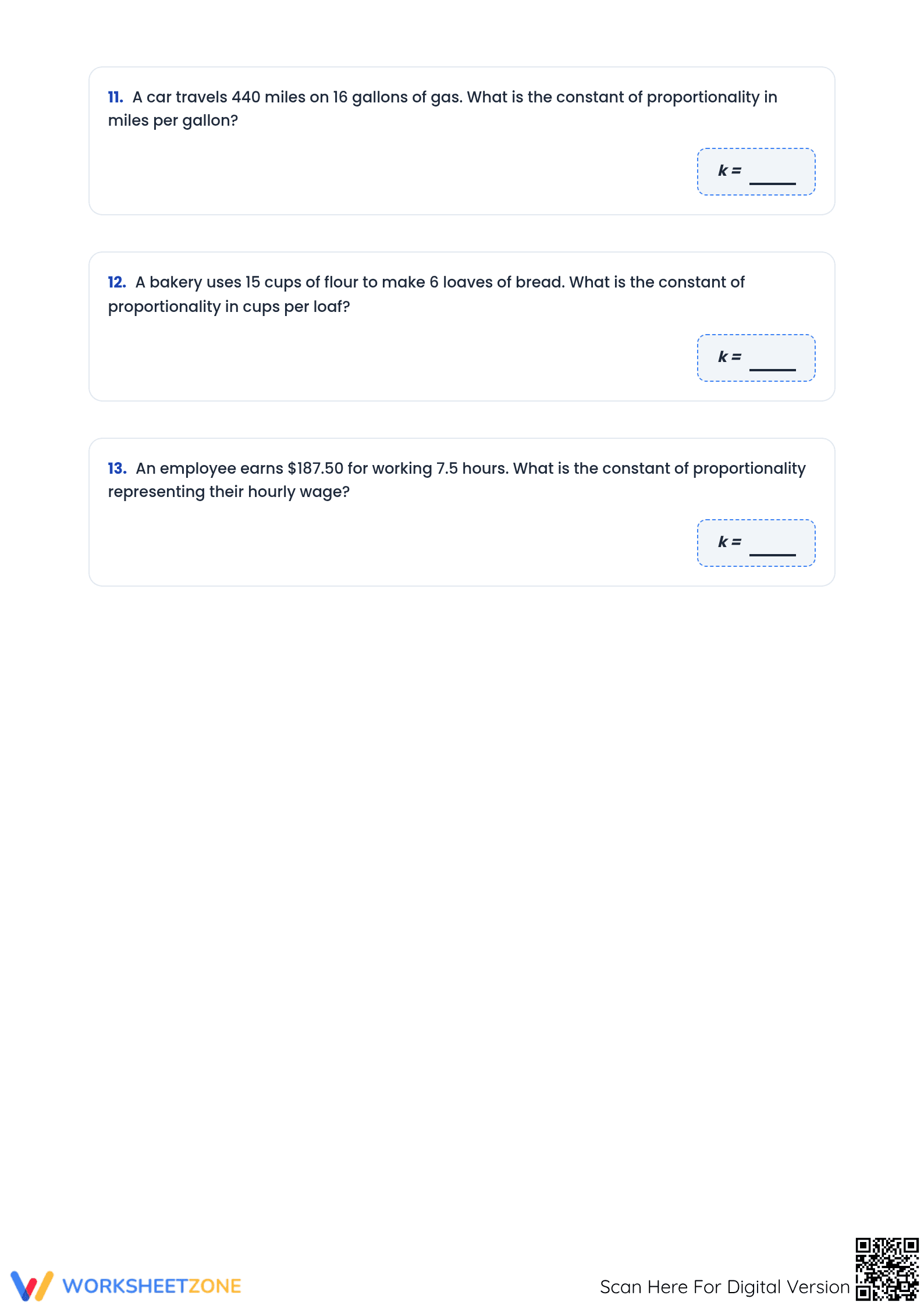
This five-page instructional resource contains thirteen unique tasks distributed across four thematic sections. Students work through three proportional tables, two coordinate plane graphs with labeled points, and four algebraic equations. The final segment presents four multi-step word problems requiring the derivation of constants from real-world contexts like wages and fuel efficiency. A complete answer key is provided for immediate grading.
Zero-Prep Workflow
The zero-prep design allows teachers to implement this lesson in under two minutes. Simply print the five-page packet and distribute it to students for a focused forty-minute session. The clear section headings and worked instructions minimize the need for verbal redirection. This workflow makes the resource an ideal solution for emergency substitute plans or sudden instructional gaps.
Standards Alignment
This resource aligns directly with `CCSS.MATH.CONTENT.7.RP.A.2b`, focusing on identifying the constant of proportionality (unit rate) in tables, graphs, equations, and verbal descriptions of proportional relationships. The tasks also support the development of MP4 (Model with mathematics) as students translate scenarios into mathematical constants. Both standard codes can be copied directly into lesson plans, IEP goals, or district curriculum mapping tools.
How to Use It
Assign Part 1 and Part 2 as guided practice immediately following a direct instruction session on ratios. Use the word problems in Part 4 as a formative assessment to check if students can transfer their calculation skills to unfamiliar scenarios. During completion, observe if students consistently use the k=y/x formula when dealing with non-integer constants. Completion typically takes one full class period.
Who It's For
This practice set is designed for Grade 7 math students but serves as an effective remediation tool for Grade 8 and Grade 9 learners. The scaffolded structure supports English Language Learners by providing visual representations before moving to abstract equations. It pairs naturally with a ratio table anchor chart to reinforce unit rates.
Aligned to the 7.RP.A.2b standard, this worksheet targets the critical skill of identifying the constant of proportionality in diverse mathematical formats. Research by Fisher & Frey (2014) emphasizes the importance of providing students with multiple representations—including graphical, tabular, and verbal models—to build deep conceptual understanding of proportional relationships. By requiring students to calculate the unit rate (k) through thirteen structured problems, this resource facilitates the cognitive shift from concrete calculation to abstract algebraic modeling. The inclusion of real-world scenarios ensures that learners perceive the practical utility of these mathematical constants in everyday applications like hourly wages and unit conversion. This multi-representation approach is validated by recent EdReports findings as a high-impact strategy for middle school mathematics mastery. Educators can rely on this validated instructional design to provide rigorous evidence-based practice that bridges the gap between basic ratios and complex linear functions.


