


























Views
Downloads

Essential Compound Words Worksheet | Grade 1 ELA
Paste this activity's link or code into your existing LMS (Google Classroom, Canvas, Teams, Schoology, Moodle, etc.).
Students can open and work on the activity right away, with no student login required.
You'll still be able to track student progress and results from your teacher account.
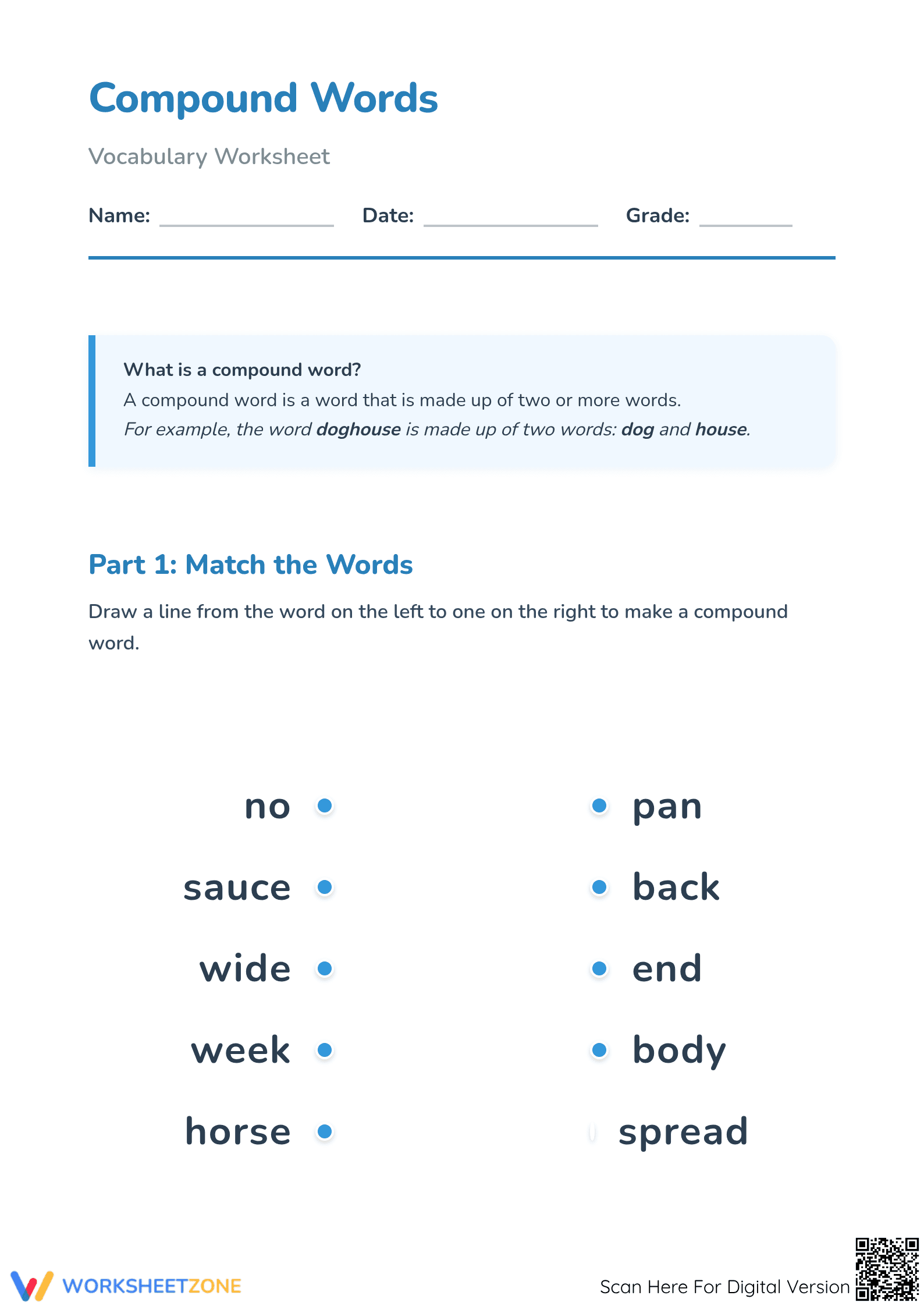
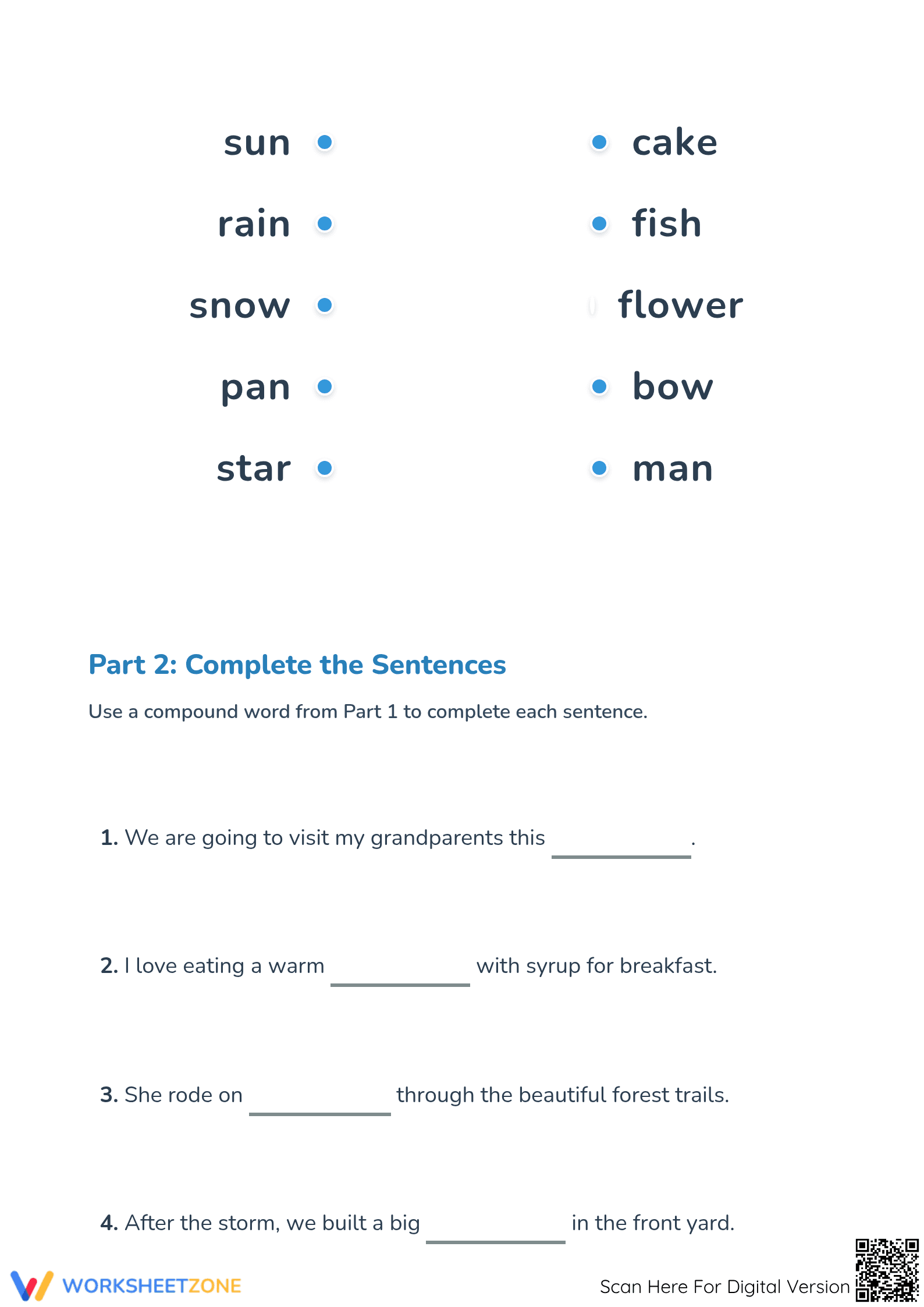
This Grade 1 compound words worksheet helps students build essential vocabulary by joining two independent words to create new meanings. Students engage in 14 structured tasks that move from simple word matching to contextual application in sentences. By mastering these word parts, young learners improve their decoding skills and expand their reading comprehension through morphological awareness.
At a Glance
- Grade: 1 · Subject: ELA
- Standard:
CCSS.ELA-LITERACY.L.1.4— Determine or clarify the meaning of unknown and multiple-meaning words- Skill Focus: Compound word construction
- Format: 2 pages · 14 problems · Answer key included · PDF
- Best For: Independent practice or morning work
- Time: 15–20 minutes
The worksheet consists of two high-quality printable pages. Page one features a clear, student-friendly definition of compound words using the "doghouse" example to anchor understanding. It then presents the first half of a 10-item matching exercise. Page two completes the matching set and introduces a sentence-completion section where students must apply their newly formed words in context. A full answer key is included for rapid grading.
This resource is designed for immediate classroom implementation with a total teacher preparation time of under 2 minutes. Step 1: Print the two-page PDF (30 seconds). Step 2: Distribute to students for independent or small-group work (30 seconds). Step 3: Review using the provided answer key for instant feedback (1 minute). The clear layout and included definition make it an ideal candidate for emergency sub plans.
This resource aligns with CCSS.ELA-LITERACY.L.1.4, which requires students to determine or clarify the meaning of unknown and multiple-meaning words and phrases. Specifically, it addresses the foundational skill of understanding how word parts combine to alter meaning. The inclusion of sentence-level practice also supports vocabulary acquisition. This standard code can be copied directly into lesson plans, IEP goals, or district curriculum mapping tools.
Use this worksheet during the "You Do" phase of a gradual release lesson on word parts. After introducing the concept with an anchor chart, assign the matching section as a formative assessment to check for recognition. The sentence completion section works best as a follow-up activity to ensure students understand the semantic shift that occurs when words combine. Expected completion time is 15 to 20 minutes.
This activity is tailored for first-grade students but serves as an excellent intervention tool for second graders needing a refresher on word structures. It is particularly effective for English Language Learners (ELLs) who benefit from seeing how familiar base words like "sun" and "flower" create new concepts. Pair this with a compound word picture sort for a comprehensive literacy center.
Research from Fisher & Frey (2014) emphasizes that morphological awareness, including the ability to combine base words into compound structures, is a significant predictor of reading comprehension in early elementary grades. This worksheet targets CCSS.ELA-LITERACY.L.1.4 by requiring students to physically and cognitively bridge two distinct lexical units to form a single semantic concept. By utilizing both matching and sentence completion, the resource follows a scaffolded approach to vocabulary acquisition. According to the NAEP framework, early mastery of word-building strategies reduces cognitive load during decoding, allowing first-grade learners to focus on fluency and meaning. This 14-task printable provides the structured repetition necessary for students to internalize common compound word patterns, ensuring they can identify and define these terms when encountered in complex texts. It serves as a foundational tool for developing the linguistic flexibility required for higher-level literacy tasks.


