


























Views
Downloads
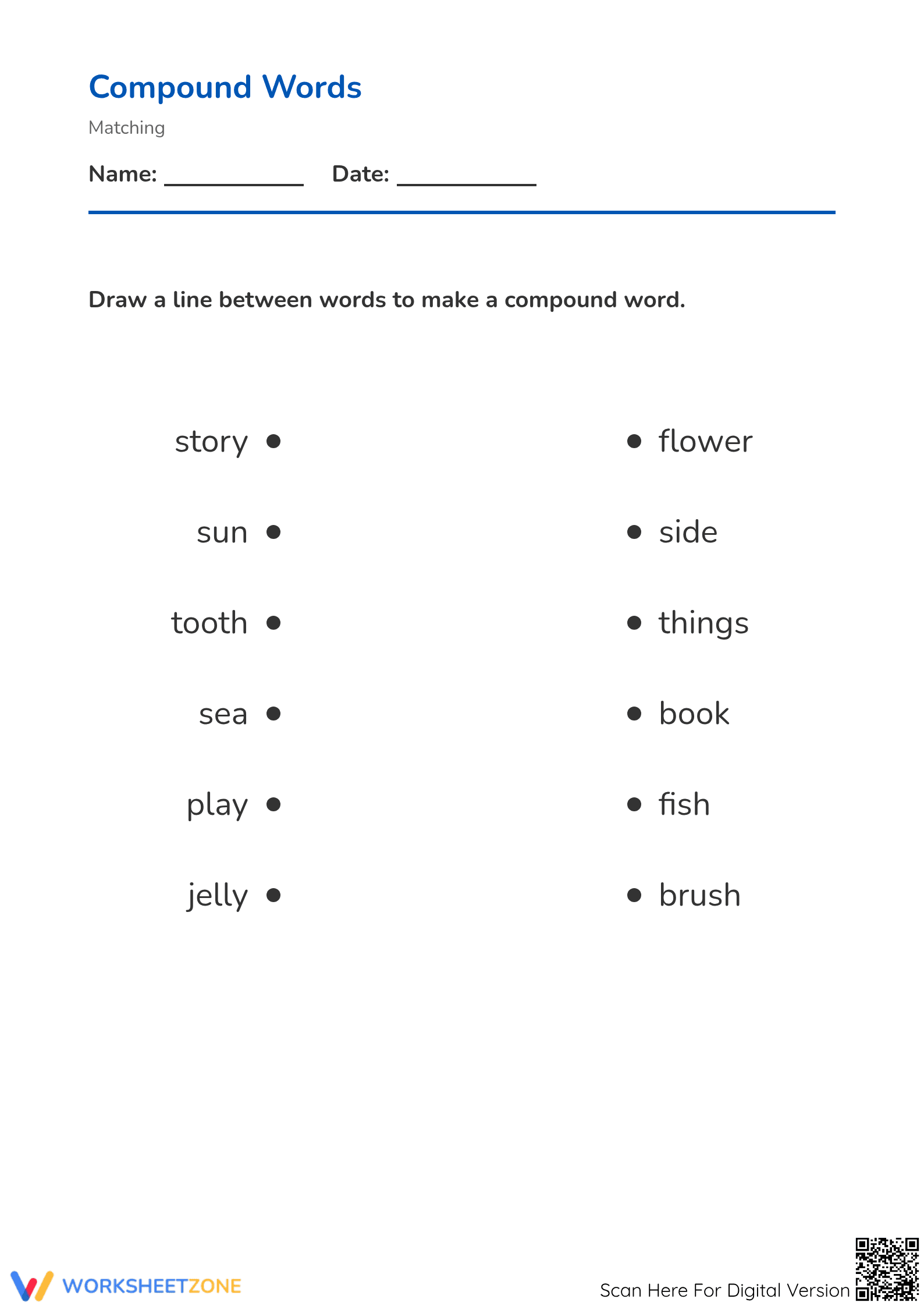

Grade 1 Compound Words — Printable No-Prep Worksheet
Paste this activity's link or code into your existing LMS (Google Classroom, Canvas, Teams, Schoology, Moodle, etc.).
Students can open and work on the activity right away, with no student login required.
You'll still be able to track student progress and results from your teacher account.
This Grade 1 English Language Arts worksheet helps students build vocabulary by identifying and forming compound words. By drawing lines to connect root words like "sun" and "flower," young learners develop essential word analysis skills and expand their reading comprehension. The straightforward matching format ensures immediate engagement and focused practice.
At a Glance
- Grade: 1 · Subject: ELA
- Standard:
CCSS.ELA-LITERACY.L.1.4— Determine the meaning of unknown words- Skill Focus: Forming Compound Words
- Format: 1 page · 6 problems · Answer key included · PDF
- Best For: Independent practice and morning work
- Time: 5–10 minutes
Inside this single-page resource, educators will find a clear, distraction-free matching activity featuring six common compound word pairs. Students read the root words on the left side of the page and draw a connecting line to the corresponding root word on the right side. The layout uses a large, readable font perfect for early readers. A complete answer key is provided on a separate page, allowing for quick grading or self-checking by students.
Zero-Prep Workflow
This resource is designed for immediate classroom implementation:
- Print (1 min): Download the PDF and print. The black-and-white design saves ink.
- Distribute (1 min): Hand out during morning work or literacy centers. Instructions are simple enough for independent work.
- Review (1 min): Use the included answer key to rapidly check student work.
With prep time under two minutes, this activity is perfect for emergency sub plans.
Standards Alignment
This worksheet aligns with CCSS.ELA-LITERACY.L.1.4, requiring students to determine the meaning of unknown words based on grade 1 reading. By combining known words to form a new concept, students practice foundational morphological skills. Both standard codes can be copied directly into lesson plans, IEP goals, or district curriculum mapping tools.
How to Use It
This matching activity works exceptionally well as an independent literacy center task after direct instruction on compound words. Teachers can also assign it as a quick formative assessment at the end of a phonics lesson. While students are working, observe whether they are reading both columns completely before drawing their lines, which indicates strong decoding skills rather than guessing. Most first graders will complete this focused task within a 5 to 10-minute timeframe.
Who It's For
This worksheet is primarily designed for first-grade students developing their vocabulary and word recognition skills. It serves as an excellent reinforcement tool for students who benefit from visual matching and straightforward, uncluttered layouts. For differentiation, teachers can pair this activity with physical word cards or an anchor chart displaying common compound words to support English Language Learners or students needing extra scaffolding.
Mastering compound words is a critical step in early literacy development, directly supporting CCSS.ELA-LITERACY.L.1.4 as students determine the meaning of unknown words. According to Fisher & Frey (2014), explicit vocabulary instruction that includes morphological awareness—such as understanding how smaller, familiar words combine to create entirely new meanings—significantly improves reading comprehension and decoding fluency in primary grades. When young learners practice identifying the individual components of compound words through structured matching exercises, they build a much stronger foundation for tackling complex, multisyllabic words in later academic years. This targeted matching activity provides the exact type of repeated, focused practice necessary to solidify these essential cognitive connections. By integrating this evidence-based approach into daily literacy routines, educators can effectively accelerate vocabulary acquisition and foster greater reading independence among early elementary students.


