































Complete Travel Vocabulary Word Search | Grades 6–8 ELA

Paste this activity's link or code into your existing LMS (Google Classroom, Canvas, Teams, Schoology, Moodle, etc.).
Students can open and work on the activity right away, with no student login required.
You'll still be able to track student progress and results from your teacher account.
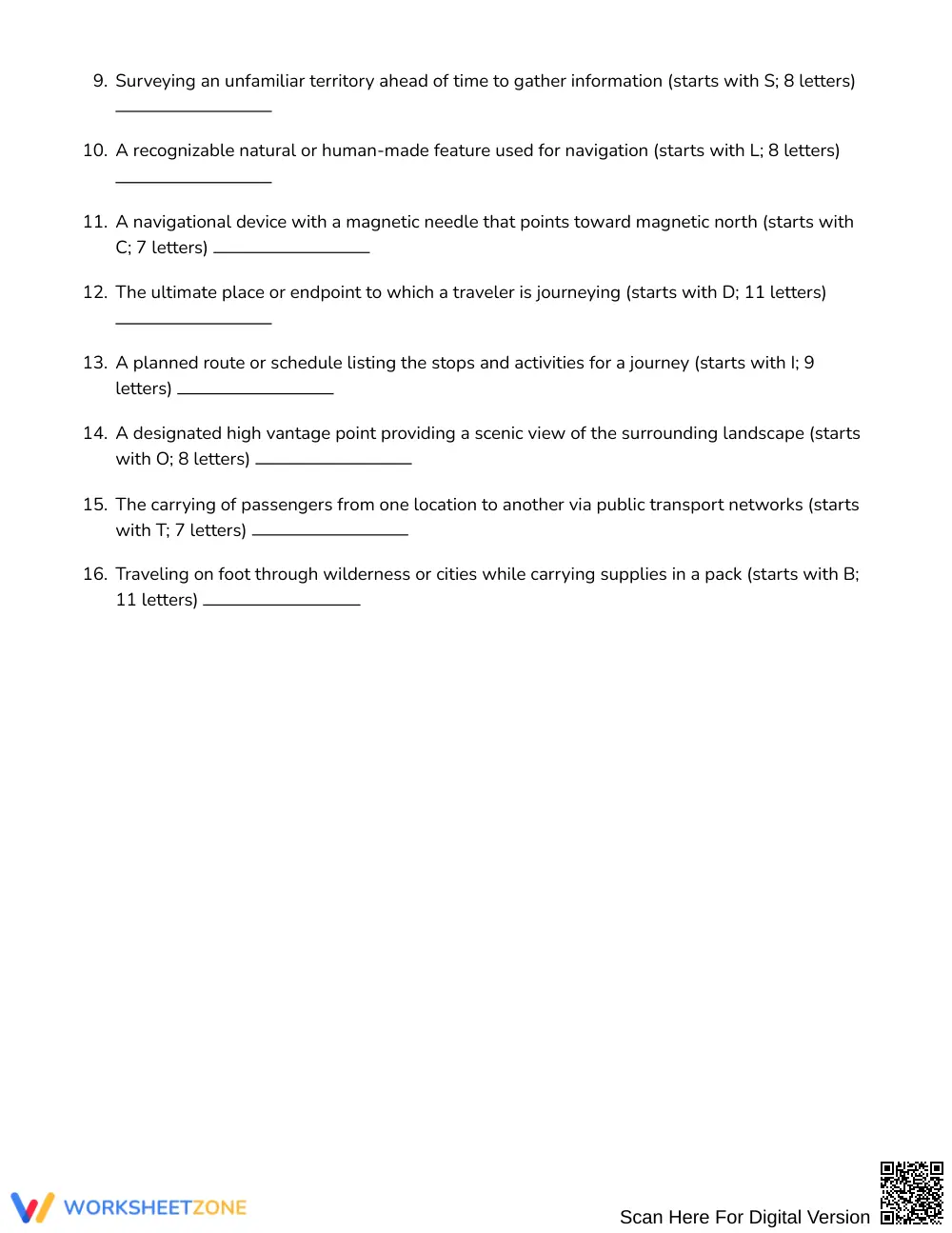
This travel and local exploration word search strengthens adolescent vocabulary through context clues and active retrieval. Students analyze sixteen descriptive clues to identify specialized geography and transit terms, then locate each target word within an intricate letter grid. The resource reinforces domain-specific terminology while supporting orthographic mapping and spelling recognition in middle school English language arts.
At a Glance
- Grade: Grades 6–8 · Subject: English Language Arts (ELA)
- Standard: Not standards-assessed — vocabulary enrichment
- Skill Focus: Travel and local exploration
- Format: 3 pages · 16 words · Answer key included · PDF
- Best For: Vocabulary reinforcement and independent station work
- Time: 20–30 minutes
The printable packet spans 3 pages designed for immediate classroom distribution alongside a comprehensive 3-page answer key. Rather than relying on a passive word bank, the activity features 16 rigorous definition clues that require students to recall or deduce terms such as wayfinding, itinerary, and expedition. Solutions are formatted clearly in the answer key to facilitate peer assessment or rapid self-checking.
Puzzle Mechanics and Structure
This no-bank challenge engages learners through a demanding 18 x 18 letter matrix containing 16 hidden vocabulary words. Words run in all 8 compass directions: north, northeast, east, southeast, south, southwest, west, and northwest, including backward and diagonal placements. By omitting an overt word list and providing descriptive semantic clues instead, the activity demands active semantic retrieval before students begin scanning the grid.
Standards Alignment
This resource serves as targeted vocabulary enrichment and is not aligned to a specific grade-level standard. It provides supplementary language acquisition practice that enriches tier-two and tier-three travel, transit, and exploration terminology for middle school learners.
How to Use It
Deploy this activity during independent practice after introducing informational texts about geography or journeys, or utilize it as an engaging sponge activity for early finishers. Teachers can conduct formative assessment by observing whether students identify the terms from memory or require reference dictionaries to decipher clues like overlook or trailhead. Expected completion time ranges from 20 to 30 minutes.
Who It's For
Designed for Grades 6–8 students, this challenge suits general education classes, language acquisition clusters, and gifted enrichment groups seeking deeper lexical practice. For differentiated support, pair this activity with an illustrated travel anchor chart or personal student glossaries before students search the puzzle.
Vocabulary acquisition in middle school requires deliberate opportunities for retrieval and contextual application. According to Fisher & Frey (2014), intentional word study that connects definitions to structured language tasks reinforces semantic pathways and aids long-term retention across secondary content areas. This 16-word travel and exploration word search for Grades 6–8 integrates definitional clues with orthographic visual scanning across an 18 x 18 grid, transforming a traditional puzzle into an active retrieval exercise. Rather than copying terms from a passive list, learners synthesize context clues to identify domain-specific words such as itinerary, wayfinding, and expedition. This approach supports lexical precision, word consciousness, and spelling consolidation without standard-specific assessment constraints. Middle school educators can integrate this enrichment task into literacy centers, thematic geography units, or independent practice blocks to bolster student engagement and deepen functional vocabulary mastery.


