




























Complete Total Accumulation Worksheet | Grade 12 Calculus
Paste this activity's link or code into your existing LMS (Google Classroom, Canvas, Teams, Schoology, Moodle, etc.).
Students can open and work on the activity right away, with no student login required.
You'll still be able to track student progress and results from your teacher account.
This Grade 12 calculus worksheet develops students' ability to model real-world accumulation using definite integrals. High school seniors analyze rate equations, determine curve intersections, and calculate both net signed change and total bounded area across physical contexts. Students leave equipped to evaluate engineering thresholds, resource capacities, and dynamic rate balances with mathematical precision.
At a Glance
- Grade: 12 · Subject: Calculus
- Standard: Integral Applications — Model net change and accumulation across intersecting rate functions
- Skill Focus: Model Total Accumulation in an Applied Scenario
- Format: 5 pages · 10 problems · Answer key included · PDF
- Best For: Advanced definite integral application practice
- Time: 45–60 minutes
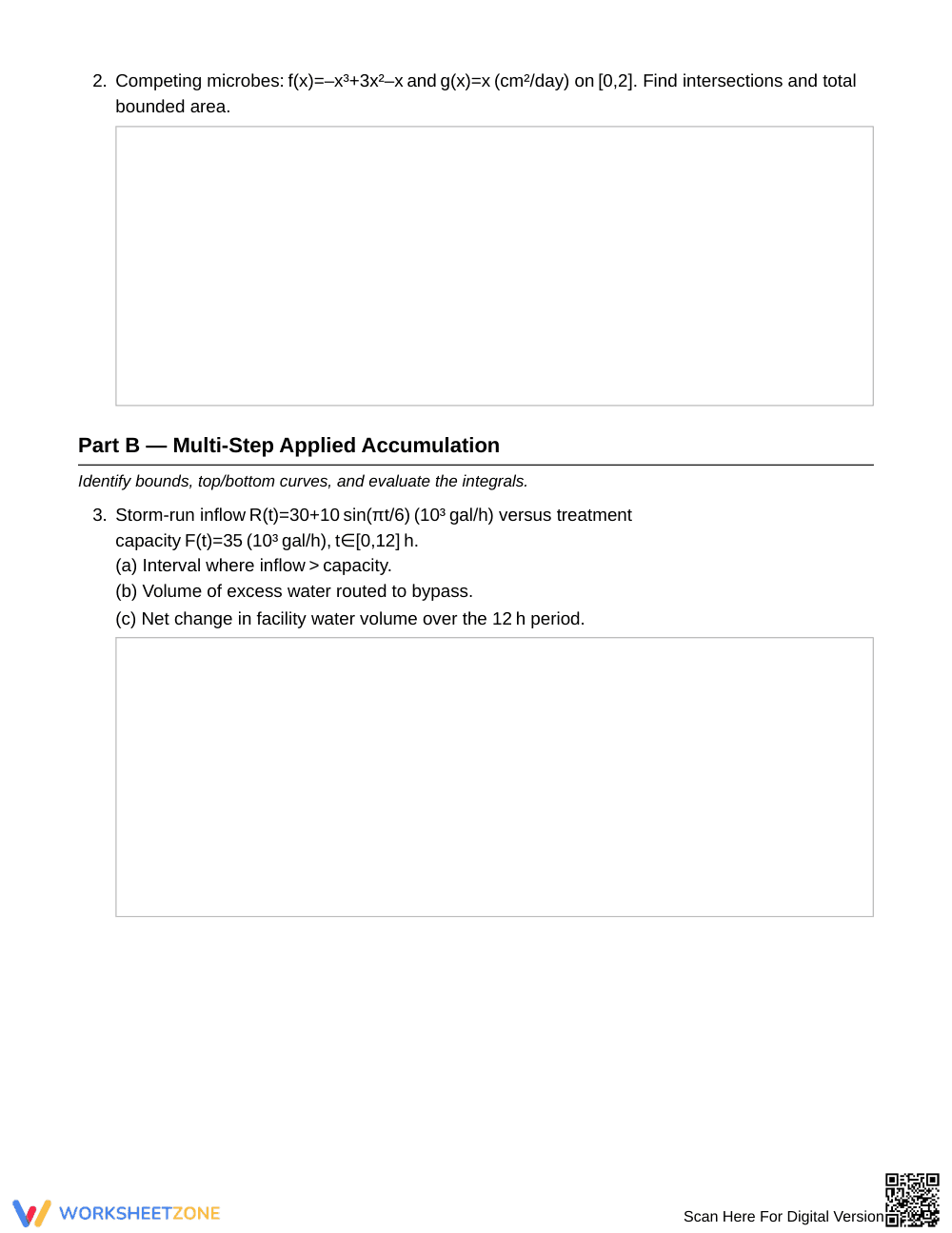
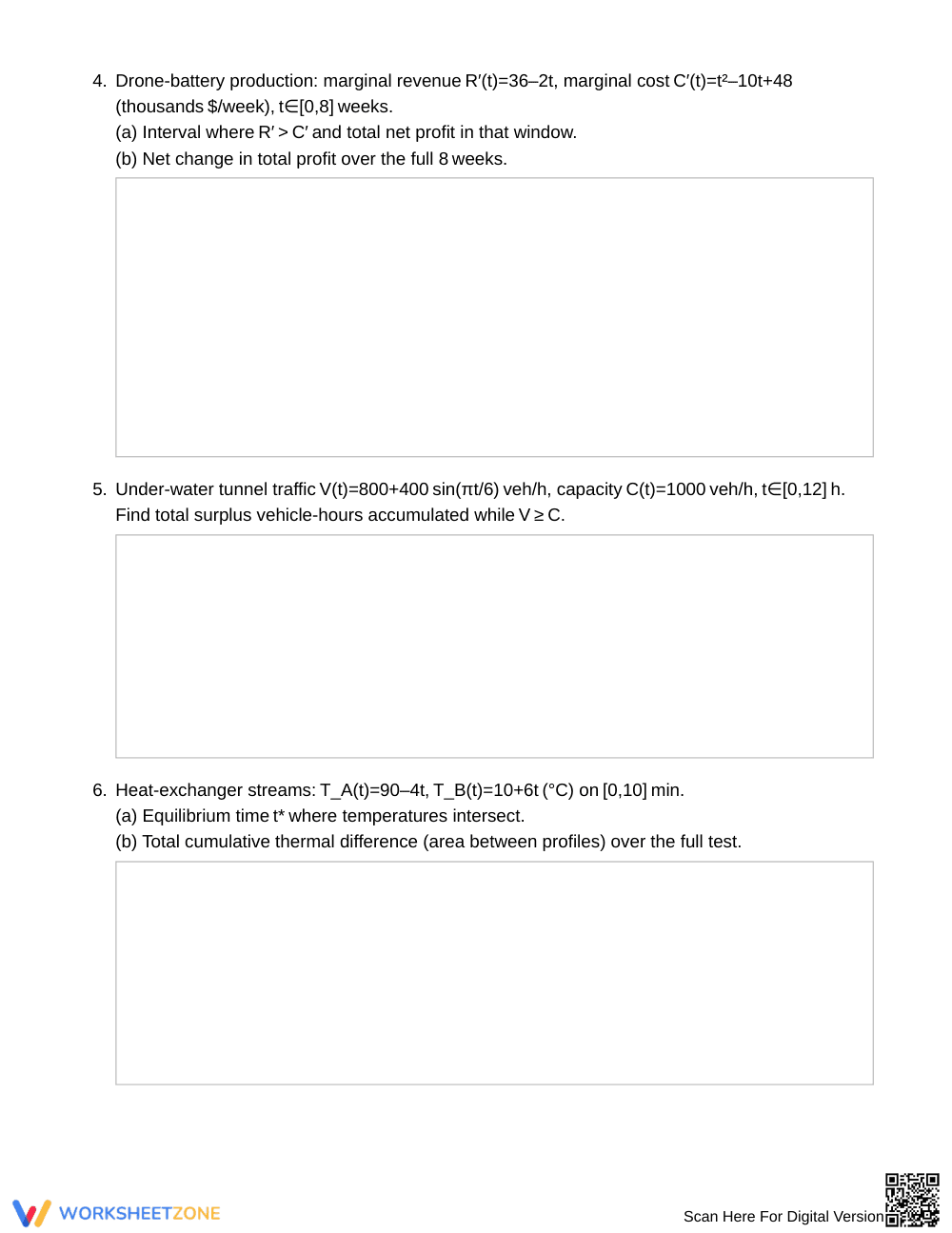
This 5-page printable resource delivers 10 rigorous, multi-part mathematical modeling tasks accompanied by a comprehensive 2-page answer key. The opening page provides a foundational reference box defining net change versus absolute bounded area alongside a worked reservoir flow exemplar. Tasks span renewable power grids, storm runoff management, manufacturing finance, and chemical reaction turnover, requiring exact definite integrals and interpreted decimal values.
Skill Progression
- Guided practice (Part A, Problems 1–2): Direct two-curve models with provided intervals that scaffold curve identification and contrast net surplus against absolute geometric area.
- Supported practice (Part B, Problems 3–8): Multi-step real-world scenarios requiring students to solve for intersection points, evaluate piece-wise accumulation intervals, and interpret operational extrema.
- Independent practice (Part C, Problems 9–10): Complex optimization and policy-selection problems challenging learners to track continuous storage ceilings and evaluate piecewise extraction strategies.
This structured progression follows the gradual-release framework, transitioning students from formulaic computation to autonomous engineering decisions.
Standards Alignment
This resource directly targets core AP Calculus and advanced high school calculus objectives covering applications of integration. Students interpret definite integrals as accumulators of rates of change, determine boundaries by equating functions, and compute areas of regions bounded by multiple curves. This targeted alignment integrates directly into lesson plans, AP exam preparation units, or district curriculum mapping tools.
How to Use It
Deploy this worksheet after direct instruction on the Fundamental Theorem of Calculus and area between intersecting curves. Use Part A and Part B during collaborative workshop sessions where pairs analyze rate curves, and assign Part C as an individual summative check. During class practice, formatively check whether students remember to take the absolute value when computing total physical volume rather than signed net change. Expected completion time spans 45 to 60 minutes.
Who It's For
This worksheet is tailored for Grade 12 AP Calculus AB, BC, or honors calculus students mastering integral modeling. For learners requiring extra support, have them sketch and shade top versus bottom curves before integrating. Pair this exercise with a graphing utility exploration or an applied differential equations lecture on conservation of mass.
Mastering total accumulation modeling in Grade 12 Calculus requires students to synthesize algebraic curve analysis, definite integration, and contextual rate interpretation. According to Fisher & Frey (2014), structuring complex mathematical problem sets through gradual release ensures that students successfully transition from basic procedural calculations to autonomous, higher-order modeling. This worksheet operationalizes that research by leading learners from basic two-rate surplus comparisons to multi-stage engineering decisions and capacity thresholds. Students systematically distinguish between net signed change and total area bounded between functions, reinforcing the physical meaning of integration across 10 rich applied scenarios. By embedding concrete contexts—such as solar battery storage limits, chemical kinetics, and civic water management—the tasks demonstrate how definite integrals quantify physical accumulation. This rigorous problem progression establishes a dependable bridge between pure calculus mechanics and real-world scientific modeling, making it an essential resource for advanced secondary STEM courses.


