





























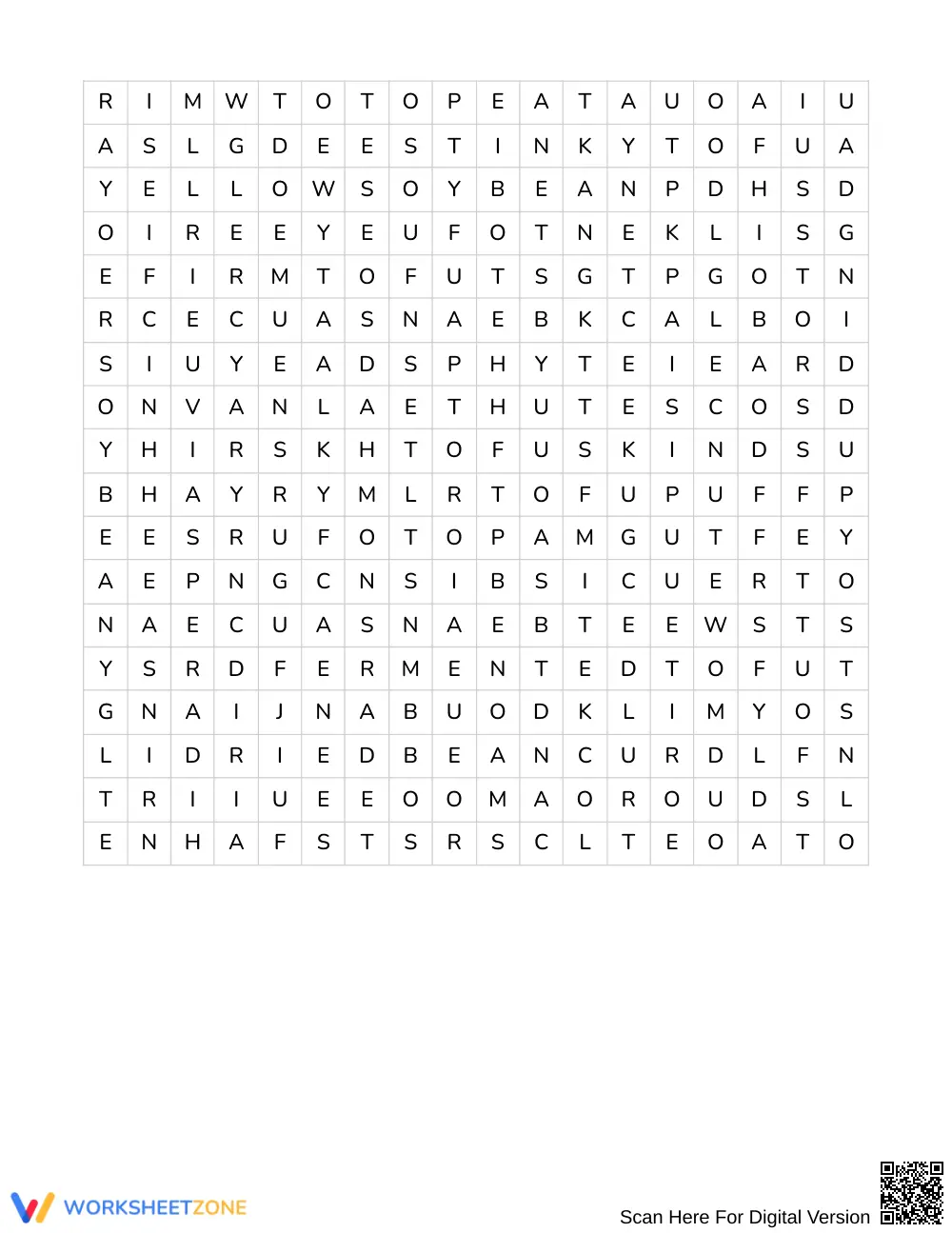


Complete Tofu & Soy Food Word Search | Grades 6–7 ELA

Paste this activity's link or code into your existing LMS (Google Classroom, Canvas, Teams, Schoology, Moodle, etc.).
Students can open and work on the activity right away, with no student login required.
You'll still be able to track student progress and results from your teacher account.
This Grades 6–7 vocabulary word search builds culinary and cultural literacy by challenging students to identify 16 specialized soy ingredients. Learners read informative culinary descriptions, deduce each target term, and locate the vocabulary words hidden across an expansive letter grid without the aid of a pre-listed word bank.
At a Glance
- Grade: Grades 6–7 · Subject: English Language Arts
- Standard: Not standards-assessed — vocabulary enrichment
- Skill Focus: Tofu and soy ingredients
- Format: 3 pages · 16 words · Answer key included · PDF
- Best For: Vocabulary enrichment and cultural food study
- Time: 25–35 minutes
What's Inside
This 3-page printable activity features a full 16-clue puzzle layout paired with comprehensive reference pages. Instead of a basic search list, students engage with detailed definitional clues covering items like doubanjiang, mapo tofu, and dried bean curd. A complete grid solution is included for rapid verification.
How the Puzzle Works
The activity centers on a large 18 by 18 letter grid containing 16 words hidden in eight possible orientations: north, northeast, east, southeast, south, southwest, west, and northwest. Because no word bank is provided, students must actively interpret the clue definitions before tracing the letter patterns across the puzzle matrix.
Standards Alignment
This activity is designed purely for vocabulary enrichment and cultural exploration; it is not aligned to a specific state or national curriculum standard. It serves as supplemental practice for developing contextual comprehension and domain-specific vocabulary.
How to Use It
Distribute this word search after reading an informational text on East Asian agriculture, culinary traditions, or food science. Alternatively, assign the puzzle as an engaging bell ringer or independent station during cultural heritage units. Monitor students as they cross-reference clues against the grid, observing their ability to identify key root words and context markers. Most learners will complete the search within 25 to 35 minutes.
Who It's For
This resource supports middle school students in Grades 6–7 who are expanding their descriptive reading skills and cultural vocabulary. For students needing support, pair the activity with an illustrated culinary anchor chart or allow collaborative partner work to decipher unfamiliar cooking methods.
Domain-specific vocabulary acquisition relies heavily on contextual reasoning and repeated cognitive engagement with rich content words. In their research on content-area literacy, Fisher & Frey (2014) emphasize that students develop stronger conceptual retention when specialized terms are introduced through definitional clues and meaningful context rather than rote memorization. This Grades 6–7 English Language Arts vocabulary enrichment resource presents 16 words centered on traditional Chinese tofu and soy ingredients across an 18 by 18 grid. By withholding a visible word bank, the activity requires learners to read detailed culinary descriptions, infer the corresponding specialty ingredient, and locate the orthographic pattern within a multi-directional letter matrix. This multi-step process reinforces semantic retrieval, reading stamina, and spelling precision. Teachers can integrate the activity into cultural food units, informational text studies, or vocabulary extension stations to solidify academic and cultural terminology effectively.


