































Complete Surname Patterns Word Search | Grades 7–8 ELA

Paste this activity's link or code into your existing LMS (Google Classroom, Canvas, Teams, Schoology, Moodle, etc.).
Students can open and work on the activity right away, with no student login required.
You'll still be able to track student progress and results from your teacher account.
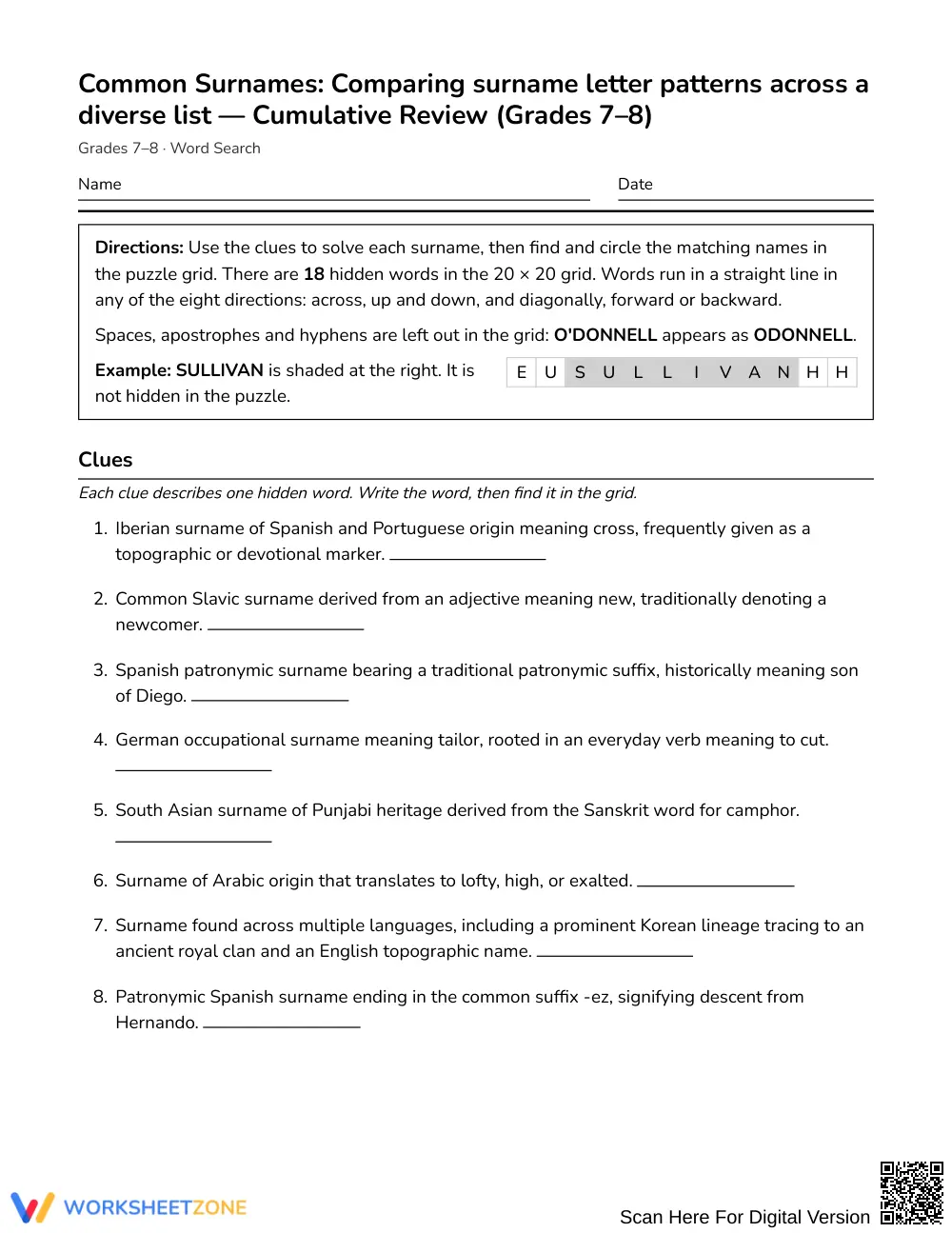
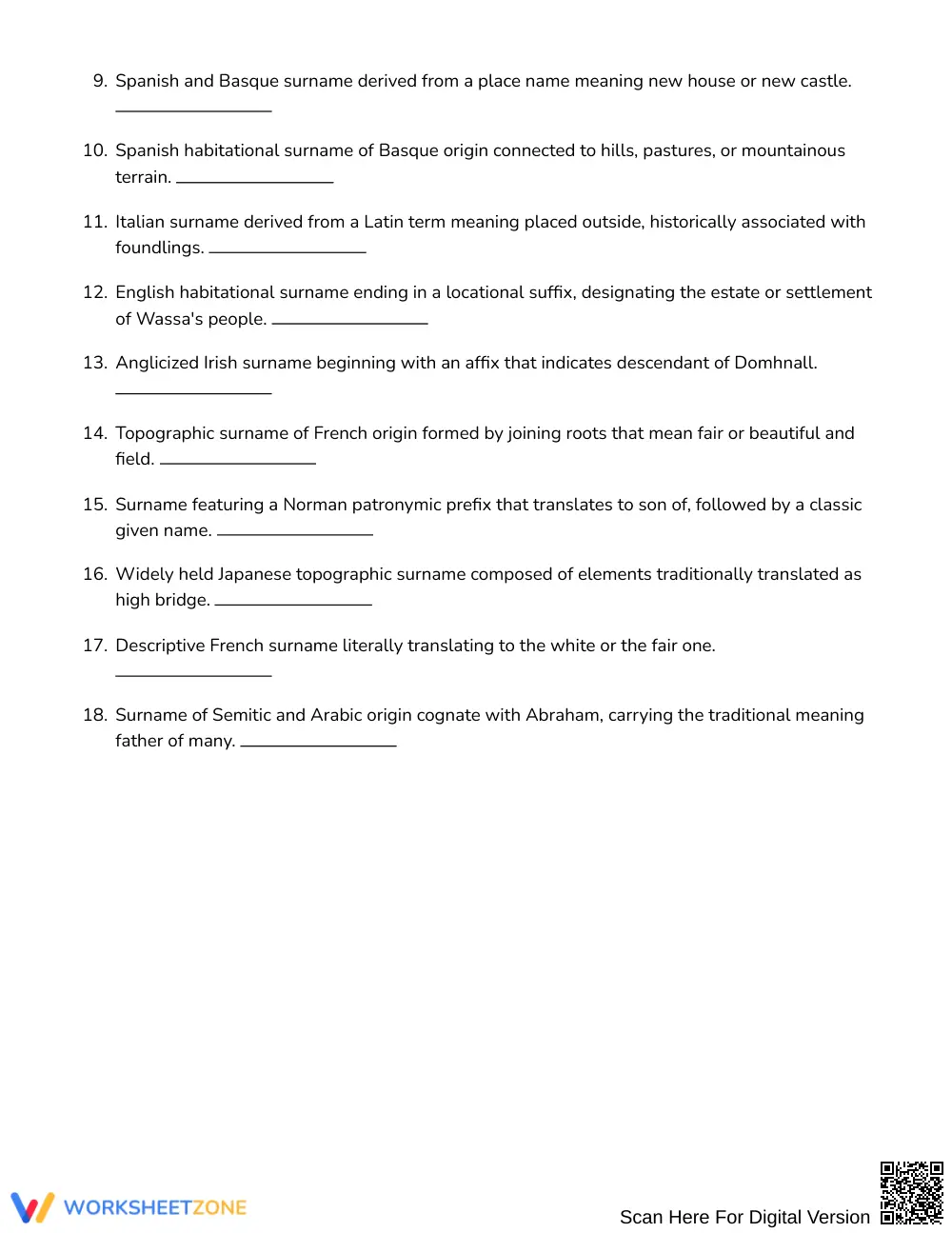
This etymology-focused word search helps middle school students examine orthographic structures by comparing surname letter patterns across a diverse list of global naming traditions. Learners analyze 18 clues detailing linguistic origins and morphology before finding each target surname, strengthening cross-cultural vocabulary recognition and spelling pattern awareness through active orthographic problem-solving.
At a Glance
- Grade: Grades 7–8 · Subject: English Language Arts (ELA)
- Standard: Not standards-assessed — vocabulary enrichment
- Skill Focus: Comparing surname letter patterns and morphological roots across a diverse list
- Format: 3 student pages · 18 hidden words · Full answer key included · Printable PDF
- Best For: Independent vocabulary enrichment, spelling pattern review, and morphology warm-ups
- Time: 25–35 minutes
What's Inside
This 3-page printable activity features 18 target words embedded within a dense letter grid alongside an etymological clue sheet. Instead of a simple alphabetical list, students read contextual clues describing patronymic affixes, occupational roots, and topographic origins from Arabic, French, Gaelic, Germanic, Iberian, Japanese, Korean, and Slavic naming systems. The package includes a shuffled word bank and a comprehensive 4-page answer key that visually highlights each solved surname for rapid verification.
How the Puzzle Works
The puzzle is built on a 20 x 20 letter grid containing 18 hidden surnames arranged across eight compass directions: north, northeast, east, southeast, south, southwest, west, and northwest. Students read descriptive etymological clues to identify each surname, reference a shuffled word bank to verify their spelling, and search the grid forward, backward, and diagonally to circle each completed name.
Standards Alignment
This resource serves as supplemental vocabulary enrichment and is not aligned to an assessed state standard. Rather than isolating individual grade-level benchmarks, the activity supports general morphological awareness, phonics decoding, and linguistic pattern recognition across multilingual contexts.
How to Use It
Use this word search during an introductory unit on morphology or after direct instruction on prefixes and suffixes to reinforce how morphemes convey meaning. It also serves as an engaging mid-unit review station or purposeful early-finisher task. While students work, circulate to observe whether they use root clues or rely strictly on letter matching to scan the grid. Expect completion within 25 to 35 minutes.
Who It's For
Designed for middle school learners in Grades 7–8, this activity benefits general education classes, English language learners, and enrichment clusters exploring multicultural linguistic patterns. For students needing support, suggest highlighting the origin keywords in each clue before locating names. Pair this activity with an anchor chart on common global affixes to bridge morphological analysis and word recognition.
Word study activities centered on comparing surname letter patterns across diverse naming traditions promote orthographic mapping and structural word analysis in secondary classrooms. Research by Fisher & Frey (2014) emphasizes that intentional vocabulary instruction combining semantic clues with orthographic inspection accelerates word consciousness and morphological understanding. In this non-assessed enrichment resource, Grade 7 and Grade 8 students analyze 18 clues covering multilingual roots, prefixes, and suffixes before locating target surnames in a dense 20 x 20 puzzle grid. By engaging with patronymic markers such as the Spanish suffix -ez or the Norman prefix Fitz-, alongside occupational roots like Schneider, learners encounter how phonological and morphological structures evolve across global languages. Integrating etymological puzzle tasks provides low-stakes, high-utility practice that strengthens word recognition, spelling precision, and cultural literacy across diverse student cohorts during routine language arts instruction.


