





























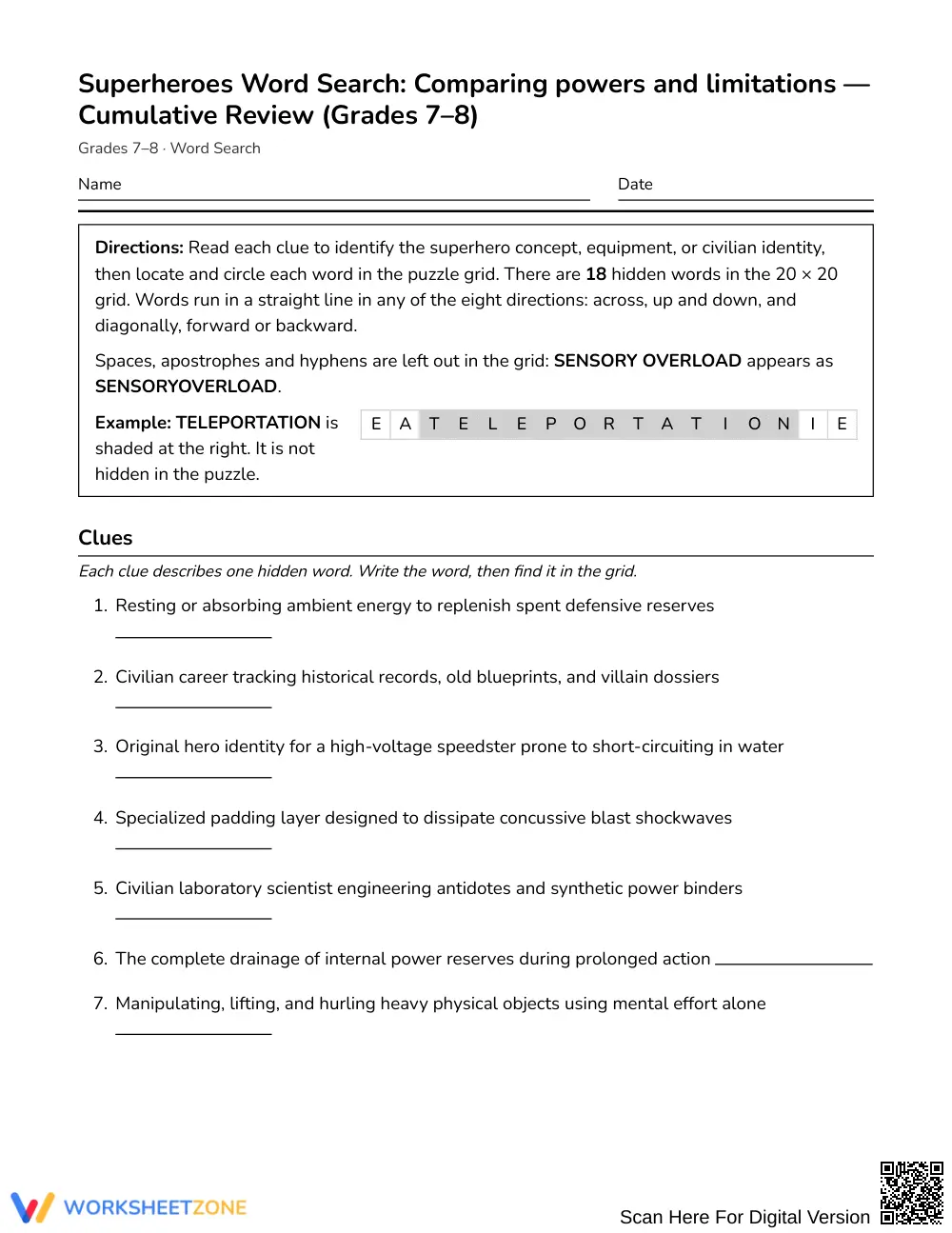


Complete Superhero Powers Word Search | Grades 7–8 ELA

Paste this activity's link or code into your existing LMS (Google Classroom, Canvas, Teams, Schoology, Moodle, etc.).
Students can open and work on the activity right away, with no student login required.
You'll still be able to track student progress and results from your teacher account.
This superhero-themed vocabulary word search challenges students in Grades 7–8 to analyze character abilities, physical vulnerabilities, and supportive civilian roles. Learners read detailed definitions to determine corresponding terminology before locating each term in the puzzle grid, strengthening content-area literacy and analytical reading comprehension through engaging, context-rich vocabulary reinforcement.
At a Glance
- Grade: Grades 7–8 · Subject: English Language Arts (ELA)
- Standard: Not standards-assessed — vocabulary enrichment
- Skill Focus: Comparing powers and limitations
- Format: 3 pages · 18 words · Answer key included · PDF
- Best For: Vocabulary review and early finisher enrichment
- Time: 25–35 minutes
What's Inside
The activity includes a 3-page printable activity featuring 18 words embedded within the puzzle. Rather than relying on a simple word bank, this activity provides 18 conceptual clues that define hero abilities such as telekinesis and intangibility, combat drawbacks like depletion and susceptibility, civilian support professions, and specialized rescue equipment. A four-page comprehensive answer key clearly highlights every hidden term for fast verification.
Puzzle Structure and Mechanics
The activity is built on a 20 x 20 letter grid containing 18 hidden vocabulary terms placed across all eight compass directions: north, northeast, east, southeast, south, southwest, west, and northwest. Students read each clue to identify the targeted concept, verify the correct spelling, and track letter sequences forwards, backwards, and diagonally across the dense matrix.
Standards Alignment
This activity serves as vocabulary enrichment and is not aligned to a formal state or national content standard. It reinforces contextual vocabulary acquisition, deductive reasoning, and character analysis concepts commonly taught across middle school language arts and creative writing units.
How to Use It
Introduce this puzzle after direct instruction on characterization, internal and external conflict, or science fiction tropes. Teachers can use it as a silent activator to prompt discussion about character weaknesses, or assign it during independent practice to anchor creative writing workshops. Observe whether students solve terms by scanning clues first or searching letters haphazardly; purposeful clue analysis indicates solid conceptual understanding. Most students finish within 25 to 35 minutes.
Who It's For
This resource is designed for Grades 7–8 English Language Arts students, creative writing electives, and middle school reading intervention groups needing engaging print-and-go enrichment. Pair this word search directly with high-interest narrative passages or a character-building anchor chart to help learners apply their power-and-limitation vocabulary in original analytical writing.
Academic vocabulary acquisition requires meaningful interaction with nuanced concepts rather than passive memorization. As highlighted by Fisher & Frey (2014), intentional word exposure through diverse structural formats deepens lexical networks and aids long-term retention across secondary content areas. By framing vocabulary within thematic classifications of strengths, limitations, and operational support, this activity encourages middle school students to process definitions critically before identifying target terms within the letter array. The cognitive act of matching descriptive clues to specialized terminology activates orthographic mapping and morphological awareness, both critical components of fluent adolescent reading comprehension. Integrating purposeful, low-stakes vocabulary activities alongside formal text study helps bridge the gap between receptive word knowledge and expressive literacy skills. When learners manipulate thematic words across multiple contexts, they build the contextual confidence required to interpret complex character motivations, evaluate literary conflicts, and deploy precise descriptive language across their own analytical compositions.


