































Complete Succession Stages Worksheet | Grades 7-12 Science

Paste this activity's link or code into your existing LMS (Google Classroom, Canvas, Teams, Schoology, Moodle, etc.).
Students can open and work on the activity right away, with no student login required.
You'll still be able to track student progress and results from your teacher account.
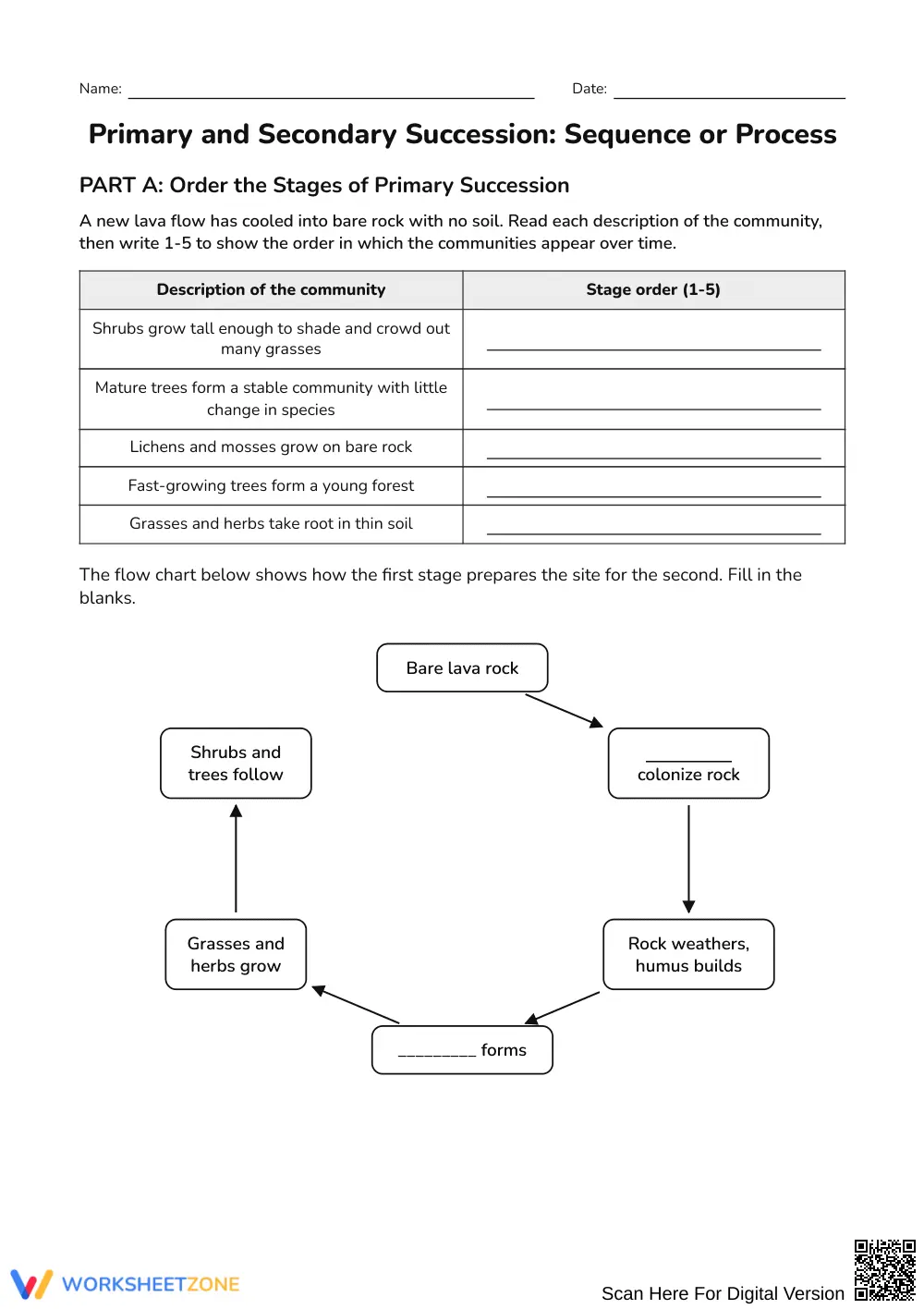
This comprehensive science worksheet guides secondary students through ordering ecological succession stages and explaining environmental transitions. Students analyze how pioneer species modify habitats to allow subsequent communities to establish, comparing primary and secondary succession patterns across 26 targeted questions to master ecological community dynamics.
At a Glance
- Grade: Grades 7–12 · Subject: Science
- Standard: Ecological Succession — Sequence ecological stages and explain community changes over time
- Skill Focus: Ordering stages and explaining transitional environmental mechanisms
- Format: 4 pages · 26 problems · Answer key included · PDF
- Best For: Core instruction, data analysis, and formative review
- Time: 40–55 minutes
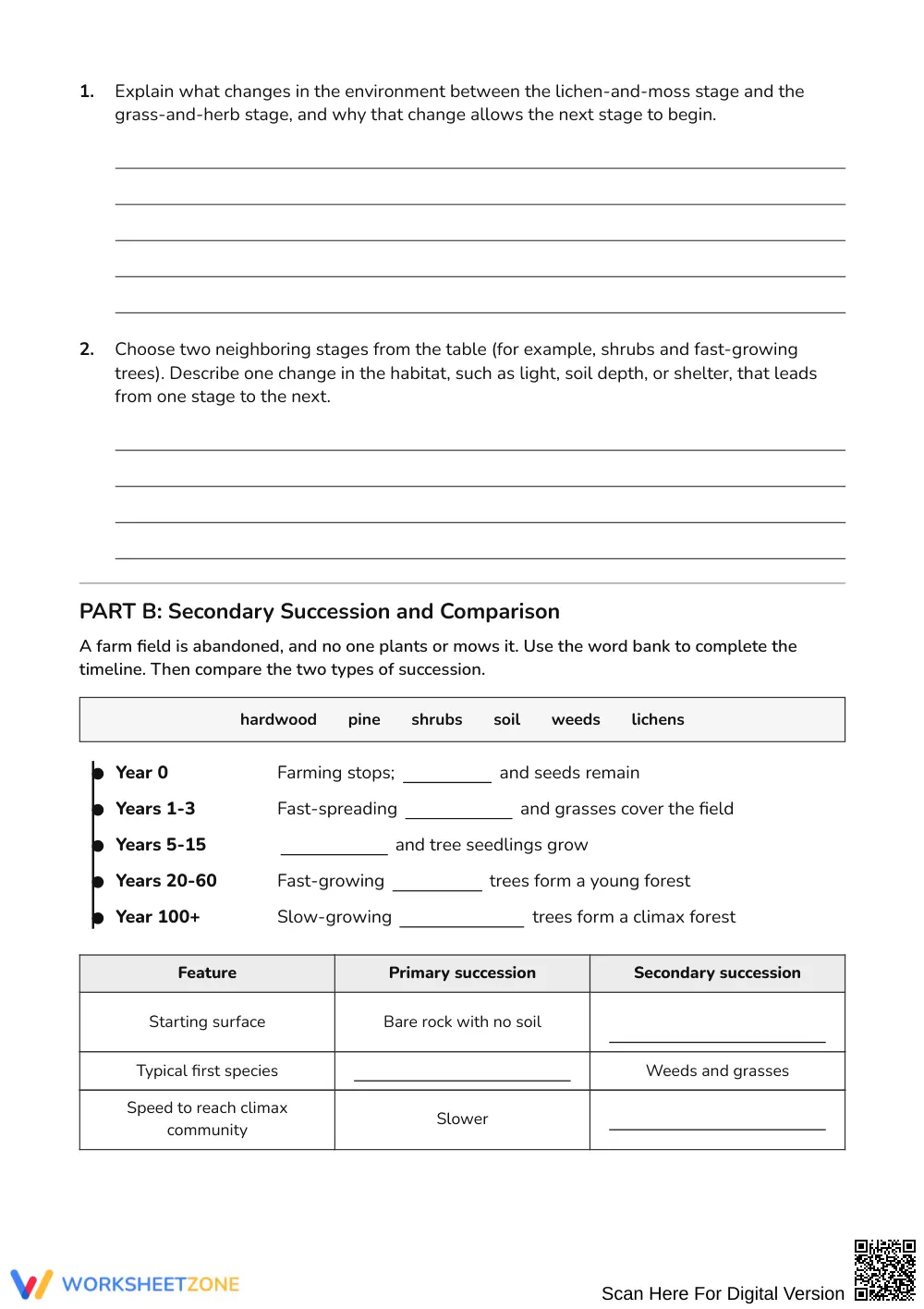
The 4-page worksheet delivers 26 structured tasks organized into four distinct parts. Across these sections, students engage with chronological ordering tables, fill-in-the-blank process flowcharts, a comparative matrix with a dedicated word bank, quantitative line-graph analysis tracking species richness over 120 years, and scenario-based free-response prompts supported by a complete 4-page answer key.
Skill Progression
- Guided Practice (Part A): Students sequence 5 primary succession stages on bare lava rock, fill in a causal flow chart, and write short explanations detailing how pioneer lichens generate the soil layer required for grasses and shrubs.
- Supported Practice (Parts B & C): Using a provided word bank, students complete a secondary succession timeline and compare both pathways in a structured table before interpreting 120-year species richness graph data.
- Independent Practice (Part D): Students independently evaluate comparative disturbance scenarios—contrasting volcanic lava coverage with wildfire recovery—to predict community trajectory and define climax equilibrium.
This structured progression follows a gradual-release instructional framework, transitioning students from scaffolded ordering tasks to independent causal argumentation.
Curriculum Alignment
This resource aligns directly with secondary life science standards focused on ecosystem dynamics, functioning, and resilience. Students demonstrate how abiotic and biotic interactions drive ecological succession following natural disturbances. Both standard descriptions can be copied directly into lesson plans, IEP goals, or district curriculum mapping tools.
How to Use It
Implement this resource during mid-unit instruction after introducing pioneer species and abiotic weathering. For targeted formative assessment, inspect students' explanations in Part A to ensure they identify soil development as the causal mechanism allowing plant colonization. Alternatively, assign Parts C and D as a post-instruction checkpoint or sub plan; students typically finish the full activity within 40 to 55 minutes.
Who It's For
Designed for middle and high school life science and biology classrooms, this resource supports diverse learners through explicit visual flowcharts and data tables. Educators can scaffold the graphing tasks for emerging bilingual students or use Part D as an analytical extension for advanced learners. Pair this worksheet directly with a short direct-instruction lesson or interactive diagram illustrating primary succession chronosequences.
Structured ecological succession coursework enables secondary science students to master ecosystem dynamics by ordering developmental stages and explaining the environmental mechanisms that drive transitional community shifts. According to Fisher & Frey (2014), cognitive outcomes improve substantially when instruction utilizes a gradual-release framework that moves systematically from guided sequencing to data interpretation and independent evidence-based analysis. This 4-page science resource embodies that instructional architecture across 26 targeted problems, requiring learners to trace primary succession from bare rock to mature forest, contrast regeneration speeds between disturbed and bare landscapes, and analyze 120 years of species richness models. By moving beyond passive memorization toward mechanistic explanation and graphical data analysis, the activity supports durable scientific reasoning aligned with secondary life science standards for ecosystem stability and resilience, providing teachers with verifiable evidence of student conceptual mastery.


