































Complete Succession CER Worksheet | Grade 7–12 Science

Paste this activity's link or code into your existing LMS (Google Classroom, Canvas, Teams, Schoology, Moodle, etc.).
Students can open and work on the activity right away, with no student login required.
You'll still be able to track student progress and results from your teacher account.
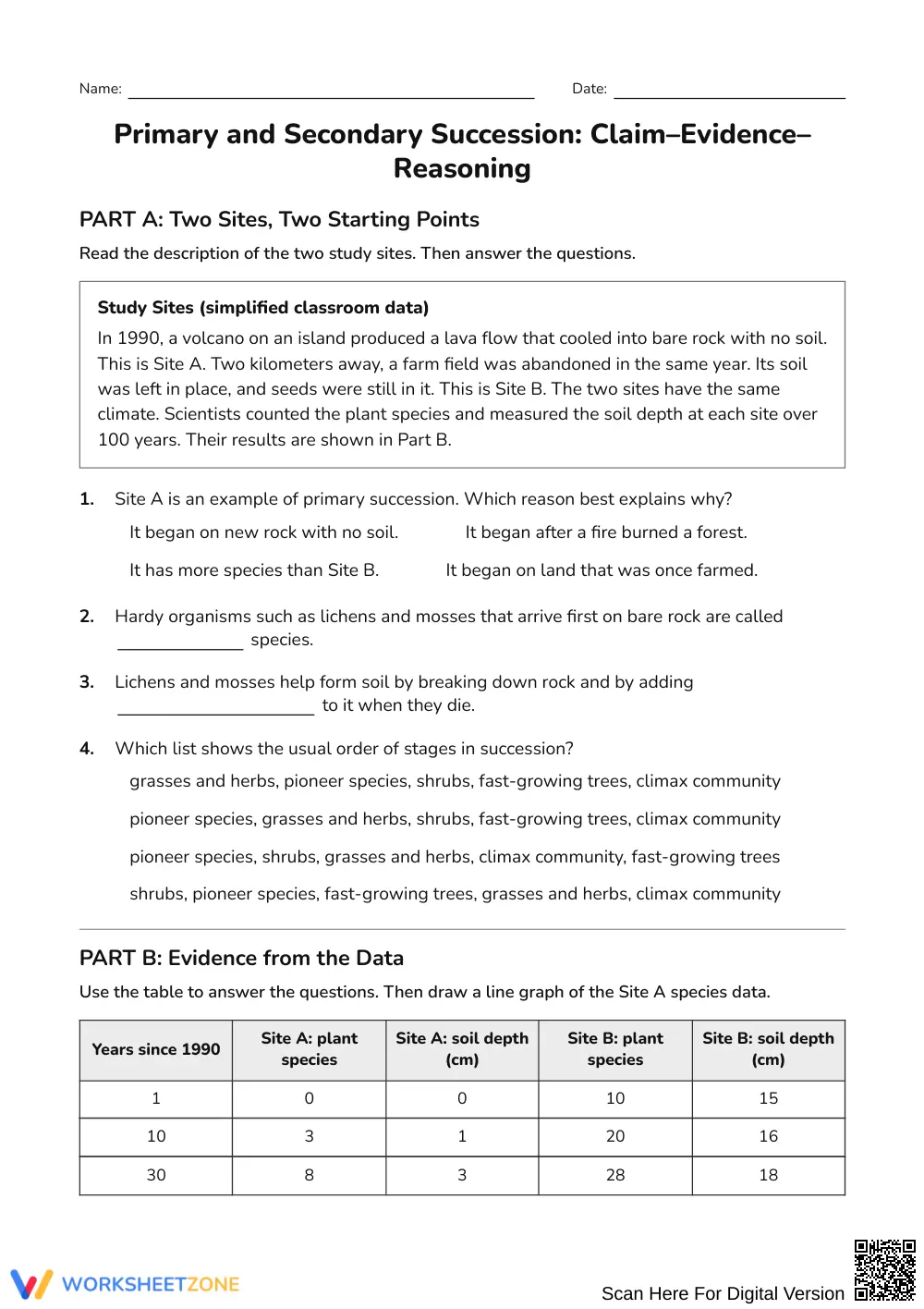
This 4-page ecological succession worksheet trains secondary science students to evaluate ecosystem recovery through structured data analysis and scientific argumentation. Students examine contrasting 100-year field studies, graph plant biodiversity trends, and construct complete Claim-Evidence-Reasoning (CER) explanations showing why secondary succession proceeds faster than primary succession.
At a Glance
- Grade: Grades 7–12 · Subject: Life Science and Biology
- Standard: Scientific Explanation — Construct, evaluate, and communicate evidence-based claims about ecological recovery and succession dynamics
- Skill Focus: Claim-Evidence-Reasoning (CER) analysis using comparative ecological succession datasets
- Format: 4 pages · 16 scaffolded problems · Complete 4-page answer key · Printable PDF
- Best For: Biology and life science ecological succession units
- Time: 45–60 instructional minutes
What's Inside
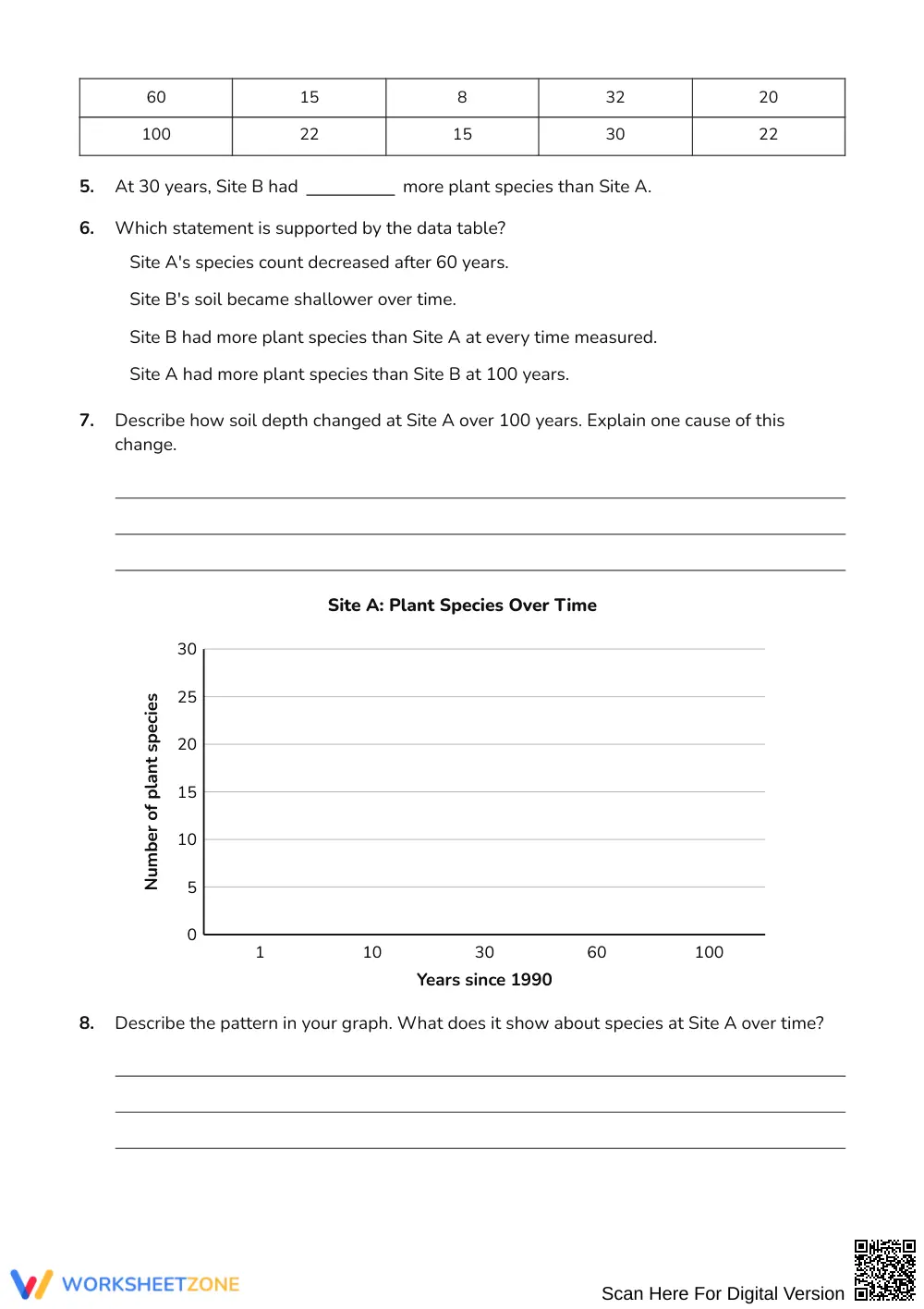
This resource features 16 structured tasks organized across four printable pages. Part A introduces volcanic rock and abandoned field scenarios through multiple-choice questions. Part B provides quantitative species counts and soil depth tables spanning 100 years, paired with graphing and interpretation items. Part C provides structured CER writing frames and critical evaluation prompts. A 4-page answer key supplies complete model responses.
Skill Progression
- Guided Practice (Part A, 4 tasks): Students identify starting conditions, distinguishing bare rock from soil-based habitats and sequencing pioneer to climax communities.
- Supported Practice (Part B, 5 tasks): Learners extract numerical data from a 100-year comparison table, plot species counts, and explain soil accumulation causes.
- Independent Practice (Part C, 7 tasks): Students draft a complete Claim-Evidence-Reasoning response, classify novel disturbances, and evaluate an anomalous data claim.
This sequence implements a gradual-release model moving students from guided recall to independent scientific argumentation.
Standards Alignment
This activity aligns with middle and high school life science standards requiring students to construct explanations based on evidence for how ecosystems recover after disturbances. Students quantitatively demonstrate how soil presence accelerates community establishment. Both standard codes can be copied directly into lesson plans, IEP goals, or district curriculum mapping tools.
How to Use It
Assign this worksheet after direct instruction on ecological succession to anchor definitions in empirical data. In a 45–60 minute practice block, students complete the graphing and CER sections in pairs. For formative assessment, check student evidence citations in Part C to verify they incorporate specific numerical metrics rather than broad generalizations.
Who It's For
This resource serves general biology and life science students in grades 7–12. Pre-formatted CER prompts support developing writers, while the final evaluation item extends advanced thinkers. Pair this resource with an introductory ecosystem stability lesson or disturbance video.
Ecological succession instruction requires secondary students to bridge conceptual models with empirical data. According to Fisher & Frey (2014), structured scaffolds such as Claim-Evidence-Reasoning frameworks substantially improve student retention and disciplinary literacy when paired with authentic data tables. This 4-page worksheet guides learners across 16 sequential problems, moving from baseline ecosystem classifications to multi-variable table analysis and scientific argumentation. By tracking 100 years of plant species richness and soil accumulation across volcanic rock and abandoned farmland, students quantify how pioneer species establish communities and why secondary succession proceeds faster. The scaffolded progression addresses widespread misconceptions regarding ecosystem recovery timelines and community stability. With a complete 4-page answer key providing exemplar responses, this printable resource enables educators to measure scientific reasoning mastery across middle and high school life science classrooms.


