





























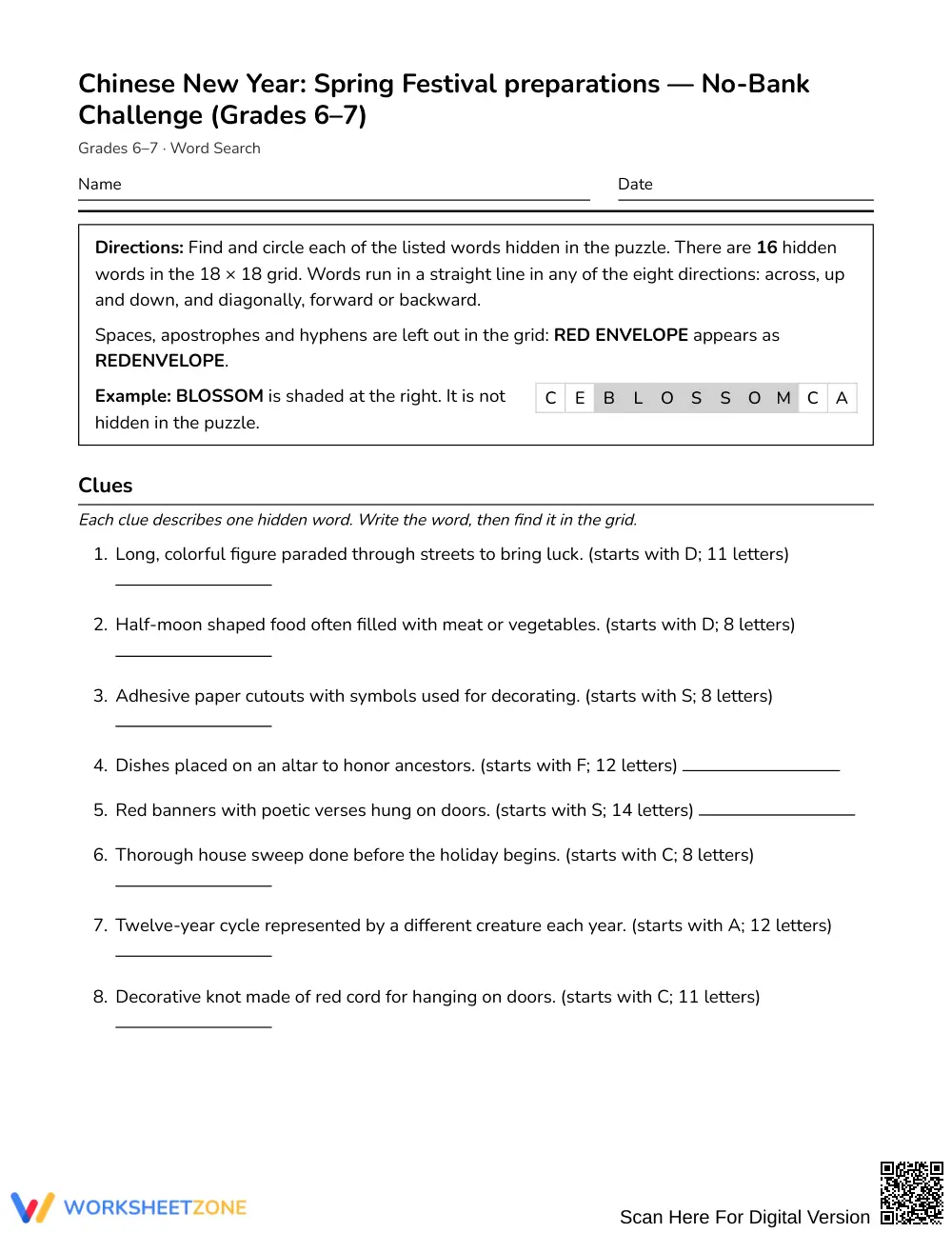
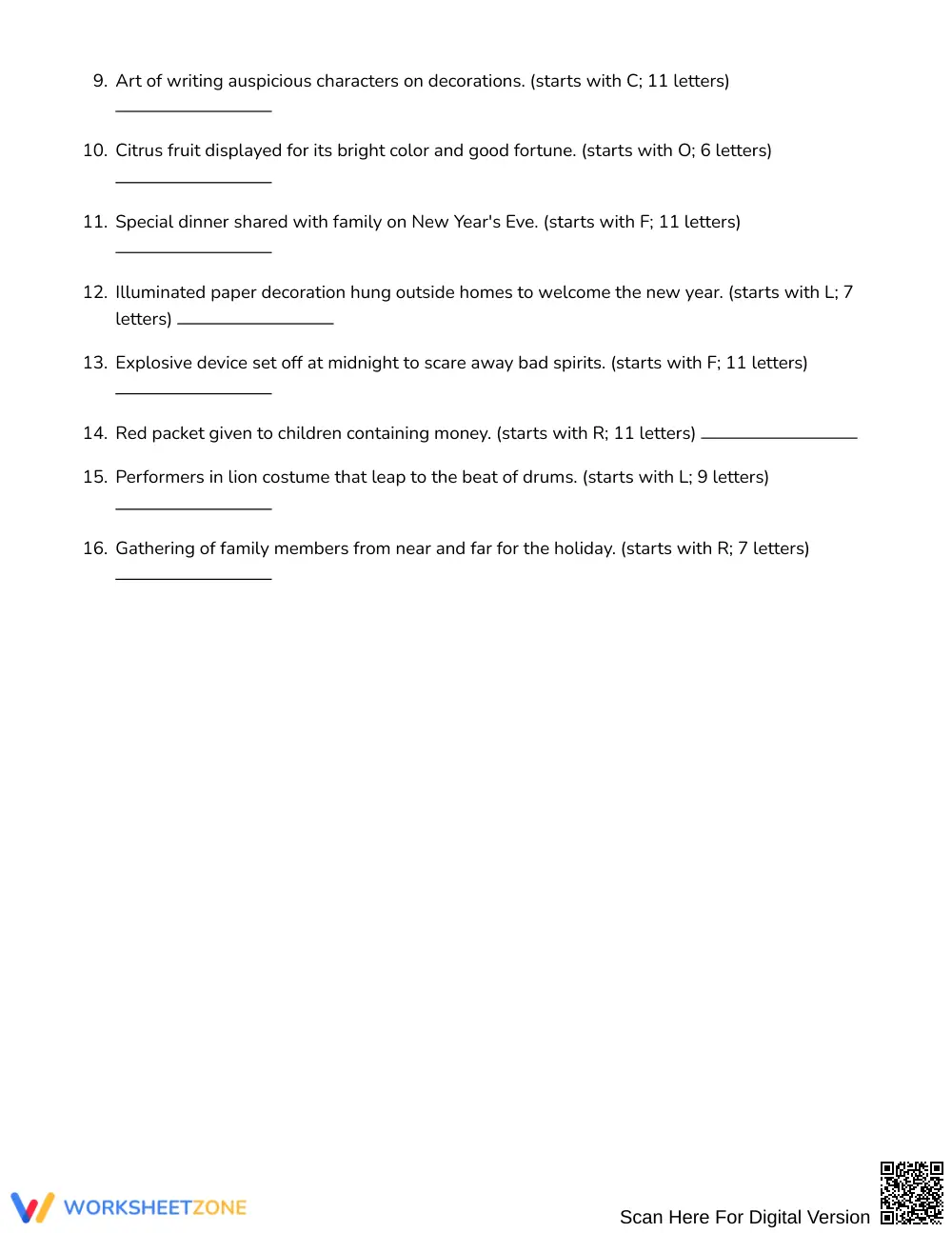


Complete Spring Festival Word Search | Grades 6–7 ELA

Paste this activity's link or code into your existing LMS (Google Classroom, Canvas, Teams, Schoology, Moodle, etc.).
Students can open and work on the activity right away, with no student login required.
You'll still be able to track student progress and results from your teacher account.
This Grades 6–7 English Language Arts word search challenges students to explore cultural traditions surrounding Chinese New Year through Spring Festival preparations. Learners decode 16 clue-based definitions to identify key holiday vocabulary before locating each term across the puzzle, reinforcing contextual comprehension and building seasonal background knowledge.
At a Glance
- Grade: Grades 6–7 · Subject: ELA
- Standard: Not standards-assessed — vocabulary enrichment
- Skill Focus: Spring festival preparations vocabulary
- Format: 3 pages · 16 words · Answer key included · PDF
- Best For: Cultural vocabulary enrichment and holiday units
- Time: 20–30 minutes
What's Inside: The 3-page printable resource includes a letter grid containing 16 hidden vocabulary words related to festive traditions. Rather than relying on a word bank, the activity supplies descriptive clues for each term, prompting students to deduce the correct holiday terms—such as calligraphy, dumplings, and spring couplets—before scanning the grid. A complete 3-page solution key provides full term placements.
Puzzle Structure and Mechanics
The puzzle features an 18 x 18 letter grid testing visual scanning and orthographic recall. Words run in all 8 directions: north, northeast, east, southeast, south, southwest, west, and northwest. Without a provided word bank, students interpret 16 contextual clues to identify each target word before searching, reinforcing active vocabulary recall.
Standards Alignment
This activity serves as cultural vocabulary enrichment and is not aligned to a specific standard. It reinforces domain-specific terminology associated with world cultures and community celebrations without formal standards assessment constraints.
How to Use It
Deploy this word search during an ELA unit on world cultures or as a seasonal station during Spring Festival. Distribute the puzzle after direct instruction on Lunar New Year customs, allowing students 20 to 30 minutes to read clues and highlight target terms. For formative assessment, observe whether students solve the definitions first or scan randomly, identifying terms needing reinforcement.
Who It's For
This resource is designed for Grades 6–7 students expanding cultural vocabulary and reading comprehension. It provides productive challenge for general education classes and supports English learners through clue-based context. Pair this activity with an informational text describing the Chinese zodiac, reunion dinners, and holiday customs.
Vocabulary acquisition relies on meaningful context and active retrieval rather than rote memorization. As emphasized by Fisher & Frey (2014), intentional word-learning routines succeed when learners interact with domain-specific terms through multiple modalities, including definitional reasoning and orthographic processing. This Grades 6–7 Spring Festival puzzle exemplifies this framework by replacing standard word banks with 16 descriptive definitions. Students must comprehend the cultural significance of artifacts like spring couplets, red envelopes, and lantern displays before locating the corresponding words across an 18 x 18 grid. This two-phase process bridges semantic understanding with visual word recognition, fostering deeper retention of cultural vocabulary. By encouraging students to evaluate definitions and recognize letter sequences in 8 directions, educators promote active engagement with informational language while enriching multicultural literacy across middle school classrooms.


